The sky is falling! Not joking!
Chinese rocket's worrisome return to Earth not the first time space garbage has ruined someone's -- or some cow's -- day
Advertisement
Read this article for free:
or
Already have an account? Log in here »
To continue reading, please subscribe:
Digital Subscription
One year of digital access for only $1.44 a week*
- Enjoy unlimited reading on winnipegfreepress.com
- Read the E-Edition, our digital replica newspaper
- Access News Break, our award-winning app
- Play interactive puzzles
*Billed as $5.77 plus GST every four weeks. After 52 weeks, price increases to the regular rate of $19.95 plus GST every four weeks. Offer available to new and qualified returning subscribers only. Cancel any time.
To continue reading, please subscribe:
Add Free Press access to your Brandon Sun subscription for only an additional
$1 for the first 4 weeks*
- Enjoy unlimited reading on winnipegfreepress.com
- Read the E-Edition, our digital replica newspaper
- Access News Break, our award-winning app
- Play interactive puzzles
*Your next Brandon Sun subscription payment will increase by $1.00 and you will be charged $17.95 plus GST for four weeks. After four weeks, your payment will increase to $24.95 plus GST every four weeks.
Read unlimited articles for free today:
or
Already have an account? Log in here »
Hey there, time traveller!
This article was published 14/05/2021 (1984 days ago), so information in it may no longer be current.
Congratulations, everyone! If you are lucky enough to be reading today’s feature, it means you were not fatally beaned last weekend by a huge chunk of metal falling from the stars.
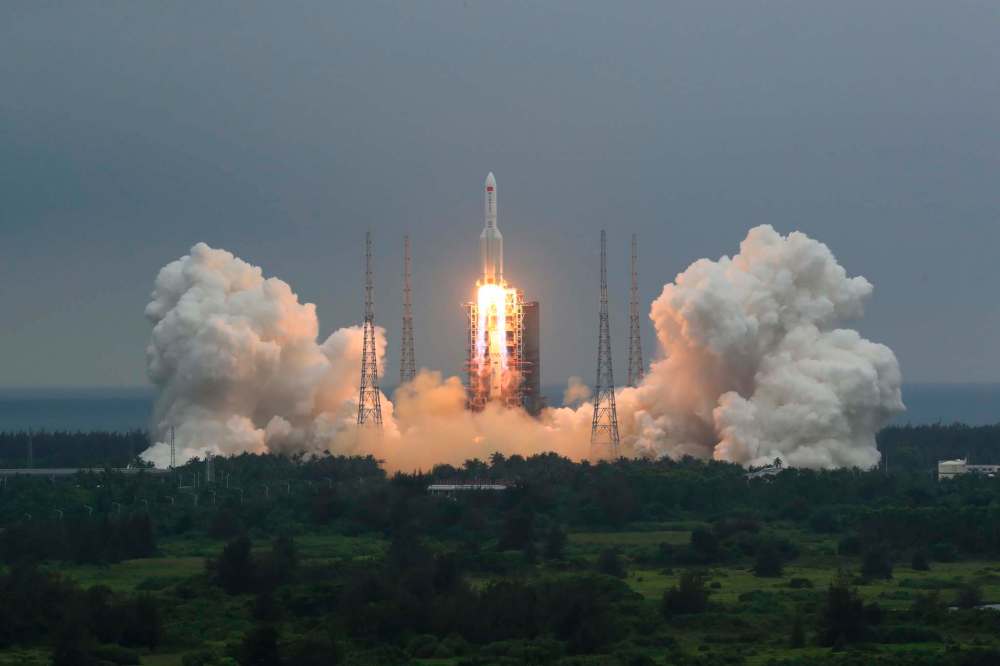
Just after midnight last Saturday, the world breathed a sigh of relief when it was confirmed that a section of the Chinese Long March 5B rocket, used to launch a space-station module into orbit last month, fell into the Indian Ocean north of the Maldives — though it’s not yet clear if any parts hit land.
For days, scientists and an increasingly fearful public had been trying to determine where this huge piece of Chinese space junk might land after making an uncontrolled re-entry into Earth’s atmosphere. The Chinese space agency said most of the 18-tonne booster rocket was destroyed during re-entry.
Before that, however, scientists and officials were unable to give a clear prediction of its possible landing site, because it was orbiting the planet unpredictably every 90 minutes at about 27,000 km/h without controls to guide its trajectory.
Although no one was killed by the haphazard return of the booster rocket, NASA quickly issued a statement saying: “It is clear that China is failing to meet responsible standards regarding their space debris.”
The reality is what goes up usually comes down, and we don’t always know where it will land, as we see from today’s death-defying list of Five Famous Cases of Space Junk Crashing Back to Earth:
5) The space debris: Falling rocket kills cow
The crash landing: Every day, a tonne or two of defunct satellites, rocket parts and other man-made orbiting junk hurtles into the atmosphere, where about four-fifths of it burns up on re-entry. But that means a fair number of space fragments — some large enough to be lethal — make it through. The good news is this: miraculously, there have been no recorded deaths or serious injuries from people being hit by space debris.
The bad news is this: The same cannot be said for the world’s cow population. In 1961, a cow munching grass in Cuba became the first known fatality of a piece of plummeting space junk. According to the New York Times, a 25-metre Thor Able Star rocket blasted off from Cape Canaveral on Nov. 30, 1960, to place in orbit a U.S. navy navigation satellite and a smaller spacecraft to monitor solar radiation.
“Two-and-a-half minutes later, trouble developed in the rocket’s second stage and the range safety officer beamed a command to the vehicle that blew it up — all over Cuba’s Oriente Province, just north of the American base at Guantanamo Bay,” the Times reported in 1979. “President Fidel Castro branded the accident as ‘further evidence of Yankee aggression,’ announcing that the fragments had splattered over a wide area and killed a cow. Five days later, 300 students at Havana University — accompanied by cows and bulls — demonstrated in front of the United States Embassy, demanding compensation for the accident and chanting, ‘With cows or without cows the revolution will win.’”
The cow, which had been grazing in a meadow in the south of Cuba, was reportedly named “Rufina” and her demise became an international incident. The director of the CIA later quipped: “It was the first — and last — time that a satellite has been used in the production of ground beef.” It was also dubbed “the herd shot round the world.”
4) The space debris: Radioactive debris pelts Canada
The crash landing: The hazards of space junk struck a little too close to home in 1978 when the nuclear-powered Soviet satellite Cosmos 954 plummeted to Earth, scattering potentially radioactive debris across the Northwest Territories, Alberta and Saskatchewan.
Here’s what the Washington Post reported on Jan. 25, 1978: “In one of the most spectacular accidents of the Space Age, a five-ton Soviet surveillance satellite with an atomic power plant aboard burned up in the atmosphere yesterday over the remote reaches of Canada’s Northwest Territory. Presumably, the 110 pounds of uranium that fuelled the power plant and the radioactive strontium, cesium and iodine that were the fission products of the uranium burned up with the satellite so high in the atmosphere that they were scattered to the four corners of the Earth.”
According to the CBC’s archives, the crash of Cosmos 954 scattered radioactive waste across a 124,000-square-kilometre swath. A joint Canada-U.S. cleanup effort, dubbed “Operation Morning Light,” ran until October 1978, but just 0.1 per cent of the satellite’s power source was reportedly recovered. Searchers were ultimately able to recover 12 large pieces of the satellite, 10 of which were radioactive. Canada billed the Soviet Union for an estimated $6-million tab for the cleanup, but the Soviets eventually coughed up roughly half that amount.
The crash, which led to some pointed questions in Parliament, drew international attention to the use of radioactive materials in space. Wrote Steven Freeland of theconversation.com: “It was just a quirk of fate that Cosmos 954 did not land on Toronto or Quebec City, where the radioactive fallout would have necessitated a large-scale evacuation.”
3) The space debris: Soviet space junk injures sailors
The crash landing: It didn’t kill them, but five Japanese sailors survived a cosmic collision in 1969, according to multiple reports. Not a great deal is known about the incident, but news reports state five sailors on a small Japanese freighter were injured when falling space debris from what was believed to be a Soviet spacecraft struck the deck of their vessel.
According to the Washington Post, Japanese diplomats informed a United Nations committee that an unidentified object had fallen from space and hit a freighter that was travelling off the coast of Siberia, seriously injuring five crewmen. Soviet ships soon showed up looking for the wreckage. Japanese officials said that experts identified the debris as part of a Soviet satellite, but Tokyo initially kept that information a secret, out of a desire to avoid provoking a conflict with Moscow, according to the Associated Press.
A list of such incidents published by Brown University states: “On the Sea of Japan, a Japanese boat was cutting through the waves. All hands on deck were watching the water… all of a sudden pieces of metal pelted down like hailstones.” It’s believed to be one of the earliest reports of damage caused by space junk returning to Earth.
In his 2017 book, Cosmic Debris, author Jonathan Powell estimates the odds of being hit by lightning at 1.4 million to one, whereas the odds of being hit by a fragment of space junk are about one trillion to one. “Fragments have been known to fall on decks of ships, the odds of which are literally astronomical. However, this was the case regarding a Japanese cargo ship, struck by several fragments while stationed off the port of De-Kastri in Russia.Considering the size of De-Kastri oil terminal, one of the biggest to deliver oil to the Asian markets, it seems even more improbable that the debris should single out this one particular Japanese freighter. Five sailors received injuries from the debris, with each individual fragment weighing around 10 kg,” he wrote.
2) The space debris: Only human to be hit
The crash landing: You could say Lottie Williams’s story is one in a million, but you’d be wildly underestimating the odds. As far as anyone knows, Williams is the only human in history known to have been beaned by a piece of man-made debris falling from the stars. Back in January 1997, Williams and two friends were walking through a park in Tulsa, Okla., at about 3:30 a.m. when they saw a huge fireball streaking from the skies.
“It was just a big ball of fire, shooting across the sky at just a fast speed,” she recalled in 2011. “We were stunned, in awe. It was beautiful.” But that awe quickly turned to fear. “We were still walking through the park when I felt a tapping on my shoulder,” Williams told Fox News. With no one near her at the time, she started to run, thinking a stranger had appeared out of the shadows. Then she heard something hit the ground behind her.
“The weight was comparable to an empty soda can,” Williams said. “It looked like a piece of fabric except when you tap it, it sounded metallic.”
Excited, she took the debris to her local library and was referred to the astronomy club and National Weather Service, where she learned about a Delta II rocket that had re-entered the atmosphere the night before. Williams then sent it to the Center for Orbital and Reentry Debris Studies (CORD) where analysis confirmed the piece of blackened, woven material to be part of the fuel tank of a Delta II rocket that had launched a U.S. air force satellite in 1996.
“I think I was blessed that it doesn’t weigh that much,” she told National Public Radio years later. “I mean, that was one of the weirdest things that ever happened to me.” She wanted to stress the whole thing wasn’t some elaborate joke. “A lot of people thought it was a hoax,” Williams noted. “I just want people to know this actually happened.”
1) The space debris: Skylab parks in Australia
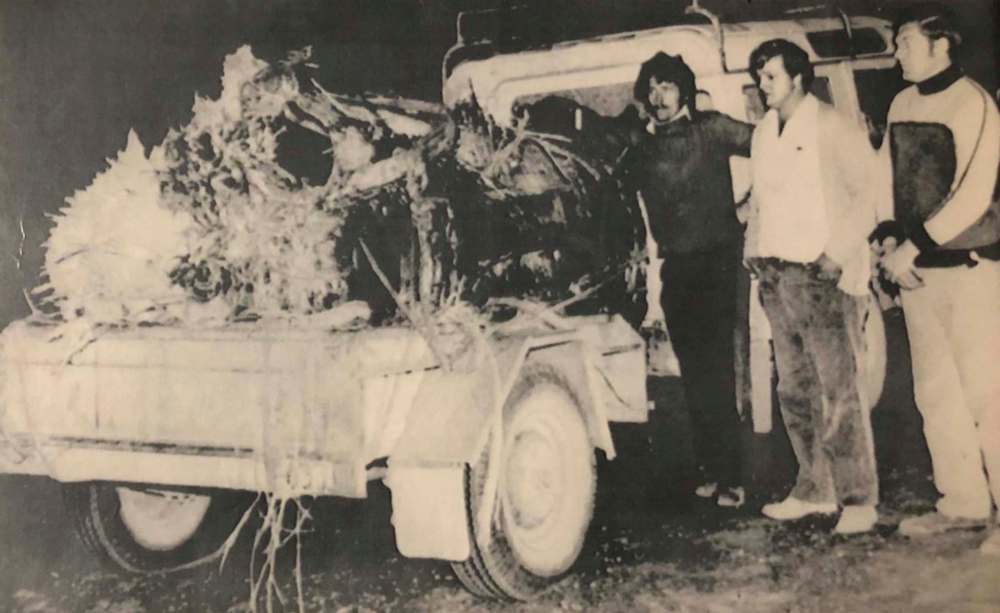
The crash landing: It’s not a title anyone covets, but Australia holds the record for getting smacked by the largest pieces of space junk in history. In 1979, the first U.S, space station, Skylab, disintegrated over Western Australia, peppering the area around the southern coastal town of Esperance with fragments.
Ground controllers did their best to bring the nine-storey 90-tonne station down over the Indian Ocean, where its broken-apart pieces couldn’t hurt anyone, but NASA had spent more time and energy figuring out how to get it into space than they did on how to safely get it back down.
Even though Skylab was devised for just a nine-year lifespan, NASA failed to build in any control or navigation mechanisms to return the orbiter to terra firma.When the station’s orbit began rapidly decaying, the orbiting workshop became a loose cannon. On the ground, despite the risk of getting beaned by shards of falling space metal, there was a sense of light-heartedness, with some people holding “Sklyab parties” to mark the occasion. It lit up the sky with streaks of fire, scattered debris across fields and small towns, and became a key part of Australia’s space history.
No one was hurt, but the town of Esperance jokingly issued a $400 fine to the United States for littering, a penalty that was finally paid in 2009 by a bemused California radio station. The San Francisco Examiner newspaper offered a $10,000 reward to the first person to deliver a piece of Skylab debris to its offices within 72 hours of the crash.
“It didn’t count on news of the bounty travelling all the way to Australia,” History.com recalls. “There, 17-year-old Stan Thornton of tiny Esperance awoke to the commotion when Skylab broke apart in the atmosphere and pelted his house with space station fragments. Thinking quickly, he grabbed a few charred bits of material from his yard, hopped on a plane without so much as a passport or suitcase and made it to the Examiner’s office before the deadline. The newspaper good-naturedly paid out the award.” The biggest and best pieces of the doomed station are now in Australian museums.
doug.speirs@freepress.mb.ca