Tokyo’s drinkers drown frustrations over virus limits, Games

Advertisement

Advertise with us

TOKYO (AP) — On the eve of the Tokyo Olympics’ opening ceremony, the government’s attempts to curb a coronavirus surge by targeting drinkers is drowning in liquor, frustration and indifference.

Read this article for free:


or

Already have an account? Log in here »

To continue reading, please subscribe:

Subscribe and receive a limited-edition Free Press branded hat or tote.

Digital Subscription

One year of digital access for only $205*

  • Enjoy unlimited reading on winnipegfreepress.com
  • Read the E-Edition, our digital replica newspaper
  • Access News Break, our award-winning app
  • Play interactive puzzles

*First annual payment billed as $205.00 + GST for one year. This annual subscription will automatically renew at $233.00 + GST every 52 weeks (10% off the regular annual price of $259.35). Offer available to new and qualified returning subscribers only. Cancel any time.

To continue reading, please subscribe:

Add Free Press access to your Brandon Sun subscription for only an additional

$1 for the first 4 weeks*

  • Enjoy unlimited reading on winnipegfreepress.com
  • Read the E-Edition, our digital replica newspaper
  • Access News Break, our award-winning app
  • Play interactive puzzles
Start now

*Your next Brandon Sun subscription payment will increase by $1.00 and you will be charged $17.95 plus GST for four weeks. After four weeks, your payment will increase to $24.95 plus GST every four weeks.

Hey there, time traveller!
This article was published 20/07/2021 (1853 days ago), so information in it may no longer be current.

TOKYO (AP) — On the eve of the Tokyo Olympics’ opening ceremony, the government’s attempts to curb a coronavirus surge by targeting drinkers is drowning in liquor, frustration and indifference.

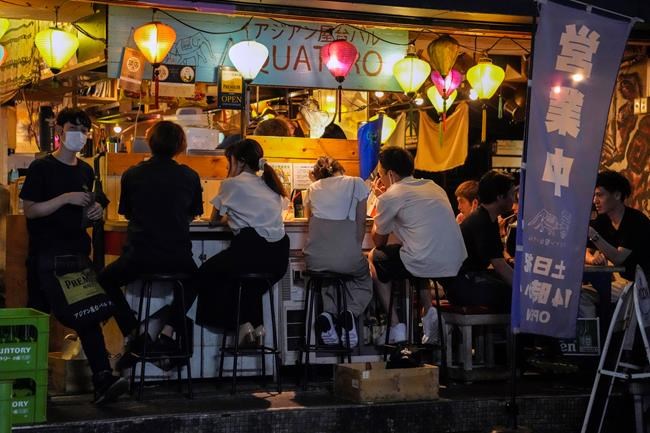
Japan has asked the city’s restaurants and bars to close by 8 p.m., if not entirely, to keep people from socializing in close contact with strangers and spreading the virus, but the state of emergency hasn’t deterred many. Instead, drinkers moved outdoors, and many bars in Tokyo’s famed nightlife districts are bustling with defiant customers.

“Nobody is convinced when (the government) victimizes people who are drinking alcohol without showing decent scientific evidence, even while going ahead with the Olympics,” said Mio Maruyama, a 28-year-old real estate industry worker who was chatting with her colleagues on the street in Tokyo’s Shinjuku district.

People gather at a bar after government imposed 8 p.m. closing time for restaurants and bars under Tokyo's fourth state of emergency Saturday, July 17, 2021, in Tokyo. The latest state of emergency has asked restaurants and bars to close by 8 p.m., if not entirely. This has pushed people to drink outside, although many bars remain open and bustling with customers who are defying the rules and expressing frustration and indifference. (AP Photo/Kiichiro Sato)

She says she’s interested in watching the Games, especially new sports like skateboarding and Japan’s Rui Hachimura, an NBA star, “but when I think of how politicians are playing around with this, I’m not quite rooting for this event from my heart.”

“It’s not that we are breaking the rules just because we’re against the inconsistency between politicians’ words and actions,” she said, referring to a 40-person reception for International Olympic Committee members on Sunday that included the prime minister and the governor of Tokyo. “But when you see such things, you might think that rulebreakers were right in doing what they’re doing.”

The IOC reception happened at a time when the public is barred from going to parties or even attending most Olympic events. Many Japanese are frustrated by that contrast — but are hardly staying home.

At around 9:30 p.m. in Shinjuku, people crisscrossed in front of the world’s busiest train terminal. Nighttime turnout was modest compared to before the pandemic, but bar districts like Kabukicho were still illuminated with neon lights from a few food establishments that were still open after 8 p.m.

Exempted from the emergency state mandate, 24/7-open convenience stores were busy with shoppers. Near one of the shops, some drinkers were talking with city workers wearing green Tokyo Metropolitan Government vests who were asking people to refrain from drinking and chatting outside.
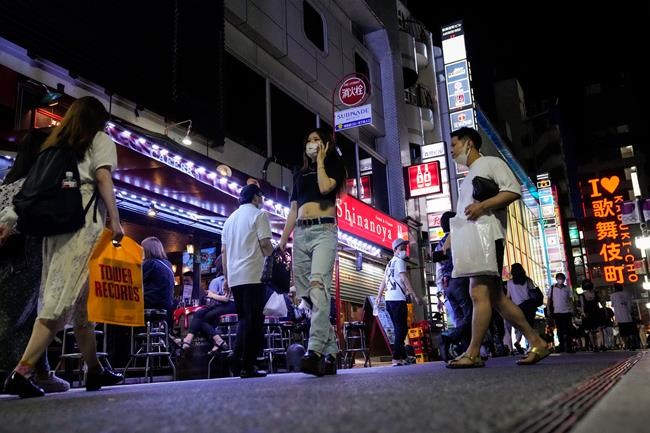
People walk around and gather at a bar after government imposed 8 p.m. closing time for restaurants and bars under Tokyo's fourth state of emergency Saturday, July 17, 2021, in Tokyo. The latest state of emergency has asked restaurants and bars to close by 8 p.m., if not entirely. This has pushed people to drink outside, although many bars remain open and bustling with customers who are defying the rules and expressing frustration and indifference. (AP Photo/Kiichiro Sato)

On a quiet street in east Shinjuku, Naoto Suga picked up a can of lemon-flavored liquor that his friend had just brought him. They sat on a curbside, along with around a dozen others who were also drinking on the street.

“We’ve been here every night for the past three days or so,” said Suga, 25, who works in a nearby apparel shop.

“I don’t think the Olympics itself made this (situation), but even before the Games, things like the state of emergency have remained half measures, and I think that’s making things worse,” he said. “People are all used to the state of emergency, so it’s getting less meaningful now.”

Suga, who hasn’t received the COVID-19 vaccine yet, also lamented the slower rollout in Japan, especially for younger people. Everyone 12 and older is eligible to be vaccinated, but younger people are last in line. Only 22% of Japan’s population has been fully vaccinated so far.

“To be honest, I’m for hosting the Olympics; it’s better than not doing so given the debt of venue buildings,” he said. “But I don’t quite have a particular sport I want to watch. I’ve lost interest.”
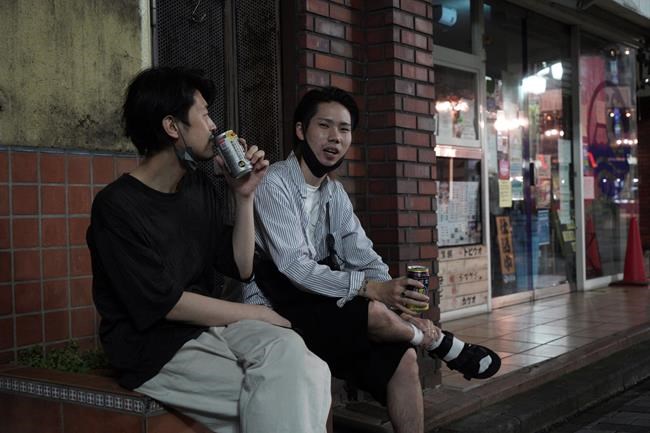
Naoto Suga, right, 25, drinks canned alcohol roadside with his friend in Tokyo’s Shinjuku district Monday, July 19, 2021.
Naoto Suga, right, 25, drinks canned alcohol roadside with his friend in Tokyo’s Shinjuku district Monday, July 19, 2021. "I don’t think the Olympics itself made this (situation), but even before the Games, things like the state of emergency have remained half measures, and I think that's making things worse," Suga said. "People are all used to the state of emergency, so it's getting less meaningful now." (AP Photo/Kantaro Komiya)
People gather at a bar after government imposed 8 p.m. closing time for restaurants and bars under Tokyo's fourth state of emergency Saturday, July 17, 2021, in Tokyo. The latest state of emergency has asked restaurants and bars to close by 8 p.m., if not entirely. This has pushed people to drink outside, although many bars remain open and bustling with customers who are defying the rules and expressing frustration and indifference. (AP Photo/Kiichiro Sato)
Report Error Submit a Tip

More Stories

Bombers manage to hand Redblacks another loss

Taylor Allen 7 minute read Preview

Bombers manage to hand Redblacks another loss

Taylor Allen 7 minute read Updated: 8:35 AM CDT

It looked bad. Real bad.

Winnipeg Blue Bombers quarterback Zach Collaros made his return to the lineup on Friday night against the Ottawa Redblacks, and he was once again the victim of a blindside hit.

The one he suffered in Hamilton on July 5 appeared relatively modest in comparison and yet, it sidelined him for a month with a neck injury.

So when Redblacks linebacker Lucas Cormier came around the edge unblocked and hammered Collaros from behind in the second quarter, you could hear a pin drop inside Princess Auto Stadium.

Read
Updated: 8:35 AM CDT

Could renewed interest in strategically critical rare earth elements finally make sub-sector profitable?

Joel Schlesinger 6 minute read Preview

Could renewed interest in strategically critical rare earth elements finally make sub-sector profitable?

Joel Schlesinger 6 minute read 3:00 AM CDT

Rare earth elements are among the most critical of mined resources for modern economies.

They’re essential in manufacturing specialized magnets used in a host of technologies from wind turbines and electric vehicles to hard drives, smartphones, television screens, and fibre optics. Most notably, however, rare earth minerals are increasingly vital to the defence industry.

These 17 elements — closely related chemically and usually found all together in mineral deposits — have indeed been growing in geopolitical importance as the United States, Canada and other Western nations recognize their dependence on production from China.

It is the world’s largest producer and processor of rare earths, including the most in-demand elements neodymium and praseodymium used to manufacture very light and powerful magnets for an array of technologies, including the most advanced weapons of modern warfare.

Read
3:00 AM CDT

Nola chef earns national award

Eva Wasney 2 minute read Preview

Nola chef earns national award

Eva Wasney 2 minute read Yesterday at 2:01 AM CDT

Celebrated Winnipeg chef Emily Butcher has another feather to add to her toque. The executive chef and owner of Nola and Bar Accanto in St. Boniface has received the Culinary Award of Excellence from Restaurants Canada, a national foodservice advocacy organization.

Read
Yesterday at 2:01 AM CDT

West Kildonan Industrial residents call for speed bumps after child hit by truck

Morgan Modjeski 3 minute read Preview

West Kildonan Industrial residents call for speed bumps after child hit by truck

Morgan Modjeski 3 minute read Updated: 3:09 PM CDT

Residents in the West Kildonan Industrial neighbourhood are calling on the city to install speed bumps in their area after a child was hit and dragged by a vehicle Thursday.

Katelyn Bemister lives near the area where the child — who was hospitalized as a result of the incident and has been upgraded to stable condition — was struck. She says people frequently speed in the area.

“They’re going really fast, and they’re not really paying attention at all to the pedestrians in the area,” says Bemister.

In video supplied to the Free Press by a resident, the child can be seen riding a bike down a sidewalk along the 500 block of North Point Boulevard.

Read
Updated: 3:09 PM CDT

Three security guards charged with assault after Sea Bears star injured outside nightclub

Nicole Buffie 3 minute read Preview

Three security guards charged with assault after Sea Bears star injured outside nightclub

Nicole Buffie 3 minute read Thursday, Aug. 13, 2026

Three security guards are facing assault charges, accused of injuring a Winnipeg Sea Bears player at a nightclub earlier this month.

Read
Thursday, Aug. 13, 2026

Manitoba supports MAID delay: Asagwara

Carol Sanders 5 minute read Preview

Manitoba supports MAID delay: Asagwara

Carol Sanders 5 minute read Yesterday at 2:00 AM CDT

The number of Manitobans receiving medical assistance in dying in 2026 is on track with previous years while the plan to extend it to those suffering from mental illness is delayed indefinitely by the federal government — a move Manitoba’s health minister supports.

“There’s so much more work that needs to be done,” Uzoma Asagwara said.

The parliamentary committee that issued its recommendation in June was the third special committee of Parliament struck to assess the eligibility of people with mental illness since 2021, when MAID eligibility was expanded to include people who were not at the end of their lives.

A key condition for MAID eligibility is that a patient must be suffering from a grievous and irremediable medical condition.

Read
Yesterday at 2:00 AM CDT