

Riding Mountain’s head gardener gets growing
Lyndon Penner plans to make a statement in national park

Advertisement
Read this article for free:
or
Already have an account? Log in here »
To continue reading, please subscribe:
Monthly Digital Subscription
$1 per week for 24 weeks*
- Enjoy unlimited reading on winnipegfreepress.com
- Read the E-Edition, our digital replica newspaper
- Access News Break, our award-winning app
- Play interactive puzzles
*Billed as $4.00 plus GST every four weeks. After 24 weeks, price increases to the regular rate of $19.95 plus GST every four weeks. Offer available to new and qualified returning subscribers only. Cancel any time.
Monthly Digital Subscription
$4.99/week*
- Enjoy unlimited reading on winnipegfreepress.com
- Read the E-Edition, our digital replica newspaper
- Access News Break, our award-winning app
- Play interactive puzzles
*Billed as $19.95 plus GST every four weeks. Cancel any time.
To continue reading, please subscribe:
Add Free Press access to your Brandon Sun subscription for only an additional
$1 for the first 4 weeks*
*Your next subscription payment will increase by $1.00 and you will be charged $16.99 plus GST for four weeks. After four weeks, your payment will increase to $23.99 plus GST every four weeks.
Read unlimited articles for free today:
or
Already have an account? Log in here »
Hey there, time traveller!
This article was published 25/09/2021 (1683 days ago), so information in it may no longer be current.
If you want to do something bold and innovative in the garden, says Lyndon Penner, you must take a risk. Fortune favours the bold, says Penner, who is the new head gardener at Riding Mountain National Park.
“The worst thing that anybody could ever say about a public garden — or any garden for that matter — is that it was boring or that their visit wasn’t memorable. I would much rather go down in flames trying something that hasn’t been done before than just do what’s always been done or what’s safe.”
So, buckle your seatbelts because Lyndon Penner is getting ready to create a scene. There is no doubt that whatever he is planning will be dazzling, interesting, and meaningful. Whenever Penner gives one of his many presentations, gardeners listen enthralled. He is witty, funny, irreverent, and a walking encyclopedia of horticultural knowledge. The author of four books — most recently, The Way of the Gardener: Lost in the Weeds Along the Camino de Santiago (University of Regina Press, 2021) – Penner is Saskatchewan-born. He moved into the former gatekeeper’s residence at Riding Mountain National Park in May.

Last week I travelled to Riding Mountain to visit with Penner and two of his staff, Nancy MacKay, and Megan Cooper. Full of energy and enthusiasm, they had just finished planting more than one thousand flower bulbs — daffodils, tulips, alliums, crocuses — for next spring’s flower displays. They have also been busy collecting seeds and planting seeds and soon will be lifting scores of dahlia and canna lily and calla lily bulbs.
Penner believes that a garden needs to make a statement and communicate something. “A garden has to serve its intended purpose,” he says. Penner and his staff are reworking the ultra-long perennial borders and Victorian garden beds near the historic visitor centre to make them more reflective of the site’s British heritage. The gardens include asters, delphiniums, daylilies, peonies, poppies, Joe Pye weed, rudbeckia, and much more. Penner added three enormous cardoons, their compelling form and silvery foliage noticeable from a far distance. Widely cultivated in Victorian England, the cardoon (Cynara cardunculus) is also called the artichoke thistle and is an annual.
With demand for plants and seeds at an all-time high, Penner is wasting no time in placing his orders for next spring. He has ordered several diverse types of Cypripedium Lady’s slippers (hardy perennial orchids) from Garden Slippers, a Calgary nursery managed by Shawn Hillis that specializes in temperate orchids for the garden. “The cultivars that we’ve just ordered include Emil, Gisela, Sabine Pastel, Henric, Philipp, and a rare variety called Cypripedium x ventricosum which has exquisite purplish pink flowers with creamy white markings.”
The native lady’s slipper that grows in the park is Cypripedium calceolus. Although rare provincially, there are two naturally occurring yellow-flowered varieties which bloom every June in vast drifts. But the hybrid forms have larger flowers and bloom significantly longer than the wild species. Planting hybrids is also a way of protecting the wild species because it helps to educate people that the garden slippers are available in the nursery trade. It is an unfortunate reality that some people dig up the wild species.
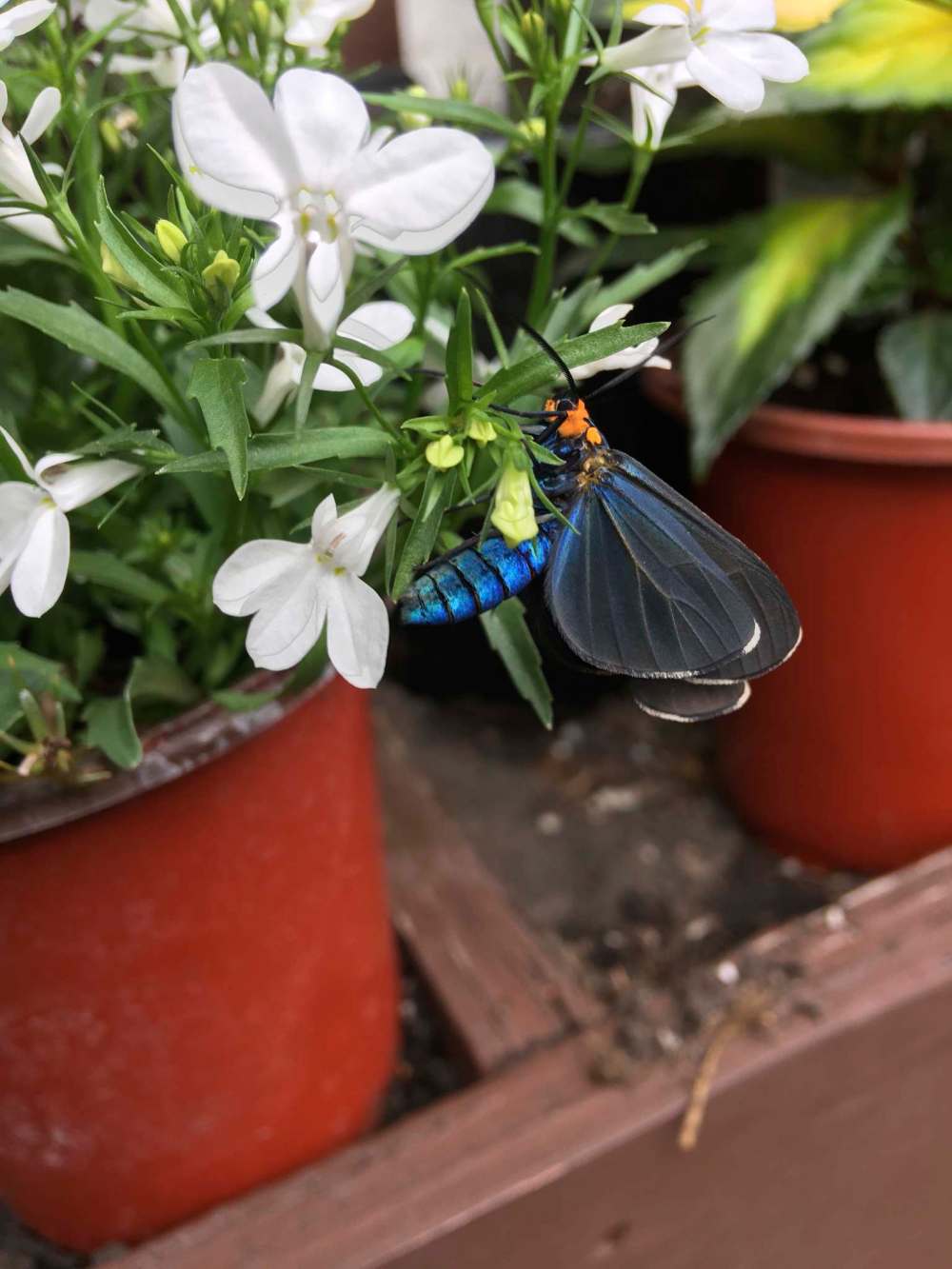
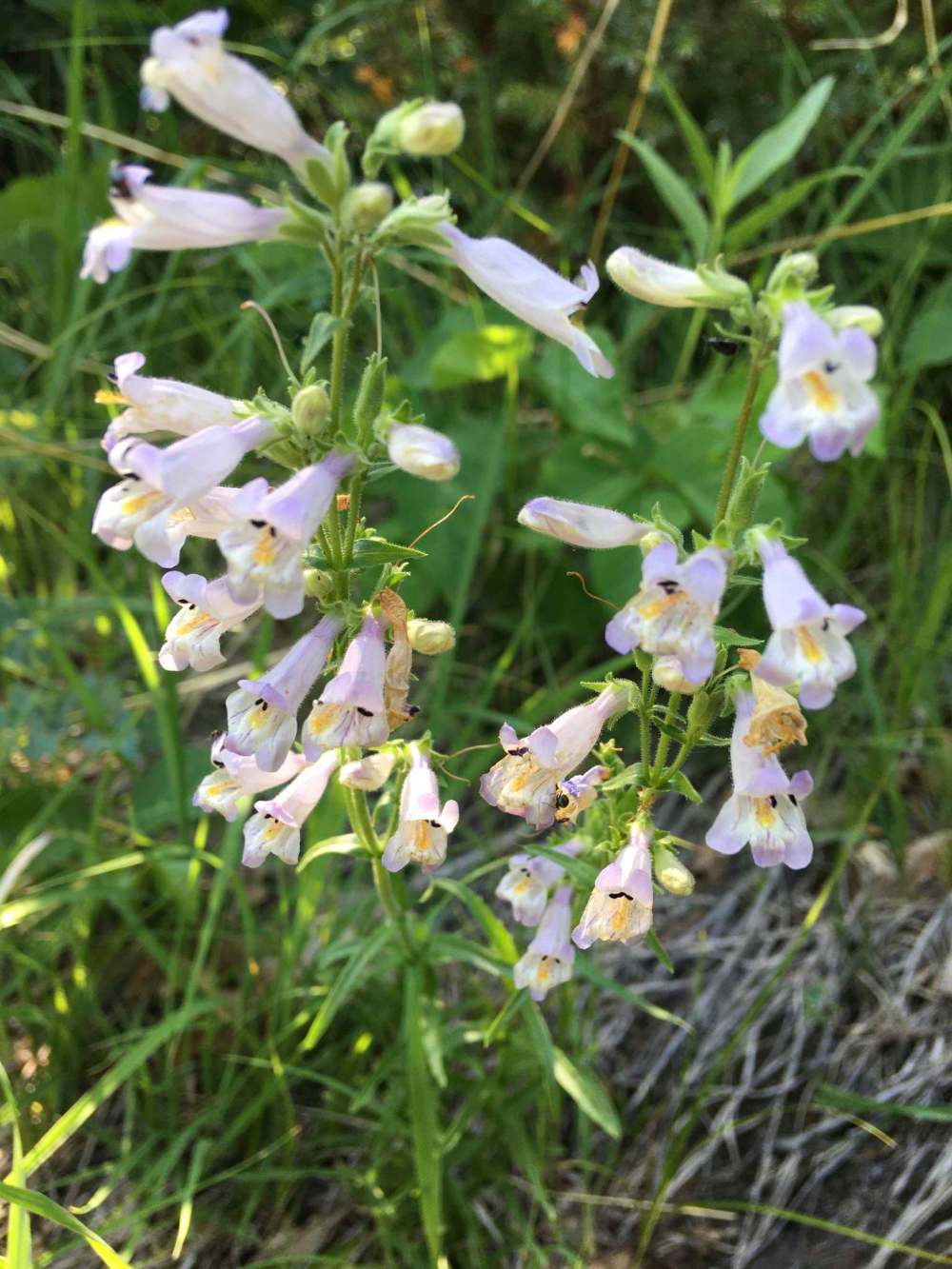
Penner hopes to add more milkweed, salvia, and echinacea as well as many varieties of penstemon which he says are fabulous for bees and butterflies. “We have just seeded the aptly named graceful penstemon (Penstemon gracilis) which is native to the park.” There are so many species of birds, butterflies, sphinx moths, and other wildlife creatures in the park including the stunning metallic blue Virginia Ctenucha moth, the largest and most broad-winged of wasp moths in North America.

In addition to enhancing visitor experience and creating beautiful gardens, Penner is passionate about creating habitat. “I want to accommodate the creatures that are already here and facilitate them, but I also want to attract other species.” This goal is being accomplished in a variety of ways.
Penner, MacKay, and Cooper added mulch this summer to all the planting beds. Mulch reduces weeds, conserves significant moisture, and feeds the soil as it decomposes but also creates habitat for insects and microbes which is important for birds. Penner is keen to make the gardens at RMNP bird friendly. There are several unusual types of birds that are native to the park. Some species, like the golden-winged warbler, are at risk. Penner was thrilled to spot his first rose-breasted grosbeak this year. There are also beautiful birds of prey such as hawks and falcons.
“Some gardeners like to do a fall cleanup. I will leave absolutely everything standing for winter — including annuals,” says Penner. “A garden should still look like a garden even in the winter months with seedheads, dried flower stalks and stems sticking out of the snow.” It is not just about creating winter interest but about providing a food source as well as habitat for overwintering birds and micro wildlife. In spring, none of the dead annuals will be pulled. The tops will be cut off, but the roots will be left to break down and feed the soil. “Not only does that provide nutrients but once the roots have decomposed it also allows for aeration. Our mandate is that we preserve and protect all life forms in the park including tiny insects, microbes, and fungi.”
Penner does not mind a bit of gentle anarchy in the garden (you don’t want it to be an uprising or a rebellion, he says). He wants to use as many native plants as he can, but he is not a purist. He also uses cultivars, many of which have longer blooming periods. “A lot of our best native plants go dormant when they are done flowering which is not conducive to good garden design. The bumblebee does not know if an aster, for example, is not a native aster. He only knows that it is lunch.”

Penner is all about detail. He is revamping the gardens that surround the historic Wishing Well Bridge that overlooks Clear Lake as well as the flowerbeds at the site of the elegant Elkhorn Manor.

Soon Penner, MacKay, and Cooper will cover the popular moose and bison topiaries with tarps for the winter. The living sculptures were created by the renowned Joe Kyte, aka Topiary Joe. The moose’s moss-filled topiary frame which stands 10-feet tall is planted with sedum. Located at Mooswa Drive, it has become the most photographed spot at Riding Mountain. Penner has ambitions to evolve the planting palette for both the moose and bison topiaries which must be replanted each year and is experimenting with hardy native plant material.
The United Nations has designated 2022 as the International Year of Glass. One of the most utilized substances in the world, glass is also one of the most underappreciated. Without giving away too much, Penner plans to style one of the show gardens after a stained-glass kaleidoscope with changing patterns as well as to recreate some of Europe’s most iconic stained-glass windows with flowers.
“We are excited about the gardens,” says Penner. “We want visitors to say, ‘I am dying to get back there, we loved it.’” I expect he’ll have his wish.
colleenizacharias@gmail.com
Colleen Zacharias
Gardening columnist
Colleen Zacharias writes about many aspects of gardening including trends, plant recommendations, and how-to information that is uniquely relevant to Prairie gardeners. She has written a column for the Free Press since 2010 and pens the monthly newsletter Winnipeg Gardener. Read more about Colleen.
Every piece of reporting Colleen produces is reviewed by an editing team before it is posted online or published in print — part of the Free Press‘s tradition, since 1872, of producing reliable independent journalism. Read more about Free Press’s history and mandate, and learn how our newsroom operates.
Our newsroom depends on a growing audience of readers to power our journalism. If you are not a paid reader, please consider becoming a subscriber.
Our newsroom depends on its audience of readers to power our journalism. Thank you for your support.
Colleen Zacharias
Gardening columnist
Colleen Zacharias writes about many aspects of gardening including trends, plant recommendations, and how-to information that is uniquely relevant to Prairie gardeners. She has written a column for the Free Press since 2010 and pens the monthly newsletter Winnipeg Gardener. Read more about Colleen.
Every piece of reporting Colleen produces is reviewed by an editing team before it is posted online or published in print — part of the Free Press‘s tradition, since 1872, of producing reliable independent journalism. Read more about Free Press’s history and mandate, and learn how our newsroom operates.
Our newsroom depends on a growing audience of readers to power our journalism. If you are not a paid reader, please consider becoming a subscriber.
Our newsroom depends on its audience of readers to power our journalism. Thank you for your support.
Advertisement Advertise With Us
Advertisement Advertise With Us
History
Updated on Monday, September 27, 2021 12:22 PM CDT: Deck corrected.