Staying power
Simplicity has kept Ticket to Ride steaming ahead
Advertisement
Read this article for free:
or
Already have an account? Log in here »
To continue reading, please subscribe:

Digital Subscription
One year of digital access for only $205*
- Enjoy unlimited reading on winnipegfreepress.com
- Read the E-Edition, our digital replica newspaper
- Access News Break, our award-winning app
- Play interactive puzzles
*First annual payment billed as $205.00 + GST for one year. This annual subscription will automatically renew at $233.00 + GST every 52 weeks (10% off the regular annual price of $259.35). Offer available to new and qualified returning subscribers only. Cancel any time.
To continue reading, please subscribe:
Add Free Press access to your Brandon Sun subscription for only an additional
$1 for the first 4 weeks*
- Enjoy unlimited reading on winnipegfreepress.com
- Read the E-Edition, our digital replica newspaper
- Access News Break, our award-winning app
- Play interactive puzzles
*Your next Brandon Sun subscription payment will increase by $1.00 and you will be charged $17.95 plus GST for four weeks. After four weeks, your payment will increase to $24.95 plus GST every four weeks.
Read unlimited articles for free today:
or
Already have an account? Log in here »
Hey there, time traveller!
This article was published 09/10/2021 (1827 days ago), so information in it may no longer be current.
What defines a great board game? It is its theme, the accessibility and elegance of the rules, the design and production of the components, the depth of strategy, or the level of enjoyment one experiences when playing it? I believe it is a combination of all of these factors, and very few games are able to fulfil all of these criteria satisfactorily.
These are games that have staying power and that are loved not only by thousands, but by millions of people around the world. There is no doubt in my mind the game Ticket to Ride is one of them.
Ticket to Ride was created by the American designer Alan R. Moon and was first published in 2004 by the game publisher Days of Wonder. Since its inception it has sold more than eight million copies worldwide and has received dozens of international awards, including the much coveted “Spiel des Jahres” in Germany. It is one of the most popular modern board games in the world, an honour that can only be shared with other mammoth titles like Catan or Carcassone.
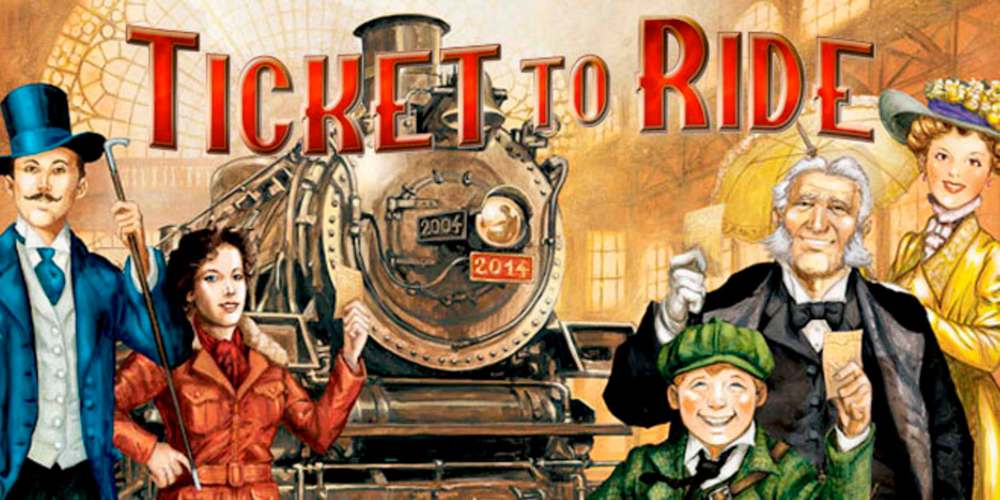
One of the reasons for its success is that it is deceptively simple. The game casts players as railroad developers, crossing North America in the age of steam. It is played on a large and colourfully illustrated map of the United States and southern Canada. It even features Winnipeg as one of its destination cities — something I am strangely proud of! In addition, it features a large deck of cards that depict train cars in different colours as well as a supply of mini plastic trains for each player in their colour. Most turns, a player can take one of two actions: They can either add cards to their hand from the card supply, or they can claim a route between two cities on the board. If they choose the latter, they trade in a set of cards of the same colour as the track and place their train tokens on that route. They then immediately receive points for that action. The longer the route they claim, the more points they get. The game ends when at least one player has two or fewer train tokens left. The player with the most points is declared winner after one final round. That’s pretty much the core of it. To add a little more depth, each player also receives another set of cards listing pairs of cities. At the end of the game, players receive bonus points for each card they were able to link up, but they lose points if they couldn’t. This adds a hidden point structure that can alter a player’s ranking at the very end.
Even though Ticket to Ride is a game that can be learned and taught easily, it also has a lot of hidden depth. The game encourages players to develop strategies and forces them to make constant tactical decisions. What is the better choice, building routes to your advantage or blocking routes to limit your opponents’ options? There are many different paths toward victory which encourages replayability. Most Ticket to Ride games last about 60 minutes, depending on the number of players.
Moon has said the idea for Ticket to Ride came to him during a morning walk along the Atlantic shore in Beverly, Mass., in 2003. He had been working on a different train-themed game for a while, but the play testing did not go particularly well. As he was pondering how to change some of the designs, a new structure for a game popped into his head. By the time he arrived back at home, the general outline for his new creation had been developed in his mind. He immediately created a prototype of a map and wrote down the basic idea for a rule set. The play testing with friends that followed was greatly successful, and after some further tweaking of routes on the board and some fine-tuning of the rules, the game as we now know it was born. Moon sent his design to three publishers. This first two didn’t reply, but Days of Wonder offered him a meeting which eventually lead to a publishing deal.
But things did not end there. Today there are plenty of expansions and stand-alone versions that were added to the original Ticket to Ride. Most of them have small variations on the gameplay itself, but the real charm is that they allow you to build your networks of railroads on different maps from around the world. There are versions set in Europe, Africa, India, Asia and the U.K., among others. The choices are endless. Ticket to Ride allows us to travel the world in our minds, even in the midst of COVID-related travel restrictions.
If you haven’t played Ticket to Ride before, you absolutely should — in my opinion it is a must-try. For first first time players, I’d recommend the original North American map as the best starting point. If you are already familiar with the game, I encourage you to bring it back to the table or to explore one of the many new destinations from around the world. All aboard!
TICKET TO RIDE
2-5 players, ages 8 and up
The original that started it all. Featuring a map of the U.S. and southern Canada. Best choice for first-time players.
TICKET TO RIDE: EUROPE
2-5 players, ages 8 and up
A stand-alone adaptation (meaning you don’t need to own any other version) of the original, featuring a map of Europe. A few extra rules regarding tunnel building and other variants. A great choice if you are looking for a new experience after playing the original version.
TICKET TO RIDE MAP COLLECTION (VARIOUS DESTINATIONS)
2-5 players, ages 8 and up
The map collections are expansions, meaning that you’ll need to own the base game for its components. The maps allow you to travel to different parts of the world. A wonderful addition to the original.
TICKET TO RIDE RAILS AND SAILS
2-5 players, ages 10 and up

The most elaborate version of ticket to Ride expands gameplay across the globe. In this version, you also move across water (thus the sails). I would recommend this to any Ticket to Ride fan who wants to expand game strategy even further. Featuring a large game box which includes a double-sided game board (one side showing the world, the other showing the Great Lakes of North America). Each side has a few differences in game play.
TICKET TO RIDE EXPRESS: NEW YORK
2-4 players, ages 8 and up
The express version features a map of Manhattan. The box and game board is smaller in size and gameplay is shorter. A great option for travelling or a quick game that last about 20 minutes.
Olaf Pyttlik is a Winnipeg board-game enthusiast and co-owner of Across the Board Game Café. In a regular column, he looks at the renaissance of board games and shares games ideas for families and friends of all ages. Email him at olaf@acrosstheboardcafe.com.