Wander the world in your garden
Landscape designer captures inspiration from his travels

Advertisement
Read this article for free:
or
Already have an account? Log in here »
To continue reading, please subscribe:

Digital Subscription
One year of digital access for only $205*
- Enjoy unlimited reading on winnipegfreepress.com
- Read the E-Edition, our digital replica newspaper
- Access News Break, our award-winning app
- Play interactive puzzles
*First annual payment billed as $205.00 + GST for one year. This annual subscription will automatically renew at $233.00 + GST every 52 weeks (10% off the regular annual price of $259.35). Offer available to new and qualified returning subscribers only. Cancel any time.
To continue reading, please subscribe:
Add Free Press access to your Brandon Sun subscription for only an additional
$1 for the first 4 weeks*
- Enjoy unlimited reading on winnipegfreepress.com
- Read the E-Edition, our digital replica newspaper
- Access News Break, our award-winning app
- Play interactive puzzles
*Your next Brandon Sun subscription payment will increase by $1.00 and you will be charged $17.95 plus GST for four weeks. After four weeks, your payment will increase to $24.95 plus GST every four weeks.
Read unlimited articles for free today:
or
Already have an account? Log in here »
Hey there, time traveller!
This article was published 08/01/2022 (1695 days ago), so information in it may no longer be current.
There are many different elements to consider when planning a landscape design: mass, form, line, texture, colour, and value. Design principles include unity, balance, proportion, rhythm, repetition, contrast, and simplicity. Everywhere Keith Lemkey travels, he gains fresh inspiration and key insights on how all these components work and play together.
Lemkey, who has forty years of design experience, owns Lemkey Landscape Design, an award-winning design-build firm. Lemkey has traveled throughout North America and visited many parts of Europe — France, England, Scotland, Portugal, Monaco, Italy, Germany, Belgium, Switzerland, and Spain. He seeks out as many gardens as he can whenever he travels. Many of the famous gardens he visits offer different perspectives that leave an indelible image in his mind and ignites his creativity.

When clients who spent their childhoods or part of their working careers living abroad want to evoke their memories or recollections of a certain place in their landscape design, Lemkey draws on his observations and experiences.
For Winnipeg clients who own a vineyard in Tuscany, Lemkey created a Tuscan-style front courtyard and brought the feel of a small piazza to a front yard that was almost all concrete at the entrance. In another project, he created an expansive, curved sweep of hydrangea shrubs bordering lush, green grass for East St. Paul clients that was inspired by gardens in Victoria, B.C., a place they love to visit.

“The front yard is where I like to make a statement,” says Lemkey. “But I don’t want to make it a statement that’s screaming at everybody. I want it to be a statement of elegance and class. The front yard — regardless of its size — is the first impression that everyone sees. It should be a warm and inviting sort of interaction so that when people walk by, it’s something they notice and remember.”
“I think I have more pictures of doorways than I have of my children.” – Keith Lemkey
Lemkey is drawn to doorways. “I think I have more pictures of doorways than I have of my children,” he says. “Doorways are an introduction. In many parts of England, for example, where houses are attached side by side, the front yard might be only six feet from the sidewalk. One memorable doorway that brought me to a complete stop was painted a very striking dark blue with a gloss finish. Holly was growing on the outer wall, framing the door on both sides. It was so unique and outstanding that it immediately caught my eye.”
Lemkey is struck by the beauty and harmonious balance that is found in a well-designed landscape as well as by the impact of architectural features – intricately designed wrought iron gates, for example, that he saw while visiting Stratford-upon-Avon in its Old Town. Or the lines of long rows of trees that direct the movement of the eye to a focal point in the far distance or the dappled light and shadow beneath a vine covered archway at Kew Gardens.
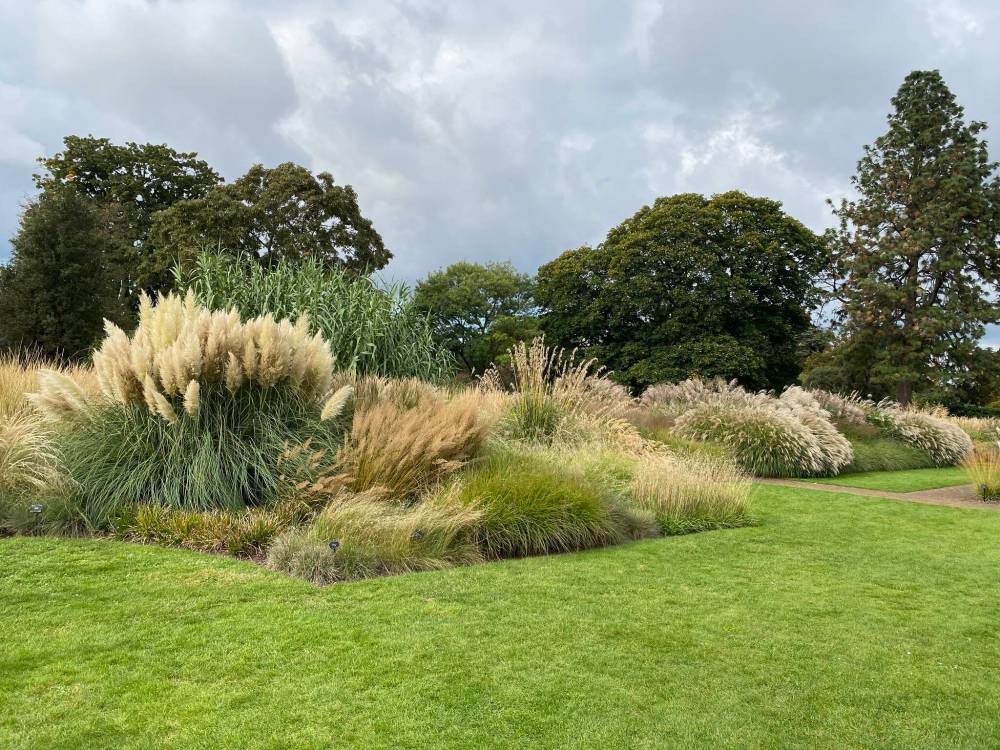
Last fall, Lemkey and his wife visited Kew Gardens for the first time with their daughter who lives in Barnes, a district in the London Borough of Richmond upon Thames in southwest London where Kew is located. “Kew is impressive, impeccable,” he says. The Great Broad Walk Borders features impressive symmetry and over 60,000 plants in the formal gardens on both sides of the centre pathway which stretches 25 to 30 feet wide. “I can only imagine what the scene must look like during the summer,” says Lemkey. “Brilliant layout.”
Lemkey also visited The Hive, a 17-metre-tall mesh-framed structure in the shape of a honeycomb that is in the centre of a wildflower meadow. It provides visitors with a unique, immersive experience: an accelerometer picks up vibrations from the activity of bees that live in Kew Gardens. One thousand LED lights gl ow according to their vibrations. “Just fascinating,” says Lemkey. “But it’s there to create awareness of the importance of bees.”
The grass displays at Kew include about 550 species. “Near the Princess of Wales Conservatory there is an area with a huge display of pampas grass — standing six to eight feet tall or more. Massive banks of pampas grass are planted in drifts so the impact of the display with its textured plumes is just so immense, it’s really quite breathtaking,” says Lemkey. Shorter varieties of different types of grasses border the display. Initially, from a design perspective, Lemkey says he felt almost a measure of disappointment because it would be so difficult to try and replicate the density, texture, and mass of the tactile display. Pampas grass can only be grown as an annual in our cold climate and would never achieve the same scale.

Scale, which is the relative size of one component of a landscape compared to another, often gets missed in most people’s landscapes, says Lemkey, because we try to have too much variety in our landscapes. “I would rather simplify things. Whenever I look at something that I find really appealing, it’s usually the simplicity of the design that attracts me the most. The design needs to flow into or connect with everything else that’s around it. It’s that interaction from one type of plant or one type of texture, structure or size, mass, density — that sense of flow — which has a soothing element.”
Many people, for example, want to replicate what they see in the English Garden at Assiniboine Park, says Lemkey. “The size of the English Garden and the mass (of the plantings) and how the textures flow from one to the other, all of it plays well. But if you are trying to scale it down, miniaturize it into somebody’s yard, it doesn’t work. You can’t make something that is big, small, and have the same visual effect. When you go to places like Kew Gardens, Versailles, Busch Gardens, Montreal Botanical Garden, or Butchart Gardens, you are looking at layers upon layers of plantings which create that sense of vista.”
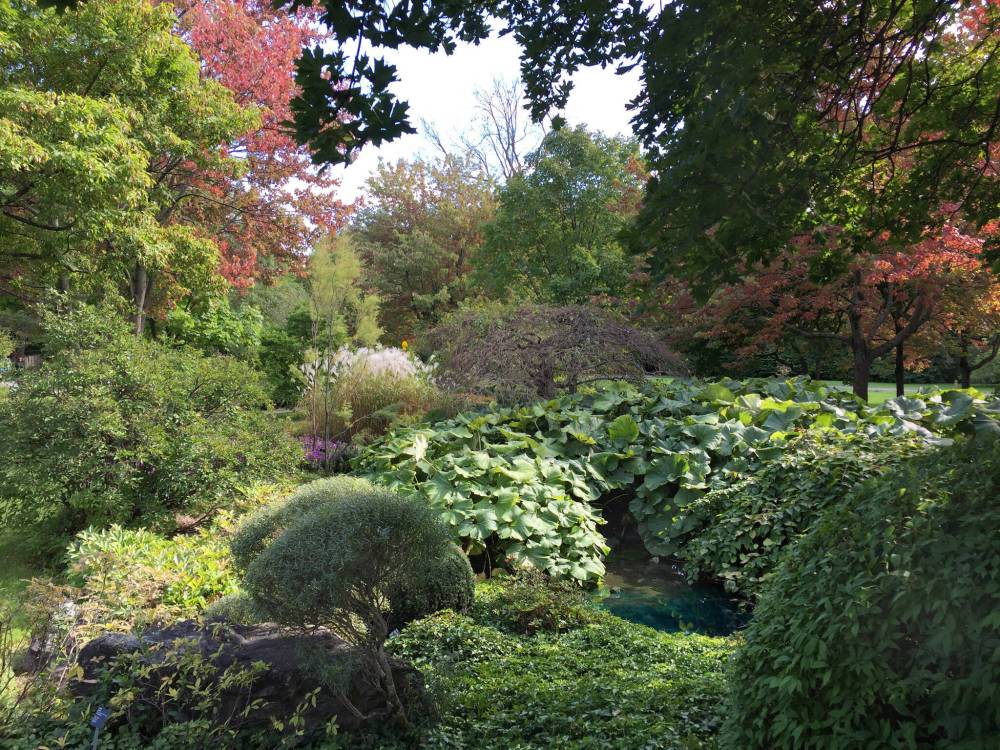
Attempting to replicate the beautiful layers of plantings, for example, at Montreal Botanical Garden, just would not be practical in a small urban garden. So how could you scale it down? “The best way to do that is through simplicity,” says Lemkey. “Keep things calmer or more relaxed to the eye.” The size of every component in the landscape should be in proportion to its surroundings, says Lemkey. Emulate the textures, colours, and shapes that play so well with one another and that you admire but on a smaller scale. “Those are some of the subtleties that are key to achieving balance.”
“Those are some of the subtleties that are key to achieving balance.” – Keith Lemkey
“A change I’ve noticed over the last 10 years,” says Lemkey, “is that most people are no longer waiting until April to plan their landscaping projects. More people are planning their projects during the winter. I think as people travel more, and watch travel shows, they are becoming more aware of the design possibilities. Wherever they travel, they bring ideas and inspiration back home.”
A great garden, says Lemkey, is a reflection of a lifestyle influenced by personal experiences, travel, art, culture, and history.
colleenizacharias@gmail.com

Colleen Zacharias
Gardening columnist
Colleen Zacharias writes about many aspects of gardening including trends, plant recommendations, and how-to information that is uniquely relevant to Prairie gardeners. She has written a column for the Free Press since 2010 and pens the monthly newsletter Winnipeg Gardener. Read more about Colleen.
Every piece of reporting Colleen produces is reviewed by an editing team before it is posted online or published in print — part of the Free Press‘s tradition, since 1872, of producing reliable independent journalism. Read more about Free Press’s history and mandate, and learn how our newsroom operates.
Our newsroom depends on a growing audience of readers to power our journalism. If you are not a paid reader, please consider becoming a subscriber.
Our newsroom depends on its audience of readers to power our journalism. Thank you for your support.
Colleen Zacharias
Gardening columnist
Colleen Zacharias writes about many aspects of gardening including trends, plant recommendations, and how-to information that is uniquely relevant to Prairie gardeners. She has written a column for the Free Press since 2010 and pens the monthly newsletter Winnipeg Gardener. Read more about Colleen.
Every piece of reporting Colleen produces is reviewed by an editing team before it is posted online or published in print — part of the Free Press‘s tradition, since 1872, of producing reliable independent journalism. Read more about Free Press’s history and mandate, and learn how our newsroom operates.
Our newsroom depends on a growing audience of readers to power our journalism. If you are not a paid reader, please consider becoming a subscriber.
Our newsroom depends on its audience of readers to power our journalism. Thank you for your support.
Advertisement Advertise With Us
Advertisement Advertise With Us