Your dog’s personality may have little to do with its breed

Advertisement

Advertise with us

WASHINGTON (AP) — Research confirms what dog lovers know — every pup is truly an individual.

Read this article for free:


or

Already have an account? Log in here »

To continue reading, please subscribe:

Subscribe and receive a limited-edition Free Press branded hat or tote.

Digital Subscription

One year of digital access for only $205*

  • Enjoy unlimited reading on winnipegfreepress.com
  • Read the E-Edition, our digital replica newspaper
  • Access News Break, our award-winning app
  • Play interactive puzzles

*First annual payment billed as $205.00 + GST for one year. This annual subscription will automatically renew at $233.00 + GST every 52 weeks (10% off the regular annual price of $259.35). Offer available to new and qualified returning subscribers only. Cancel any time.

To continue reading, please subscribe:

Add Free Press access to your Brandon Sun subscription for only an additional

$1 for the first 4 weeks*

  • Enjoy unlimited reading on winnipegfreepress.com
  • Read the E-Edition, our digital replica newspaper
  • Access News Break, our award-winning app
  • Play interactive puzzles
Start now

*Your next Brandon Sun subscription payment will increase by $1.00 and you will be charged $17.95 plus GST for four weeks. After four weeks, your payment will increase to $24.95 plus GST every four weeks.

Hey there, time traveller!
This article was published 28/04/2022 (1619 days ago), so information in it may no longer be current.

WASHINGTON (AP) — Research confirms what dog lovers know — every pup is truly an individual.

Many of the popular stereotypes about the behavior of golden retrievers, poodles or schnauzers, for example, aren’t supported by science, according to a new study.

“There is a huge amount of behavioral variation in every breed, and at the end of the day, every dog really is an individual,” said study co-author and University of Massachusetts geneticist Elinor Karlsson.

FILE - Dachshund dogs wait in a box before competition at a dog show in Dortmund, Germany, on Friday, Oct. 13, 2017. Research released on Thursday, April 28, 2022, confirms what dog lovers know _ every pup is truly an individual. A new study has found that many of the popular stereotypes about the behavior of specific breeds aren’t supported by science. (AP Photo/Martin Meissner, File)

She said pet owners love to talk about their dog’s personality, as illustrated by some owners at a New York dog park.

Elizabeth Kelly said her English springer spaniel was “friendly, but she’s also kind of the queen bee.” Suly Ortiz described her yellow Lab as “really calm, lazy and shy.”

And Rachel Kim’s mixed-breed dog is “a lot of different dogs, personality wise — super independent, really affectionate with me and my husband, but pretty, pretty suspicious of other people, other dogs.”

That kind of enthusiasm from pet owners inspired Karlsson’s latest scientific inquiry. She wanted to know to what extent are behavioral patterns inherited — and how much are dog breeds associated with distinctive and predictable behaviors?

The answer: While physical traits such as a greyhound’s long legs or a Dalmatian’s spots are clearly inherited, breed is not a strong predictor of any individual dog’s personality.

The researchers’ work, published Thursday in the journal Science, marshals a massive dataset to reach these conclusions — the most ever compiled, said Adam Boyko, a geneticist at Cornell University, who was not involved in the study.

Dogs became humanity’s best friend more than 14,000 years ago, as the only animal domesticated before the advent of agriculture.

But the concept of dog breeds is much more recent. Around 160 years ago, people began to selectively breed dogs to have certain consistent physical traits, like coat texture and color and ear shape.

The researchers surveyed more than 18,000 dog owners and analyzed the genomes of about 2,150 of their dogs to look for patterns.

They found that some behaviors — such as howling, pointing and showing friendliness to human strangers —do have at least some genetic basis. But that inheritance isn’t strictly passed down along breed lines.

For example, they found golden retrievers that don’t retrieve, said co-author Kathryn Lord, who studies animal behavior with Karlsson.

Some breeds, such as huskies and beagles, may show a greater tendency to howl. But many of these dogs don’t, as both the owner survey and genetic data showed.
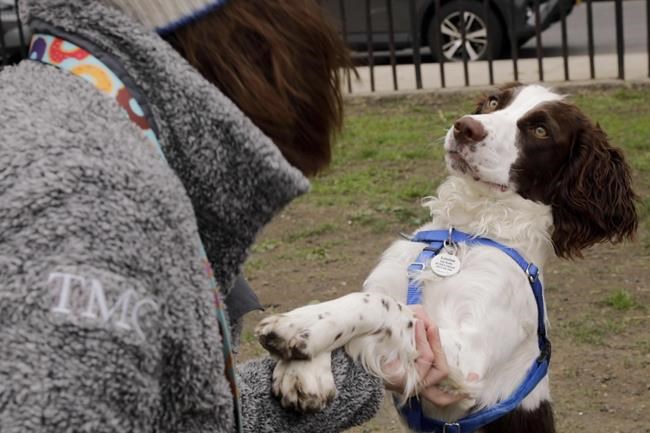
Elizabeth Kelly plays with her English springer spaniel, Louise, at McCarren Park in the Brooklyn borough of New York, on Tuesday, April 26, 2022. Kelly says Louise is
Elizabeth Kelly plays with her English springer spaniel, Louise, at McCarren Park in the Brooklyn borough of New York, on Tuesday, April 26, 2022. Kelly says Louise is "friendly, but she's also kind of the queen bee." Research released on Thursday, April 28, 2022, confirms what dog lovers know _ every pup is truly an individual. A new study has found that many of the popular stereotypes about the behavior of specific breeds aren’t supported by science. (AP Photo/Emma H. Tobin)

The researchers could find no genetic basis for aggressive behaviors nor a link to specific breeds.

“The correlation between dog behavior and dog breed is much lower than most expected,” said Jeff Kidd, a geneticist at the University of Michigan, who had no role in the research.

___

AP reporter Emma H. Tobin in New York contributed to this report.

___

Follow Christina Larson on Twitter: @larsonchristina

___

The Associated Press Health and Science Department receives support from the Howard Hughes Medical Institute’s Department of Science Education. The AP is solely responsible for all content.


Report Error Submit a Tip

More Stories

International flavour: Canadian investors may want to make like Ottawa, diversify beyond U.S.

Joel Schlesinger 6 minute read Preview

International flavour: Canadian investors may want to make like Ottawa, diversify beyond U.S.

Joel Schlesinger 6 minute read 2:01 AM CDT

Canada is learning the hard way about the dangers of putting too many eggs in its U.S. economic basket.

Much has been made about the need to diversify our economy away from the United States.

Diversification is understandably beneficial. The more varied streams of revenue a nation has, the less affected the economy will be when one of those sources is interrupted.

The same can be said about investment portfolios.

Read
2:01 AM CDT

Jets bench boss Arniel talks rebuilding from last season’s struggles

Mike McIntyre and Ken Wiebe 12 minute read Preview

Jets bench boss Arniel talks rebuilding from last season’s struggles

Mike McIntyre and Ken Wiebe 12 minute read Thursday, Oct. 1, 2026

Scott Arniel has a lot on his plate these days.

But the head coach of the Winnipeg Jets took some time Thursday to sit down with Free Press hockey writers Mike McIntyre and Ken Wiebe to discuss a number of topics on the eve of a new hockey season. This interview has been condensed and edited for clarity.

Wiebe: What was the evaluation of last season like? What did you personally do in an attempt to improve after going from first-overall to 26th-overall?

I just went back and looked at things and made sure my communication was where it needed to be with my players. Was my communication where it needed to be with my boss, with my general manager (Kevin Cheveldayoff)? How our coaching staff worked. How we handled highs and lows. Things I felt I could have done better.

Read
Thursday, Oct. 1, 2026

May be whiff of truth to ex’s odour ardour

Maureen Scurfield 5 minute read 2:01 AM CDT

DEAR MISS LONELYHEARTS: I ran into an old boyfriend I used to curl on a team with, and we went for drinks. We’ve been almost eight years apart, and I couldn’t remember why we broke up, as we always had such a great time together.

It wasn’t until the second date — this time on a weekend — that it came back to me, with a jolt. Pee-yew! I remembered he doesn’t use deodorant on weekends. Why? He enjoys his own body odour. I recalled that a bit too late, and it was just as awful as ever! I went home early.

Tonight, he called and I refused him another date. I said, “Think back. You remember why we broke up?” Then he said, “Oh yeah, you hated my no-deodorant weekend policy. Well, guess what? Some women don’t mind!” I said I really doubted that, and that ended the conversation. Miss L., wouldn’t any women find stinky underarms offensive?

— Sensitive Nose, Fort Richmond

Clock ticks down on destruction of records documenting residential school abuses

Marsha McLeod 13 minute read Preview

Clock ticks down on destruction of records documenting residential school abuses

Marsha McLeod 13 minute read Yesterday at 12:49 PM CDT

In less than a year, a private company is set to destroy the largest cache of records detailing the widespread abuse of Indigenous children at residential schools in Canada.

The destruction, which was ordered by an Ontario court in 2014 and later upheld by the Supreme Court, is set to take place on Sept. 19, 2027.

This countdown is igniting emotional conversations that seek to balance the immense historical value of the records alongside the confidentiality survivors were promised as part of the process of providing detailed testimony about abuses they’d suffered.

The records were created as part of the Indian Residential Schools Settlement Agreement, a class-action settlement stemming from survivors who began suing the federal government in the late 1990s over the harm they’d been subjected to at residential schools.

Read
Yesterday at 12:49 PM CDT

Sisters relieved hospital takes accountability after mother’s death

Scott Billeck 6 minute read Preview

Sisters relieved hospital takes accountability after mother’s death

Scott Billeck 6 minute read Thursday, Oct. 1, 2026

Eight months after losing their mother, two Winnipeg sisters say an internal hospital review has finally given them something they had been seeking since her death: accountability.

Chelsea Mann and Samantha Burns said St. Boniface Hospital officials acknowledged mistakes were made in the care of their mother, Judy Burns, during a recent meeting to discuss the findings of a critical incident review into her death.

The acknowledgement marked a significant departure from an earlier meeting with hospital officials, when they felt their concerns were largely dismissed.

Burns, 68, died on Jan. 21, three days after being admitted, after experiencing rectal bleeding.

Read
Thursday, Oct. 1, 2026

Mayoral candidate Vogiatzakis criticized for living outside Winnipeg

Malak Abas 4 minute read Preview

Mayoral candidate Vogiatzakis criticized for living outside Winnipeg

Malak Abas 4 minute read Updated: Yesterday at 6:03 PM CDT

A mayoral hopeful took heat from other candidates Friday for living outside Winnipeg while running in the civic election.

Mike Vogiatzakis’s primary residence is in the Rural Municipality of St. Andrews, about 25 kilometres north of Winnipeg — a community with its own mayor and councillors.

But the funeral director said he owns a home in Winnipeg where he divides his time, and he would move to the city full-time if elected mayor.

“It doesn’t matter where a person lives. Why are we dividing St. Andrews and Manitoba and Winnipeg? I’ve met the criteria to run for mayor,” Vogiatzakis said Friday morning.

Read
Updated: Yesterday at 6:03 PM CDT