New ropeless fishing technology, which can help save whales, tested off N.L.

Advertisement

Advertise with us

ST. JOHN'S, N.L. - A test deployment of ropeless fishing gear last month off the coast of Newfoundland brought to life a more than four-decades-old dream of biologist Michael Moore — and in a way, the test brought those dreams home.

Read this article for free:


or

Already have an account? Log in here »

To continue reading, please subscribe:

Subscribe and receive a limited-edition Free Press branded hat or tote.

Digital Subscription

One year of digital access for only $205*

  • Enjoy unlimited reading on winnipegfreepress.com
  • Read the E-Edition, our digital replica newspaper
  • Access News Break, our award-winning app
  • Play interactive puzzles

*First annual payment billed as $205.00 + GST for one year. This annual subscription will automatically renew at $233.00 + GST every 52 weeks (10% off the regular annual price of $259.35). Offer available to new and qualified returning subscribers only. Cancel any time.

To continue reading, please subscribe:

Add Free Press access to your Brandon Sun subscription for only an additional

$1 for the first 4 weeks*

  • Enjoy unlimited reading on winnipegfreepress.com
  • Read the E-Edition, our digital replica newspaper
  • Access News Break, our award-winning app
  • Play interactive puzzles
Start now

*Your next Brandon Sun subscription payment will increase by $1.00 and you will be charged $17.95 plus GST for four weeks. After four weeks, your payment will increase to $24.95 plus GST every four weeks.

Hey there, time traveller!
This article was published 02/08/2022 (1498 days ago), so information in it may no longer be current.

ST. JOHN’S, N.L. – A test deployment of ropeless fishing gear last month off the coast of Newfoundland brought to life a more than four-decades-old dream of biologist Michael Moore — and in a way, the test brought those dreams home.

Moore is the director of the Marine Mammal Center at the U.S.-based Woods Hole Oceanographic Institution, and he said his career has been deeply influenced by the late Newfoundland marine biologist Jon Lien. Lien is known for developing techniques to free whales caught in fishing ropes, and he released hundreds of the animals over the course of his career.

Moore said Lien first told him about the whale-saving potential of ropeless fishing gear four decades ago during a road trip across Newfoundland.
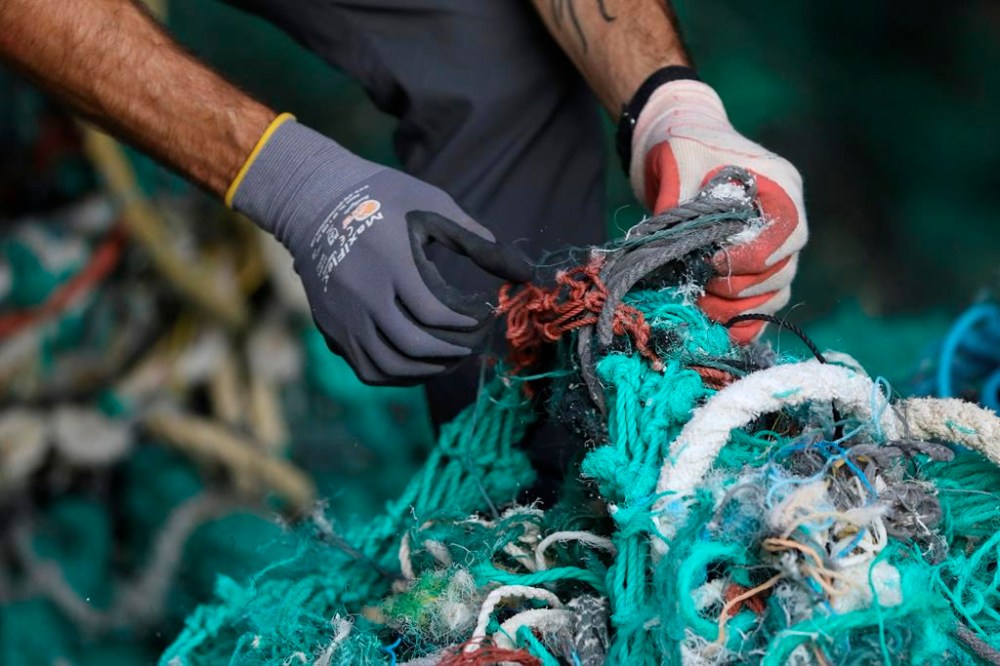
Drew McWhirter, a graduate student at Hawaii Pacific University's Center for Marine Debris Research, pulls apart a massive entanglement of ghost nets in Kaneohe, Hawaii, on Wednesday, May 12, 2021. THE CANADIAN PRESS/AP-Caleb Jones

“Forty-three years later, his hope and his prophecy is coming true,” Moore said in a recent interview about Lien. “It’s very special.”

Ropeless fishing technology is still in its infancy, but there are high hopes among scientists and fishers that it will result in fewer whales getting trapped in fishing ropes and help fishers. Efforts to deploy the new fishing methods are focused on the endangered North Atlantic right whale, of which there are only about 336 remaining in the world.

Moore authored a study in 2020 suggesting 85 per cent of right whale deaths between 2010 and 2015 were caused by entanglements with fishing gear. Scientists like Moore hope the widespread adoption of ropeless gear will curb those entanglements and allow the species to recover.

Last month, acoustic technology developed by Jasco Applied Sciences was outfitted on crab and lobster traps that were deployed off the coast of Harbour Breton, N.L., and just outside the St. John’s, N.L., harbour. The test run was launched through a partnership between Jasco, the Washington-based non-profit Sea Mammal Education Learning Technology Society, and the commercial fishing arm of the Miawpukek First Nation in Newfoundland.

Fishers can release the traps into the water and find them again through an acoustic signal, Jasco engineering manager John Moloney said in an interview Tuesday. The traps are equipped with inflatable bladders that fishers can trigger when it’s time to bring them up to the surface.
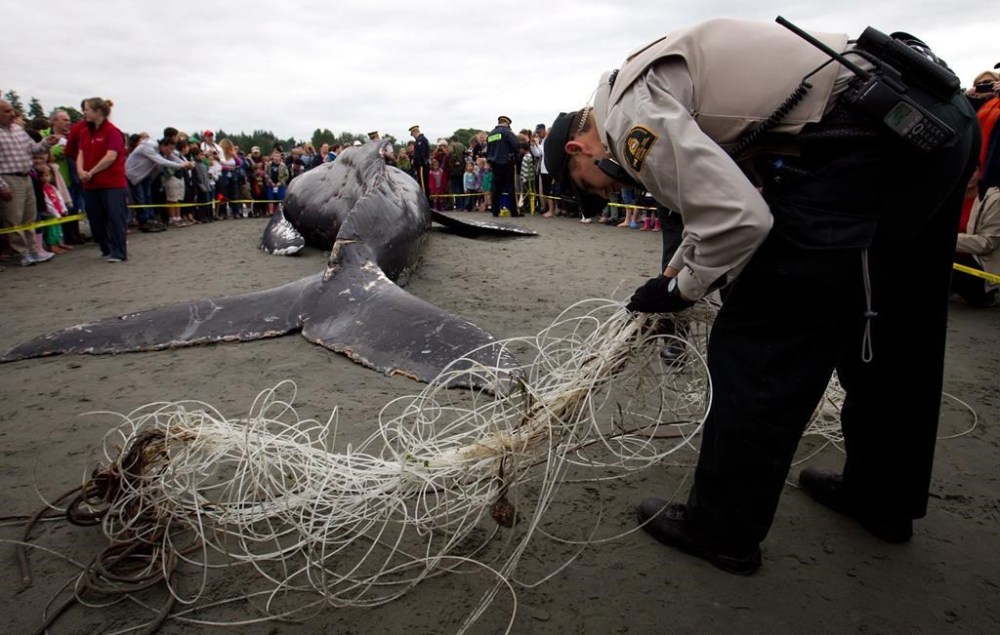
A Department of Fisheries and Oceans official checks a fishing net that was tangled around a beached humpback whale that died during low tide in White Rock, B.C., on Tuesday, June 12, 2012. THE CANADIAN PRESS/Darryl Dyck

Traditional traps are attached to buoys by long ropes that float vertically upward in the water, and passing whales can become ensnared in the lines. Without the long fishing ropes, there are fewer dangers lurking in the water.

Whales also become ensnared in what’s called “ghost gear” ⁠ — massive tangles of nets that have come loose and are left to drift endlessly through the water.

Ropeless traps will have a much higher recovery rate than traditional gear, Moloney said. And if a trap is lost, it won’t be attached to hazardous ropes, he added.

Jasco technology is also being tested in the United States, Moloney said. Some of those tests involve a group called the Ropeless Consortium, of which Moore is a part.

Both Moloney and Moore said they agreed that the cost of ropeless gear is currently a barrier to its widespread use, but Moloney said Jasco’s technology will make it more affordable. He also noted that ropeless traps will last for about 10 seasons, whereas traditional gear is often used for only one.

Drew McWhirter, a graduate student at Hawaii Pacific University's Center for Marine Debris Research, pulls apart a massive entanglement of ghost nets in Kaneohe, Hawaii, on Wednesday, May 12, 2021. THE CANADIAN PRESS/AP-Caleb Jones

There are also bureaucratic hurdles in front of the ropeless technology: the federal Fisheries Department has been supportive of its development but still has to figure out how to regulate it, Moloney said.

Still, he thinks the technology is well on its way.

“I do believe that 10 years from now, when you start talking about fishing with ropes, people will just look at you like you’re weird,” Moloney said. “It will replace rope fishing, for sure.”

This report by The Canadian Press was first published Aug. 2, 2022.

A Department of Fisheries and Oceans official checks a fishing net that was tangled around a beached humpback whale that died during low tide in White Rock, B.C., on Tuesday, June 12, 2012. THE CANADIAN PRESS/Darryl Dyck
Report Error Submit a Tip

More Stories

Woman died while getting wisdom teeth out; case raises questions about transparency of dental association

Nicole Buffie 5 minute read Preview

Woman died while getting wisdom teeth out; case raises questions about transparency of dental association

Nicole Buffie 5 minute read Friday, Sep. 4, 2026

The parents of a 23-year-old southwestern Manitoba woman who died after receiving a local anesthetic during a wisdom tooth extraction say they are in the dark about the investigation into their daughter’s death.

Dulaney and Victoria Blatz say the Manitoba Dental Association has been unwilling to give them information about the probe into their daughter’s death, saying the self-governing regulatory body must be more transparent with the public.

“We have pushed through various channels trying to get information, but it’s nothing but stalling and sidelining,” Victoria said Friday. “This has crashed our world to pieces and we just want answers.”

Virginia Blatz went to Boundary Trails Dental Centre in Morden on Nov. 27, 2024, to have her wisdom teeth removed, but never returned home.

Read
Friday, Sep. 4, 2026

Pointing fingers at Tories three years after election tiresome, accomplishes nothing

Tom Brodbeck 5 minute read Preview

Pointing fingers at Tories three years after election tiresome, accomplishes nothing

Tom Brodbeck 5 minute read 1:08 PM CDT

There is a point in every government’s life when blaming the previous government stops being an explanation and starts becoming an excuse.

For Manitoba’s NDP government, that point has arrived.

Justice Minister Matt Wiebe was asked last week about a grievance filed by Crown attorneys over excessive workloads and a government attempt to keep a report documenting those workloads out of an upcoming arbitration hearing.

Wiebe said he couldn’t discuss the arbitration case.

Read
1:08 PM CDT

Manitoba doctor denies working to revive Carberry ER in response to recruitment lawsuit

Erik Pindera 4 minute read Preview

Manitoba doctor denies working to revive Carberry ER in response to recruitment lawsuit

Erik Pindera 4 minute read Sunday, Sep. 6, 2026

A Manitoba doctor has denied he was working as a recruiter after an Ontario doctor accused him of misleading him about a position at the Carberry hospital.

Dr. Klevis Iliriani, who worked at the hospital in Carberry from May to August 2024, filed his statement of claim in Court of King’s Bench earlier this year.

Iliriani, who lives in an Ottawa suburb, has alleged recruiters negligently misrepresented the job at the Carberry hospital and breached the terms of his contract, which resulted in less pay than promised.

His court filing names defendants Dr. Dave Maharajh and Barry Banek as the recruiters.

Read
Sunday, Sep. 6, 2026

Dynacare labs quickly reach capacity ahead of strike

Nicole Buffie 5 minute read Preview

Dynacare labs quickly reach capacity ahead of strike

Nicole Buffie 5 minute read Saturday, Sep. 5, 2026

Patients were being turned away from several Dynacare locations Saturday morning as people packed the labs in hopes of getting their blood collection done before workers strike.

By 10:30 a.m. the lobby at the Dynacare at 1581 Regent Ave. was standing-room only and walk-up patients were being turned away as the wait time for those lucky enough to get in creeped past two hours.

One woman got in right before workers cut off walk-ins at 10 a.m. after travelling to two other locations.

“I was driving by at 7:15 this morning and there was already a line-up to the road, so I was like ‘nope, not going there’ so I went to the one on Sterling Lyon (Parkway) and it was closed, and then I went to the one at St. Vital Mall and there had a line zig-zagging all the way through the corridors so I gave up and came back,” said Joanna, who declined to give her last name.

Read
Saturday, Sep. 5, 2026

What’s open, what’s closed, what’s up in Winnipeg on Labour Day

Free Press staff 4 minute read Preview

What’s open, what’s closed, what’s up in Winnipeg on Labour Day

Free Press staff 4 minute read Friday, Sep. 4, 2026

Here's a roundup of hours of business for services and things to do on September 7.

Read
Friday, Sep. 4, 2026

U of M study shows female entrepreneurs have it tough on dating market

Jen Zoratti 6 minute read Preview

U of M study shows female entrepreneurs have it tough on dating market

Jen Zoratti 6 minute read Yesterday at 10:00 AM CDT

Xiumei Li had a friend who had been on the dating scene for a while.

He’d been seeing an impressive woman, a startup founder building a successful business. She was a good conversationalist. She was interesting.

She sounded great. So why didn’t it work out?

Some gentle prodding revealed he was intimidated by her, but also felt that “there was a gap between what he expected for a partner versus what this female entrepreneur had to offer,” Li says.

Read
Yesterday at 10:00 AM CDT