‘No smoking gun’: Calgary scientists studying Mars soil for signs it supported life
Advertisement
Read this article for free:
or
Already have an account? Log in here »
To continue reading, please subscribe:

Digital Subscription
One year of digital access for only $205*
- Enjoy unlimited reading on winnipegfreepress.com
- Read the E-Edition, our digital replica newspaper
- Access News Break, our award-winning app
- Play interactive puzzles
*First annual payment billed as $205.00 + GST for one year. This annual subscription will automatically renew at $233.00 + GST every 52 weeks (10% off the regular annual price of $259.35). Offer available to new and qualified returning subscribers only. Cancel any time.
To continue reading, please subscribe:
Add Free Press access to your Brandon Sun subscription for only an additional
$1 for the first 4 weeks*
- Enjoy unlimited reading on winnipegfreepress.com
- Read the E-Edition, our digital replica newspaper
- Access News Break, our award-winning app
- Play interactive puzzles
*Your next Brandon Sun subscription payment will increase by $1.00 and you will be charged $17.95 plus GST for four weeks. After four weeks, your payment will increase to $24.95 plus GST every four weeks.
Read unlimited articles for free today:
or
Already have an account? Log in here »
Hey there, time traveller!
This article was published 01/09/2022 (1468 days ago), so information in it may no longer be current.
CALGARY – A University of Calgary scientist is hoping to determine whether Mars was ever capable of supporting life.
Ben Tutolo, an associate professor in the Department of Geoscience and Faculty of Science, began his research earlier this year and is using data from the Curiosity rover that’s been exploring the Red Planet for the past decade.
The Canadian Space Agency, as part of the NASA-led Mars Science Laboratory mission, is funding the three-year study.
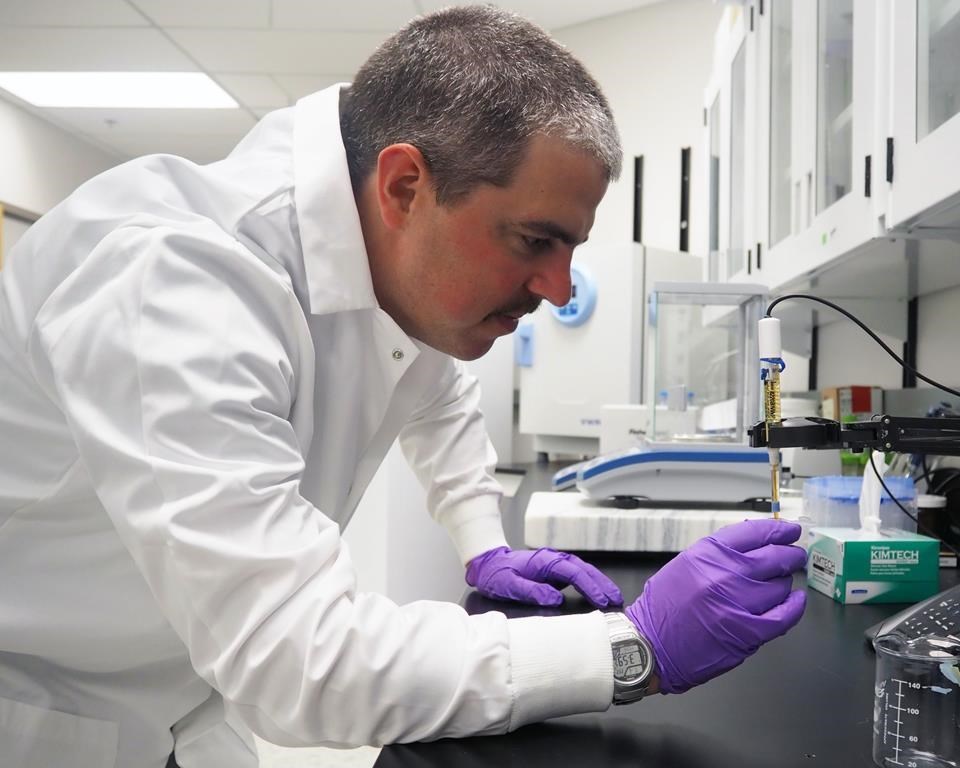
“The mission is to follow the water and understand — were ancient environments on other planets, like Mars, habitable?” said Tutolo, who is conducting the research alongside professor Steve Larter and associate professor Rachel Lauer.
“What we’re doing with the Curiosity rover is exploring the rock record there (to) understand if these rocks at that time were ultimately habitable.”
Tutolo said Curiosity has been providing a steady stream of data and has been collecting and analyzing samples as it slowly makes its way up Mount Sharp in the Gale Crater.
The rover, which had travelled almost 28 kilometres as of May 1, has multiple analyzers that can determine the chemistry and mineralogy of the rocks or soil surface on Mars. Its Canadian-made Alpha Particle X-ray Spectrometer has analyzed 1,211 samples and sent 2,659 results back to Earth.
“It’s scooping up, drilling samples … it can utilize in situ like a roving geologist who would also have a geochemical laboratory in the field,” Tutolo said.
The focus of the research is to study the geological transition from the oldest lake sediments where Curiosity began its exploration to younger layers of sediment farther up.
Tutolo said the geological evidence from the oldest rocks in the crater show they are from a river-fed lake that contained water.
The newer specimens have found magnesium sulphate salts, which were likely the result of the water evaporating as the planet became drier, he said.
“Obviously the transition has happened. There are no oceans or lakes on the planet today,” Tutolo said.
He said the team is also conducting field research at the Basque Lakes near Cache Creek, B.C., which contain the same sulphate minerals found on Mount Sharp on Mars.
However, Tutolo said the fact that the Mars crater is 3.5 billion years old means there might not be a definite answer to whether life did exist there.
“They have all been degraded in some ways. They’ve all been transformed by the geological processes working overtime in the crater so … there will be no smoking gun,” Tutolo said.
But he said if the rock record shows it was theoretically habitable, then it can still answer some questions.
“If it was habitable, then we could start putting together scenarios for how life could have originated in such an environment and if it did originate, how it could potentially thrive in such an environment,” he said.
“I think what we can do as objective scientists is read the story that is written in the rocks and understand and lay the foundation and paint the picture of whether it was possible.”
This report by The Canadian Press was first published Sept. 1, 2022.