On Colombia’s San Andres, a historic church’s roots run deep

Advertisement

Advertise with us

SAN ANDRES, Colombia (AP) — First Baptist Church was born by a tamarind tree perched on a hill overlooking the turquoise waters of the Caribbean.

Read this article for free:


By clicking the button above, an account will be created and you will begin to receive some of our recommended newsletters. You may opt out of any newsletter by visiting your Email and Communication Preferences page or by clicking "unsubscribe" at the bottom of any email.

or

Already have an account? Log in here »

To continue reading, please subscribe:

Digital Subscription

One year of digital access for only $1.44 a week*

  • Enjoy unlimited reading on winnipegfreepress.com
  • Read the E-Edition, our digital replica newspaper
  • Access News Break, our award-winning app
  • Play interactive puzzles

*Billed as $5.77 plus GST every four weeks. After 52 weeks, price increases to the regular rate of $19.95 plus GST every four weeks. Offer available to new and qualified returning subscribers only. Cancel any time.

To continue reading, please subscribe:

Add Free Press access to your Brandon Sun subscription for only an additional

$1 for the first 4 weeks*

  • Enjoy unlimited reading on winnipegfreepress.com
  • Read the E-Edition, our digital replica newspaper
  • Access News Break, our award-winning app
  • Play interactive puzzles
Start now

*Your next Brandon Sun subscription payment will increase by $1.00 and you will be charged $17.95 plus GST for four weeks. After four weeks, your payment will increase to $24.95 plus GST every four weeks.

Hey there, time traveller!
This article was published 04/09/2022 (1507 days ago), so information in it may no longer be current.

SAN ANDRES, Colombia (AP) — First Baptist Church was born by a tamarind tree perched on a hill overlooking the turquoise waters of the Caribbean.

Under the tree’s shade, First Baptist’s founder taught English-speaking former slaves and their descendants how to read using the Bible. The tree still stands more than 175 years later — even if crooked after surviving devastating hurricanes.

The church is so crucial to the history of the Colombian island of San Andres that detailed record of births and deaths are kept here in crumbling books that date back nearly two centuries.
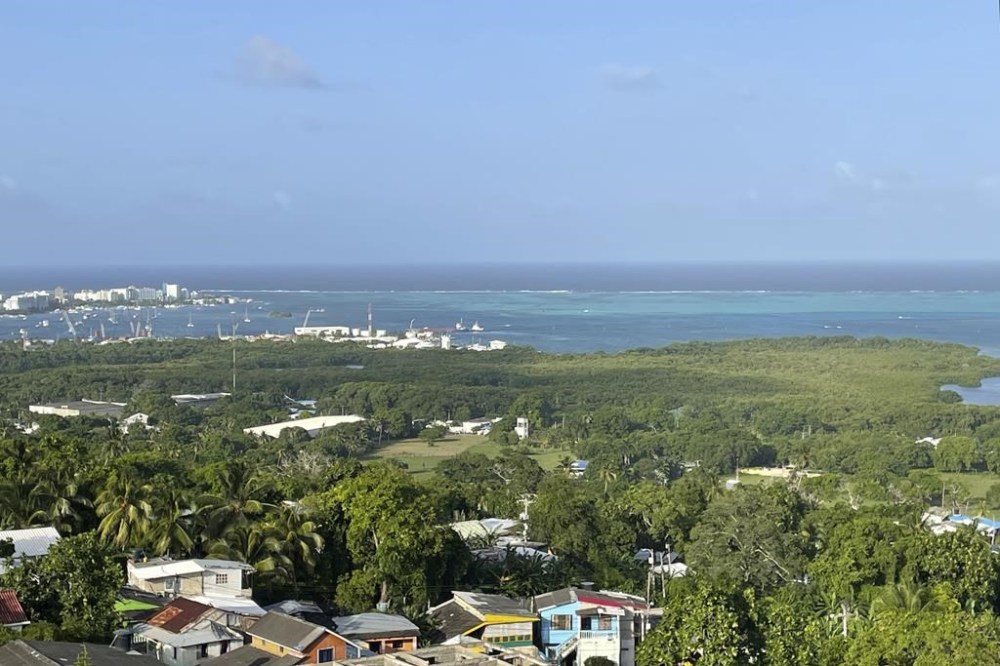
Colombia's San Andres Island is seen from a mirador on the steeple of First Baptist Church on Thursday, Aug. 18, 2022. Over a century after being claimed by Spain, San Andres was first settled in the 1630s by English Puritans. It later became an outpost for pirates and today is home to many descendants of Puritans and African slaves, and also large numbers of more recent arrivals from mainland Colombia. (AP Photo/Luis Andres Henao)

The “mother church,” as it is often called, is a source of pride for the Raizals, the English-speaking, mostly Protestant inhabitants of San Andres, Providencia and the smaller islands and keys that form an archipelago in the western Caribbean near Nicaragua, about 440 miles (710 kilometers) from the Colombian mainland.

“For a young person like me, it’s finding my roots — it’s good to know where we come from,” said the Rev. Shuanon Hudgson, 26, the church’s associate pastor.

“It’s like Marcus Garvey says,” quoting the Jamaica-born, early 20th-century Black nationalist: “‘A people without knowledge of their past history, origin and culture is like a tree without roots.’ And this church has been a pillar.”

Under the tree, a stone plaque commemorates the birth of the congregation: “Baptist work was established here by Rev. Phillip Beekman Livingston (Jr.) in 1844.”

Three years later the congregation began to meet nearby under a thatched hut.

It kept growing, and a building made in the style of the large Anglican churches of Jamaica was ordered. First built in the late 19th century in Mobile, Alabama, and then moved to New York City, the white-walled church was disassembled and shipped to the island piece by piece.

Parishioners carried the foundations on their backs from the port to one of the highest points on the island, a neighborhood known as the Hill, said Lastenia Herrera May, the wife of the current lead pastor, the Rev. Ronald Hooker, and the church was dedicated on Feb. 2, 1896.

A scenic overlook more than 100 feet up in the steeple offers some of the best views of San Andres.

Over a century after being claimed by Spain, the island was first settled in the 1630s by English Puritans. It later became an outpost for pirates and today is home to many descendants of Puritans and African slaves, and also large numbers of more recent arrivals from mainland Colombia.

Sharika Crawford, a professor of history at the United States Naval Academy in Annapolis, Maryland, whose research focuses on Colombia and its African-descended peoples, said First Baptist “was the bedrock of the Raizal community” and “the most important social institution” in the archipelago.

From its founding until 1913, she said, its pastors held great authority over the community in shaping islanders’ values and behavior.

“Before the church was formed, the island population lived without a church or religious establishment. Efforts to bring a Catholic priest never materialized,” Crawford said. “Thus, First Baptist Church and its satellite churches across San Andres and Providencia Islands had the advantage over other Christian communities such as the Catholics and Seventh-day Adventists.”
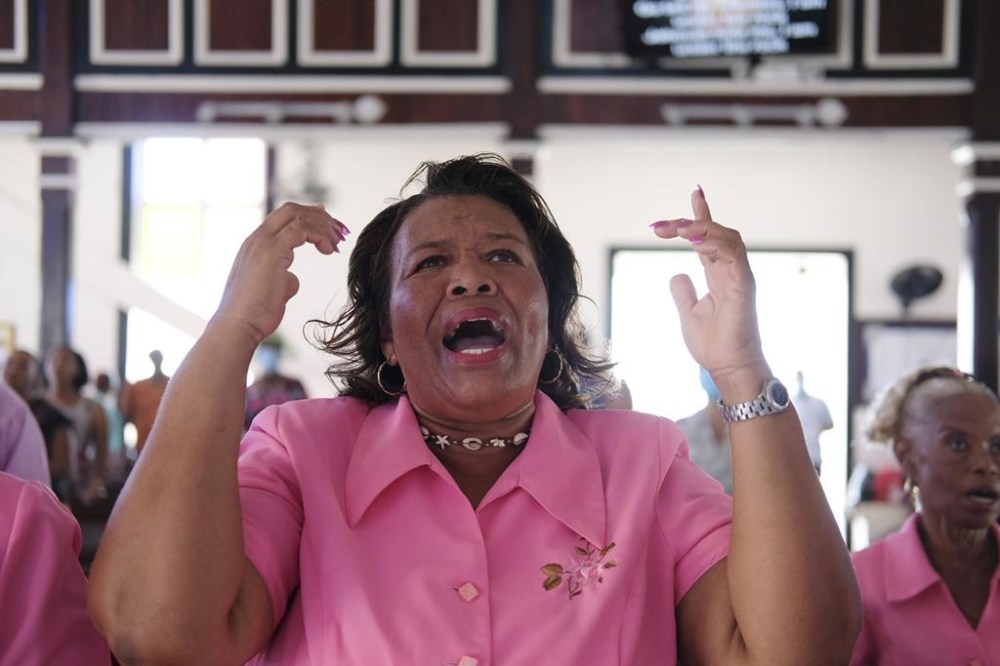
A choir member sings hymns at First Baptist Church on Colombia's San Andres island on Sunday, Aug. 21, 2022. The church is a source of pride for the Raizals, the English-speaking, mostly Protestant inhabitants of San Andres and smaller islands that form an archipelago in the western Caribbean. (AP Photo/Luis Andres Henao)

“The church had glorious moments,” Herrera May said. “By the 1900s, thousands had converted.”

Livingston, the founder, first evangelized among enslaved and freed people of San Andres, Crawford said, and the church remains a symbol of the anti-slavery struggle. Each year people from congregations across the islands gather here Aug. 1 to celebrate events commemorating emancipation.

During a recent Sunday service, Lucia Barker, 83, and other women in the choir, clothed in bright pink shirts, sang hymns. Parishioners in wooden pews, illuminated by sunlight from stained-glass windows, swayed, lifted their arms and sang along to songs infused with Calypso beats.

“This church is my life,” Barker said of the sanctuary where she was baptized, married and has worshipped for more than seven decades.

In his homily, Hudgson, the associate pastor, asked congregants to remember the sacrifice of their enslaved ancestors. He called on them to be resilient against adversity, just as the tree and the church, and listed by name and year the many hurricanes that both survived.

“Here we get the knowledge about our land, our history, how we started by this tamarind tree, how we have a church,” choir member Marjeen Martínez said. “It’s very important to maintain our roots alive.”

___

Associated Press religion coverage receives support through the AP’s collaboration with The Conversation US, with funding from Lilly Endowment Inc. The AP is solely responsible for this content.

Report Error Submit a Tip

The Free Press acknowledges the financial support it receives from members of the city’s faith community, which makes our coverage of religion possible.

More Stories

Salvation Army calls on Winnipeggers to donate merchandise as sales soar

Kelly-Anne Riess 4 minute read Preview

Salvation Army calls on Winnipeggers to donate merchandise as sales soar

Kelly-Anne Riess 4 minute read Yesterday at 2:01 AM CDT

The Salvation Army is taking donated merchandise from other regions to stock its Winnipeg thrift stores as increasing sales outpace local donations.

Retail activity at the charity’s eight Winnipeg locations grew more than 10 per cent year over year during several months, from January through April, and again in June.

Although local donations remain strong, they haven’t kept pace with demand, prompting the organization to supplement inventory with merchandise from elsewhere.

Ted Troughton, managing director of the Salvation Army’s thrift store operations, said rising living costs are bringing in new customers.

Read
Yesterday at 2:01 AM CDT

Reviving democracy requires engagement

John R. Wiens 5 minute read 2:00 AM CDT

Democracy is on the ropes everywhere in the world as politics have become extreme, divisive, virulent — just plain toxic.

It would seem like a reasonable, visceral decision not to participate, to not be contaminated or compromised by association. However, like education, where more education is the cure to a lack, a deficit in democratic politics calls for more, not less, political engagement.

In his 1919 poem The Second Coming, W. B. Yeats wrote, “Things fall apart; the centre cannot hold;” as a description of social and political catastrophe and the failure of usual safeguards in the aftermath of the First World War. He ends the first stanza with: “The best lack all conviction, while the worst / Are full of passionate intensity.”

I believe it’s an apt description of what’s going on today — not new but frightening, nonetheless.

Tire store theft sting nets four arrests

Free Press staff 2 minute read Preview

Tire store theft sting nets four arrests

Free Press staff 2 minute read Yesterday at 2:46 PM CDT

Four people have been arrested after the Winnipeg Police Major Crimes Unit launched an investigation into several break-ins and thefts targeting tire retailers in the city.

Between Sept. 12 and 29, police responded to multiple commercial break-ins resulting in estimated losses of between $50,000 and $60,000, police said in a news release.

During that time, retail stores in the 1600 block of Kenaston Boulevard and the 800 block of Leila Avenue also reported theft of merchandise valued at approximately $3,250 combined.

On the evening of Sept. 26, one of the suspects used false identification to rent a truck from a commercial rental company.

Read
Yesterday at 2:46 PM CDT

Today’s horoscope

Georgia Nicols 4 minute read Preview

Today’s horoscope

Georgia Nicols 4 minute read 2:00 AM CDT

MOON ALERT: There are no restrictions to shopping or important decisions today. The moon is in Aquarius.

ARIES (March 21-April 19)

This can be a lovely, friendly and romantic day if you can avoid intense discussions about shared property, inheritances and anything jointly held. Focus on what works. Avoid people who are intent on getting their way – not yours.

TAURUS (April 20-May 20)

Read
2:00 AM CDT

Consumer apprehension grows as US retailers adopt AI-assisted pricing tools

Dee-ann Durbin And Anne D'innocenzio, The Associated Press 7 minute read Preview

Consumer apprehension grows as US retailers adopt AI-assisted pricing tools

Dee-ann Durbin And Anne D'innocenzio, The Associated Press 7 minute read Updated: Yesterday at 6:00 PM CDT

U.S. consumers aren't just frustrated with high prices. They're angry and confused about the increasingly high-tech ways that restaurant chains and major retailers are setting those prices.

Digital price tags are rapidly replacing paper ones in grocery aisles. Artificial intelligence tools help businesses decide what to charge by predicting how customers might respond. Terms like “dynamic pricing” and “surveillance pricing” are stirring anxiety on social media, where users wonder if different people are getting different prices for the same product.

Americans have grown accustomed to changing prices when booking flights, hotel rooms and rides, but the prospect of everyday spending shaped by algorithms they don’t understand and personal data they may not realize they’re sharing has touched a nerve.

“There are major tensions happening right now between who’s really going to have the power with some of these algorithms and usage of bots and AI: the companies or the shopper,” said Katie Thomas, who leads an internal consumer behavior think tank at the management consulting firm Kearney.

Read
Updated: Yesterday at 6:00 PM CDT

Winnipeg: Home of IG’s past and future

Damon Murchison 4 minute read Preview

Winnipeg: Home of IG’s past and future

Damon Murchison 4 minute read Yesterday at 2:00 AM CDT

Shortly after IG Wealth Management was established in Canada, our founders chose Winnipeg as the home of our young, ambitious company.

Read
Yesterday at 2:00 AM CDT