FDA moves to ease rules for blood donations from gay men

Advertisement

Advertise with us

WASHINGTON (AP) — The U.S. is moving to further ease restrictions on blood donations from gay and bisexual men and other groups that typically face higher risks of HIV.

Read this article for free:


or

Already have an account? Log in here »

To continue reading, please subscribe:

Subscribe and receive a limited-edition Free Press branded hat or tote.

Digital Subscription

One year of digital access for only $205*

  • Enjoy unlimited reading on winnipegfreepress.com
  • Read the E-Edition, our digital replica newspaper
  • Access News Break, our award-winning app
  • Play interactive puzzles

*First annual payment billed as $205.00 + GST for one year. This annual subscription will automatically renew at $233.00 + GST every 52 weeks (10% off the regular annual price of $259.35). Offer available to new and qualified returning subscribers only. Cancel any time.

To continue reading, please subscribe:

Add Free Press access to your Brandon Sun subscription for only an additional

$1 for the first 4 weeks*

  • Enjoy unlimited reading on winnipegfreepress.com
  • Read the E-Edition, our digital replica newspaper
  • Access News Break, our award-winning app
  • Play interactive puzzles
Start now

*Your next Brandon Sun subscription payment will increase by $1.00 and you will be charged $17.95 plus GST for four weeks. After four weeks, your payment will increase to $24.95 plus GST every four weeks.

Hey there, time traveller!
This article was published 27/01/2023 (1304 days ago), so information in it may no longer be current.

WASHINGTON (AP) — The U.S. is moving to further ease restrictions on blood donations from gay and bisexual men and other groups that typically face higher risks of HIV.

The Food and Drug Administration on Friday announced draft guidelines that would do away with the current three-month abstinence requirement for donations from men who have sex with men. Instead, all potential donors would be screened with a new questionnaire that evaluates their individual risks for HIV based on sexual behavior, recent partners and other factors.

If finalized, many gay and bisexual men in monogamous relationships would be able to donate blood for the first time in decades. It’s the latest move by the FDA to broaden donor eligibility, with the potential to boost donations.
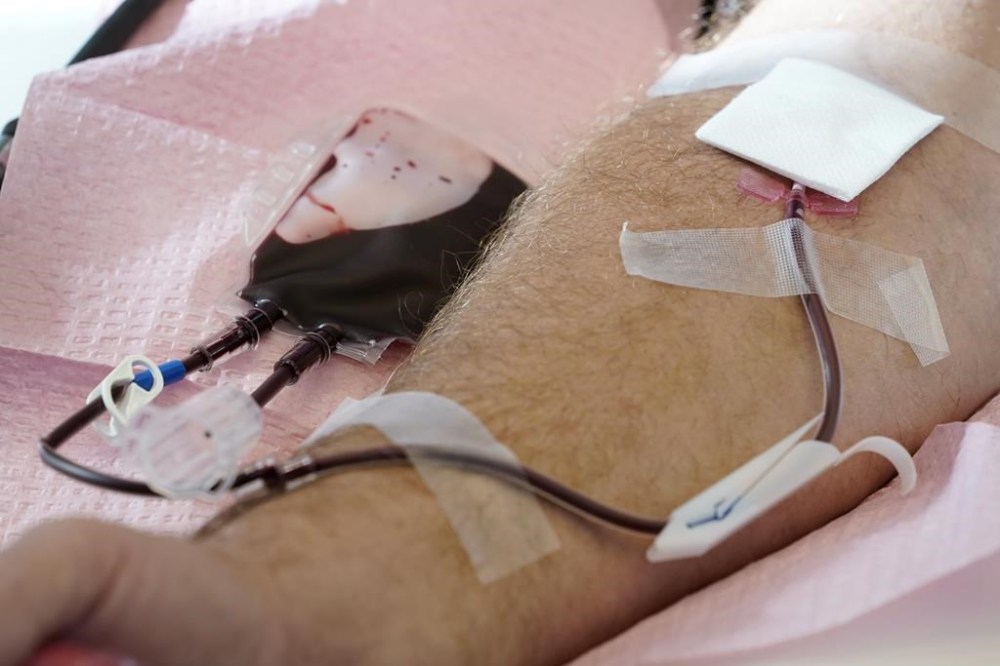
FILE - Tubes direct blood from a donor into a bag in Davenport, Iowa, on Friday, Nov. 11, 2022. The U.S. is moving to ease restrictions on blood donations from gay and bisexual men and other groups that traditionally face higher risks of HIV. The Food and Drug Administration on Friday, Jan. 27, 2023, announced draft guidelines that would do away with the current three-month abstinence requirement for donations from men who have sex with men. (AP Photo/Charlie Neibergall, File)

“We feel confident that the safety of the blood supply will be maintained,” FDA’s Dr. Peter Marks told reporters.

Gay rights groups have long opposed blanket restrictions on who can give blood, saying they discriminate against the LGBTQ community. Medical societies including the American Medical Association have also said such exclusions are unnecessary given advances in technology to test blood for infectious diseases.

“Current and former blood donation policies made unfounded assumptions about gay and bisexual men and really entangled individuals’ identity with their likelihood of having HIV,” said Sarah Warbelow of the Human Rights Campaign, an LGBTQ advocacy group.

The U.S. and many other countries started blocking blood donations from gay and bisexual men during the early 1980’s AIDS epidemic, aiming to prevent the spread of HIV through the blood supply.

In 2015, the FDA dropped the lifetime ban and replaced it with a one-year abstinence requirement. Then in 2020, the agency shortened the abstinence period to three months, after donations plummeted during the COVID-19 pandemic.

Regulators said there has been no negative impact on the blood supply as a results of those changes.

The FDA sets requirements and procedures for blood banks throughout the U.S. All potential donors answer questions about their sexual history, injectable drug use and any recent tattoos or piercing, among other factors that can contribute to the spread of blood-borne infections. Donated blood is then tested for HIV, hepatitis C, syphilis and other infectious diseases.

Under the new proposal, men who have sex with men will be asked if they have had new or multiple partners in the last three months. Those who answer affirmatively to either question and also report having anal sex would be barred from donating until a later date. The policy would also apply to women who have sex with gay or bisexual men.

Anyone who has ever tested positive for HIV would continue to be ineligible to donate blood. Those taking pills to prevent HIV through sexual contact would also still be barred, until three months after their last dose. The FDA noted that the medication, known as PrEP, can delay the detection of the virus in screening tests.

Marks said the agency is willing to consider further easing restrictions “but we have to have the science to do that.”

FDA regulators will take public comments on the proposal for 60 days before beginning to finalize the guidelines.

The proposed policy mirrors those used in Canada and the U.K.

LGBTQ groups welcomed the FDA’s announcement but said the proposal should not exclude people using PrEP medications.

“We must be conscious to not further stigmatize these safe sex practices and uplift individuals taking precautions,” said Jose Abrigo of Lambda Legal, which has long pushed to change the FDA policy.

The FDA based its latest proposal, in part, on a recent study of 1,600 gay and bisexual men. The FDA-funded research compared the effectiveness of a detailed, personalized questionnaire on sexual behavior to the current time-based abstinence rules.

It will take several months for blood banks to make the changes, according to Cliff Numark, an executive with Vitalant, a blood center that participated in the study. The changes will require new questionnaires, training for staff and updating computer software.

The Red Cross said it supports the FDA changes but added that it’s too early to know if they will result in more blood donations.

Lukas Pietrzak of Washington D.C., said he eagerly volunteered for the FDA study. He credits emergency blood transfusions with saving his father’s life after a cycling accident in 1991.

Pietrzak donated blood in high school but became ineligible after becoming sexually active as a gay man.

“Until I fully came out to my friends, I had to skirt around why I never went to blood drives with them,” says Pietrzak, 26, who now works for the federal government.

When there are calls for blood donations “now we’re able to be part of that,” Pietrzak said.

___

The Associated Press Health and Science Department receives support from the Howard Hughes Medical Institute’s Science and Educational Media Group. The AP is solely responsible for all content.

Report Error Submit a Tip

More Stories

Canada vows dollar-for-dollar tariff retaliation, suspends trade talks with U.S.

Catherine Morrison, The Canadian Press 7 minute read Preview

Canada vows dollar-for-dollar tariff retaliation, suspends trade talks with U.S.

Catherine Morrison, The Canadian Press 7 minute read Updated: Yesterday at 8:27 AM CDT

OTTAWA - A last-ditch effort to reach a new trade deal before a midnight tariff deadline failed Friday, as Prime Minister Mark Carney suspended talks with the United States and summoned his negotiators back to Ottawa.

The decision meant new 50 per cent tariffs on billions of dollars in Canadian exports to the U.S. took effect at 12:01 a.m., and Carney vowed Canada would retaliate with equal measures of its own.

"In recent weeks, we made important progress toward improving Canada's position as having the best deal in the world with the U.S.," Carney said in a statement just before Trump's tariff deadline.

"However, that progress has not been enough to meet our objectives for Canadians."

Read
Updated: Yesterday at 8:27 AM CDT

Today’s horoscope

Georgia Nicols 4 minute read Preview

Today’s horoscope

Georgia Nicols 4 minute read 2:00 AM CDT

Moon Alert: Until 11 p.m. PDT tonight there are no restrictions to shopping or important decisions today. The Moon is in Capricorn.

Aries (March 21-April 19)

Steer clear of confrontation with authority figures this morning. Instead, get yourself ready for a productive four weeks ahead because you intend to work and get better organized. Oh yeah – you’re going to pull your act together so you can take it on the road.

Taurus (April 20-May 20)

Read
2:00 AM CDT

Provincial teacher watchdog releases names, details in three disciplinary matters

Maggie Macintosh 6 minute read Preview

Provincial teacher watchdog releases names, details in three disciplinary matters

Maggie Macintosh 6 minute read Friday, Aug. 21, 2026

An Interlake teacher with a history of “intimidating” outbursts has been ordered to participate in counselling and study anger-management strategies after he made a child cry.

Read
Friday, Aug. 21, 2026

Roadside giants towering symbols of Canada’s quirkiness

Jen Zoratti 4 minute read Preview

Roadside giants towering symbols of Canada’s quirkiness

Jen Zoratti 4 minute read Yesterday at 2:01 AM CDT

Could you imagine a Canada without Mr. PG repping Prince George, B.C.? Or the Big Nickel in Sudbury? Or, my personal favourite, Happy Rock in Gladstone?

Earlier this summer, CBC’s Cost of Living looked at the economics of these giant roadside attractions — of which there are more than 1,500 in Canada — and the cost of keeping them.

Some are falling into disrepair — this is why public art funding is necessary, by the way, not just for construction, but maintenance — and some towns are weighing whether or not that money is better spent elsewhere.

The main character of the story: Tyra the Tyrannosaurus, the rather literal symbol of Drumheller, Alta., a.k.a. the Dinosaur Capital of the World since 2000, who could be facing extinction after the lease agreement between the town and the Drumheller and District Chamber of Commerce ends in 2029.

Read
Yesterday at 2:01 AM CDT

Plenty of alternatives to U.S. wines on the shelves

Ben Sigurdson 5 minute read Preview

Plenty of alternatives to U.S. wines on the shelves

Ben Sigurdson 5 minute read Yesterday at 6:00 AM CDT

In February 2025, Manitoba (and most other provinces) pulled American liquor from store shelves as part of the ongoing trade dispute with the United States.

Then in December, the province followed a similar course to others and put American booze that was already on hand back on shelves, selling off inventory that had been wasting away in warehouses for months, and directing proceeds from those sales to charities.

Lineups sprung up at numerous stores as consumers snapped up bestselling American products — think Maker’s Mark, Jack Daniel’s, Apothic Red and the like. After that initial rush, what was left has been languishing on shelves ever since, with many products eventually being drastically discounted for a quick sale, lest they become too long in the tooth.

I decided early on not to write about/review U.S. products in this space until things were well and truly sorted. But a few months back, I found myself in the mood for a big, oaky red wine and — in a moment of weakness, or nostalgia, or maybe just curiosity — I picked up a $30-ish California Cabernet Sauvignon.

Read
Yesterday at 6:00 AM CDT

Wooed by wood, Cedarella founder takes pride in handcrafted designs

David Sanderson 7 minute read Preview

Wooed by wood, Cedarella founder takes pride in handcrafted designs

David Sanderson 7 minute read Yesterday at 6:00 AM CDT

Marina Bulan is the founder of Cedarella, a two-year-old venture that turns out eye-catching wood products such as jewelry, kitchen decor, children’s toys and, most recently, metre-high outdoor planters that double as home street-number indicators.

Ahead of immigrating to Winnipeg a decade ago from their native Russia, Bulan and her partner thought it would be prudent to conduct some research on their soon-to-be new home, a city they knew next to nothing about.

Imagine their surprise as they were viewing the 2007 surrealist film My Winnipeg, which comically blends historical facts about our burg with what Winnipeg-born writer/director Guy Maddin has termed “mystical hypothesizing.”

(For instance, there is no proof that, as reported in the award-winning flick, Winnipeg is the sleepwalking capital of the world, and that residents keep keys to their former abodes on their person in the event they turn up there during a bout of somnambulism.)

Read
Yesterday at 6:00 AM CDT