Hope and worry: finally in queue for lung transplant

Advertisement

Advertise with us

‘A race against time.”

Read this article for free:


or

Already have an account? Log in here »

To continue reading, please subscribe:

Subscribe and receive a limited-edition Free Press branded hat or tote.

Digital Subscription

One year of digital access for only $205*

  • Enjoy unlimited reading on winnipegfreepress.com
  • Read the E-Edition, our digital replica newspaper
  • Access News Break, our award-winning app
  • Play interactive puzzles

*First annual payment billed as $205.00 + GST for one year. This annual subscription will automatically renew at $233.00 + GST every 52 weeks (10% off the regular annual price of $259.35). Offer available to new and qualified returning subscribers only. Cancel any time.

To continue reading, please subscribe:

Add Free Press access to your Brandon Sun subscription for only an additional

$1 for the first 4 weeks*

  • Enjoy unlimited reading on winnipegfreepress.com
  • Read the E-Edition, our digital replica newspaper
  • Access News Break, our award-winning app
  • Play interactive puzzles
Start now

*Your next Brandon Sun subscription payment will increase by $1.00 and you will be charged $17.95 plus GST for four weeks. After four weeks, your payment will increase to $24.95 plus GST every four weeks.

Hey there, time traveller!
This article was published 04/02/2023 (1292 days ago), so information in it may no longer be current.

‘A race against time.”

That’s how Rick Schmidt feels now that he has officially been put on the list for a lung transplant through the Manitoba Lung Transplant Program.

“It’s now a race to see if my health can hold out long enough to get the transplant,” he said.
JOHN WOODS / WINNIPEG FREE PRESS
                                Rick Schmidt is now in the second-last stage of his transplant journey as he waits for a donor lung to become available.

JOHN WOODS / WINNIPEG FREE PRESS

Rick Schmidt is now in the second-last stage of his transplant journey as he waits for a donor lung to become available.

Schmidt, 67, was diagnosed with idiopathic pulmonary fibrosis (IPF) in 2018, a type of lung disease where scar tissue forms in the lungs and leads to difficulty breathing. Drugs can slow its progress, but there is no cure. The only hope is a transplant.

After a series of tests in June, last year, the retired mediator and conflict-resolution instructor was told he qualified for a transplant. But he wasn’t put on the list to get one — he was still too healthy, compared to others who needed the life-saving surgery.

“They said I was doing too well,” said Schmidt, recalling that conversation. “It was disappointing, but a bit of a backhanded compliment at the same time.”

Although not sick enough to get on the list, he was doing poorly enough to need supplemental oxygen for things like cutting the grass, vacuuming or a walk.

He had another series of lung function tests in November. “I did disappointingly well,” he said of again failing to be sick enough to make the list.

But by early December, his health began to rapidly decline. “I started to need oxygen all the time, not just for exertion,” he said.

After contacting the Manitoba lung-transplant team to explain his new situation, they agreed it was time. After waiting a few weeks to get some dental surgery done and a minor infection cleared up, on Jan. 17 he got the news he was on the list for a transplant.

While Part 1 of his waiting is over, “Now comes Part 2, this time waiting for a donor lung to become available,” Schmidt said, noting it could happen in six months, a year — or tomorrow.

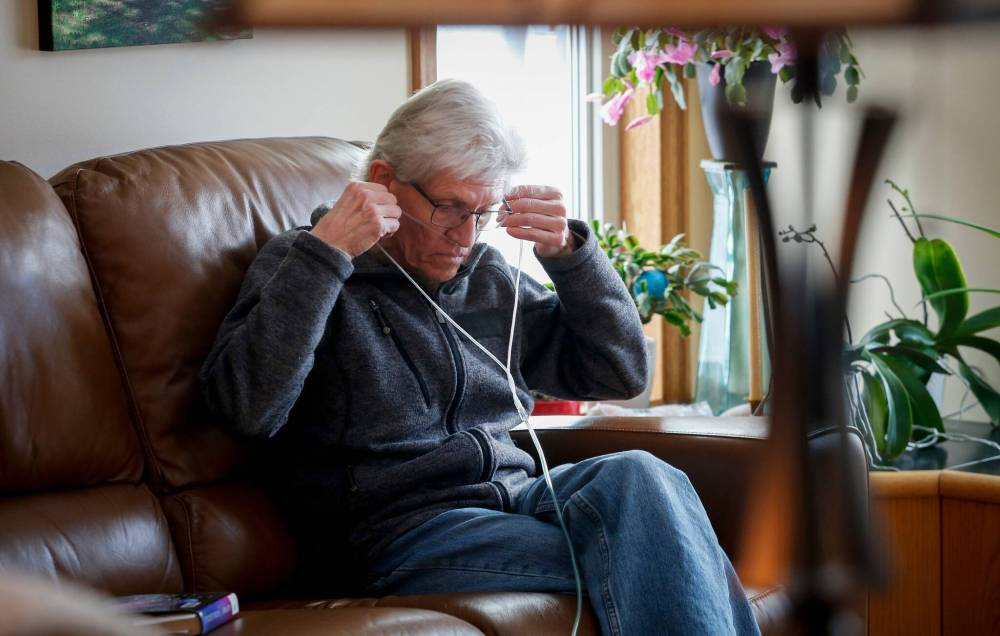
It will be a challenge. “It feels like my life has shrunk to the size of a shoe box,” he said, adding, “I have a limited amount of energy for each day. Each morning I have to decide what one thing I can do that day.”

To keep him safe from getting a cold, infection or — worst-case scenario — COVID-19, Schmidt and his wife, Sara Jane, have established a rigid set of protocols to limit their interactions with the outside world.

“COVID is a real showstopper,” said Schmidt.
JOHN WOODS / WINNIPEG FREE PRESS
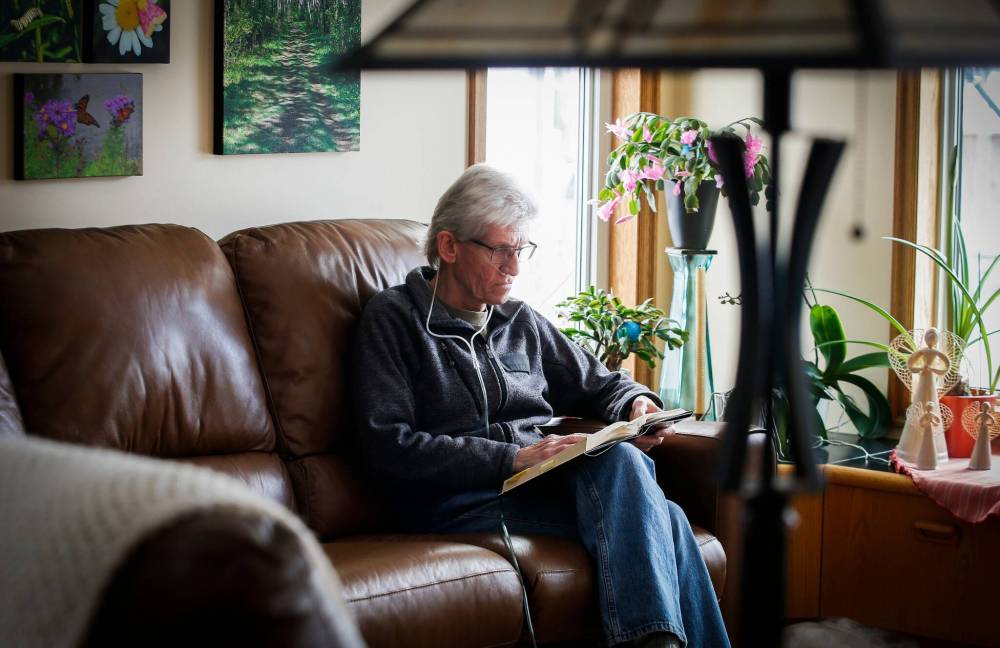
                                After a rapid decline in his health, Rick Schmidt was added to the list for a lung transplant in December.

JOHN WOODS / WINNIPEG FREE PRESS

After a rapid decline in his health, Rick Schmidt was added to the list for a lung transplant in December.

When the call comes, they will immediately head to the airport where an air ambulance will take them to Edmonton for the transplant surgery.

“We’ve got drivers all lined up and a list for the things we need to prepare and do,” Sara Jane said, adding they expect he will be in hospital there for three to four weeks.

Nancy Porhownik directs the Manitoba Lung Transplant Program. For her, working with people like Schmidt is a blessing — but also hard.

“We get to know these people really well,” she said, noting her job description includes offering emotional, psychological and spiritual support to patients as they await a call.

“We keep checking in on them, monitoring their health status, offering encouragement,” she said.

While feeling blessed to walk with patients, Porhownik also finds it hard because it can take so long for lungs to become available — patients worry they won’t be able to make it before the disease renders them too frail for the surgery.

“We try to keep them motivated and hopeful, but also realistic,” she said. “That’s a tight line to walk.”

One reason for the long wait time is the shortage of lungs for transplantation, partly because not enough Canadians sign up to be organ donors.

But lungs are also easily damaged in something like a car accident, owing to chest trauma. And there is also the matter of finding the right match for size and blood type for recipients.

For Porhownik, that means helping people like Schmidt, and the 12 other Manitobans currently on the lung transplant list, keep their spirits up while they wait.
JOHN WOODS / WINNIPEG FREE PRESS
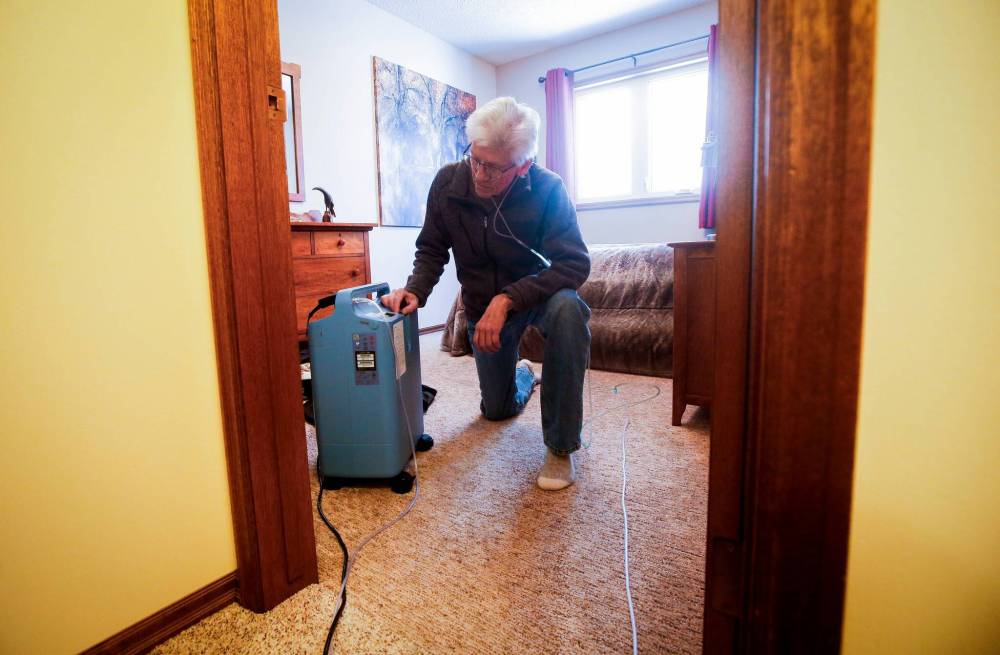
                                Rick Schmidt adjusts his oxygen machine at his home: ‘It feels like my life has shrunk to the size of a shoe box.’

JOHN WOODS / WINNIPEG FREE PRESS

Rick Schmidt adjusts his oxygen machine at his home: ‘It feels like my life has shrunk to the size of a shoe box.’

“We keep checking in with them, telling them to keep moving, to keep themselves as healthy as they can,” she said. “We know they are looking to us for support and encouragement.”

As for Schmidt, he appreciates the support he gets from Porhownik and the entire lung-transplant team.

“I’m thankful for them, for friends and for the support we are receiving in what now feels like a very small life,” he said.

That includes the care and friendship the couple receives from their home faith community, River East Church.

“Many people have offered to help in any practical way they can or make themselves available for the kind of support we need,” he said. “We know that we can count on them. We are not alone. That makes our journey through this difficult, uncharted territory easier to bear.”

To become an organ donor, visit www.signupforlife.ca.

jdl562009@gmail.com

John Longhurst

John Longhurst
Faith columnist & reporter

John Longhurst has been writing for Winnipeg's faith pages since 2003. He also writes for Religion News Service in the U.S., and blogs about the media, marketing and communications at Making the News.

Our newsroom depends on a growing audience of readers to power our journalism. If you are not a paid reader, please consider becoming a subscriber.

Our newsroom depends on its audience of readers to power our journalism. Thank you for your support.

Report Error Submit a Tip

More Stories

Ignore gossip, be good till girlfriend’s back

Maureen Scurfield 5 minute read Yesterday at 2:00 AM CDT

DEAR MISS LONELYHEARTS: I am lonely to the bone. My girlfriend has been away working for the summer, and I promised I wouldn’t cheat on her. But now I have heard through the grapevine she’s seeing a guy who works at her kids’ camp.

I think the source can be trusted, because she’s a friend who cares about me, almost like a sister. Actually I think she kind of wants me herself, but never seems to cross that line. Should I believe her “inside information” when she might be wanting to go out with me herself?

My girlfriend won’t be back until the very end of August and the messages and phone calls back and forth have been less and less frequent. Maybe she’s just busy or getting rested up to see me — or maybe she’s seeing someone else. I’m feeling jealous and I hate it! Maybe I should see somebody else too. Please advise ASAP.

— Lonely and Suspicious, Transcona

The common abuse of ‘common sense’

Alex Passey 5 minute read 2:00 AM CDT

If you spend any amount of time having deep conversations on sensitive subject matters, you will undoubtedly encounter patterns of thought and speech peppered into the discourse as if certain people were helpless but to utter them.

Perhaps you are trying to get to the heart of a complicated matter and the disagreement with your conversational partner starts to get a little heated. Often somebody will dust off the old diplomatic gem of “let’s agree to disagree” to extinguish further argument.

Or perhaps you are trying to console a grief-stricken person who has gone through a traumatic event. People in such a state will often rail against the state of the universe with powerful philosophical sentiments, demanding to know how such injustice could be permitted. You would not be the first person to misguidedly try to soothe them with something like “everything happens for a reason.” Or, less secularly, “God works in mysterious ways.”

These are known as thought-terminating clichés. Pithy little sayings that sound like folksy wisdom but serve mostly to sever a train of thinking, often because it is either uncomfortable or more complicated than the person is willing to engage. Admittedly, they often come from a good-natured place of keeping the peace, though it could easily be argued that they mostly serve to preserve to comfort or indulge the intellectual laziness of those who speak them.

Fundraising rappel from top of downtown tower with persuasive granddaughter leaves 72-year-old exhilarated

Zoe Pierce 4 minute read Preview

Fundraising rappel from top of downtown tower with persuasive granddaughter leaves 72-year-old exhilarated

Zoe Pierce 4 minute read Yesterday at 1:58 PM CDT

It’s safe to say that most people don’t spend Tuesday mornings rappelling 83 metres down the side of a downtown building.

With their 72-year-old grandmother.

But that’s exactly how 23-year-old Morgan Parker started her Tuesday.

Parker and her grandmother Christine Jameus were among 50 Manitobans who took part in Easter Seals’ Drop Zone, raising money for Manitoba Possible, a non-profit organization working to eliminate barriers to full and equal participation for people with disabilities.

Read
Yesterday at 1:58 PM CDT

Carney touts ‘substantial progress’ after Trump delays tariffs for three days

Kelly Geraldine Malone, The Canadian Press 5 minute read Preview

Carney touts ‘substantial progress’ after Trump delays tariffs for three days

Kelly Geraldine Malone, The Canadian Press 5 minute read Updated: 6:27 AM CDT

WASHINGTON - U.S. President Donald Trump announced late Tuesday a last-minute deal to delay new tariffs from slamming an array of Canadian products for three days.

Prime Minister Mark Carney said in response there’s still important work to do.

"Over the last number of weeks, Canada has engaged in intensive discussions with the United States to address outstanding trade issues and deliver greater certainty and real benefits for Canadian businesses, workers, farmers and families," Carney said in a statement.

He said "substantial progress" has been made and Canada is focused on "building a stronger, more independent and more competitive economy at home."

Read
Updated: 6:27 AM CDT

Paralyzed foster girl has system under a microscope

Chris Kitching 6 minute read Preview

Paralyzed foster girl has system under a microscope

Chris Kitching 6 minute read Yesterday at 2:00 AM CDT

An internal investigation by Manitoba’s Families Department is nearly complete in the case of a six-year-old girl who is paralyzed after being assaulted by her foster mother in Winnipeg.

The review by child-welfare officials is intended to prevent similar incidents, but it’s unlikely the public will learn the findings or recommendations.

“We’re working closely with the (child and family services) authority to make sure that every recommendation is taken seriously and implemented,” Families Minister Nahanni Fontaine said Monday.

“They’re important (investigations) because they help us identify what went wrong so we can make those changes to ensure something like this tragedy never happens again.”

Read
Yesterday at 2:00 AM CDT

Working together in a trade war

Norman Brandson 5 minute read Preview

Working together in a trade war

Norman Brandson 5 minute read 2:00 AM CDT

In the Second World War, a grand coalition, held together politically by U.S. President Franklin D. Roosevelt, succeeded in defeating Nazi Germany, after many bumps in the road. The rich history of this period reinforces the truism that coalitions — bringing together parties of divergent strength and interests to face together a common challenge — are fraught with many points of potential fracture.

Canada was not only a partner in the great international war effort but also fashioned a national coalition — presided over by Prime Minister Mackenzie King — necessitated by the federalist nature of our government. It worked after a fashion — conscription notwithstanding — and we emerged as a trusted friend and ally of our southern neighbour.

Oh, how times have changed. We are again faced with an existential threat; not to be compared to a world war, but serious enough given it’s posed not by a distant foe on another continent, but by the most powerful country in the world, with whom we share 8,800 kilometres of heretofore undefended border.

The unprovoked attack on Canada has been economic; tariffs, threats of tariffs, scrapped trade agreements and so forth — measures that have already had significant impact and promise to escalate. How does a country of 10 quasi-independent provinces with a national government constitutionally pre-eminent in international relations respond?

Read
2:00 AM CDT