Father of cellphone sees dark side but also hope in new tech

Advertisement

Advertise with us

BARCELONA, Spain (AP) — The man credited with inventing the cellphone 50 years ago had only one concern then about the brick-sized device with a long antenna: Would it work?

Read this article for free:


or

Already have an account? Log in here »

To continue reading, please subscribe:

Subscribe and receive a limited-edition Free Press branded hat or tote.

Digital Subscription

One year of digital access for only $205*

  • Enjoy unlimited reading on winnipegfreepress.com
  • Read the E-Edition, our digital replica newspaper
  • Access News Break, our award-winning app
  • Play interactive puzzles

*First annual payment billed as $205.00 + GST for one year. This annual subscription will automatically renew at $233.00 + GST every 52 weeks (10% off the regular annual price of $259.35). Offer available to new and qualified returning subscribers only. Cancel any time.

To continue reading, please subscribe:

Add Free Press access to your Brandon Sun subscription for only an additional

$1 for the first 4 weeks*

  • Enjoy unlimited reading on winnipegfreepress.com
  • Read the E-Edition, our digital replica newspaper
  • Access News Break, our award-winning app
  • Play interactive puzzles
Start now

*Your next Brandon Sun subscription payment will increase by $1.00 and you will be charged $17.95 plus GST for four weeks. After four weeks, your payment will increase to $24.95 plus GST every four weeks.

Hey there, time traveller!
This article was published 28/02/2023 (1301 days ago), so information in it may no longer be current.

BARCELONA, Spain (AP) — The man credited with inventing the cellphone 50 years ago had only one concern then about the brick-sized device with a long antenna: Would it work?

These days Martin Cooper frets like everybody else about his invention’s impacts on society — from the loss of privacy to the risk of internet addiction to the rapid spread of harmful content, especially among kids.

“My most negative opinion is we don’t have any privacy anymore because everything about us is now recorded someplace and accessible to somebody who has enough intense desire to get it,” said Cooper, who spoke with The Associated Press at the telecom industry’s biggest trade show in Barcelona, where he was receiving a lifetime award.
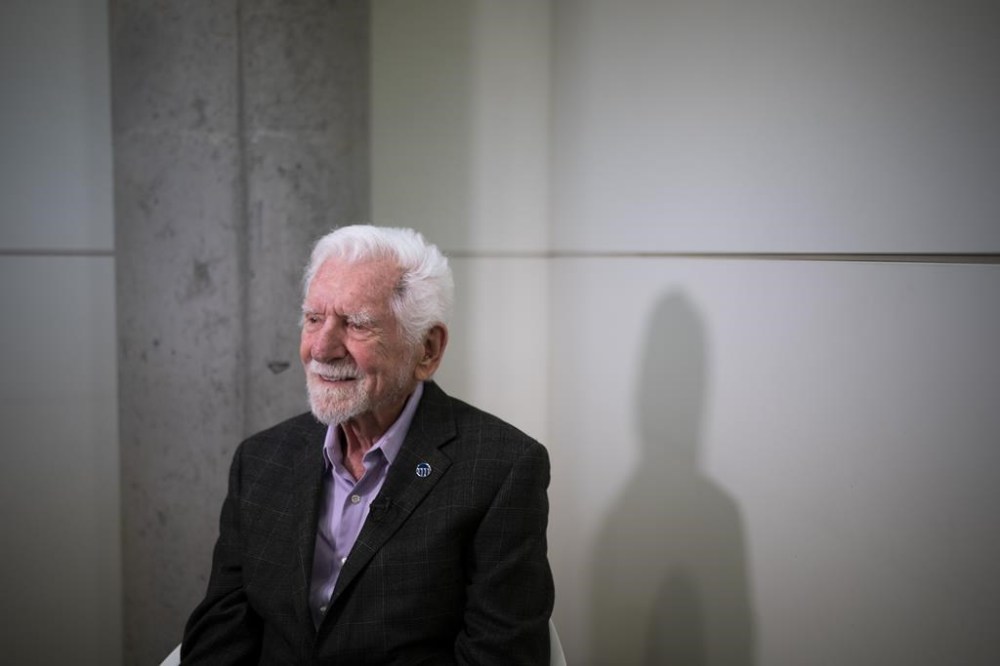
Marty Cooper, the inventor of first commercial mobile phone, during an interview with The Associated Press during the Mobile World Congress 2023 in Barcelona, Spain, Monday, Feb. 27, 2023. The four-day show kicks off Monday in a vast Barcelona conference center. It's the world's biggest and most influential meeting for the mobile tech industry. (AP Photo/Joan Mateu Parra)

Yet the 94-year-old self-described dreamer also marvels at how far cellphone design and capabilities have advanced, and he believes the technology’s best days may still be ahead of it in areas such as education and health care.

“Between the cellphone and medical technology and the Internet, we are going to conquer disease,” he said Monday at MWC, or Mobile World Congress.

Cooper, whose invention was inspired by Dick Tracy’s radio wristwatch, said he also envisions a future in which cellphones are charged by human bodies.

It’s a long way from where he started.

Cooper made the first public call from a handheld portable telephone on a New York City street on April 3, 1973, using a prototype that his team at Motorola had started designing only five months earlier.

To needle the competition, Cooper used the Dyna-TAC prototype — which weighed 2.5 pounds and was 11 inches long — to call to his rival at Bell Labs, owned by AT&T.

“The only thing that I was worried about: ‘Is this thing going to work?’ And it did,” he said.

The call helped kick-start the cellphone revolution, but looking back on that day Cooper acknowledges, “we had no way of knowing this was the historic moment.”

He spent the better part of the next decade working to bring a commercial version of the device to market, helping to launch the wireless communications industry and, with it, a global revolution in how we communicate, shop and learn about the world.

Still, Cooper said he’s “not crazy” about the shape of modern smartphones, blocks of plastic, metal and glass. He thinks phones will evolve so that they will be “distributed on your body,” perhaps as sensors “measuring your health at all times.”

Batteries could even be replaced by human energy.

“You ingest food, you create energy. Why not have this receiver for your ear embedded under your skin, powered by your body?” he imagined.

While he dreams about what the future might look like, Cooper is attuned to the industry’s current challenges, particularly around privacy.

In Europe, where there are strict data privacy rules, regulators are concerned about apps and digital ads that track user activity, allowing technology and other companies to build up rich profiles of users.

“It’s going to get resolved, but not easily,” Cooper said. “There are people now that can justify measuring where you are, where you’re making your phone calls, who you’re calling, what you access on the Internet.”

Smartphone use by children is another area that needs limits, Cooper said. One idea is to have “various internets curated for different audiences.”

Five-year-olds should be able to use the internet to help them learn, but “we don’t want them to have access to pornography and to things that they don’t understand,” he said.

As for his own phone use, Cooper says he checks email and does online searches for information to settle dinner table arguments.

However, “there are many things that I have not yet learned,” he said. “I still don’t know what TikTok is.”

Report Error Submit a Tip

More Stories

American Hostage stars recall warmth of Winnipeggers during brutal winter

Randall King 7 minute read Preview

American Hostage stars recall warmth of Winnipeggers during brutal winter

Randall King 7 minute read Friday, Sep. 18, 2026

TORONTO — When you stream the eight-part series American Hostage, a sense of familiarity may strike.

That’s because the show was shot in Winnipeg — especially in the Exchange District — from November of last year to the beginning of February, with Winnipeg portraying Indianapolis circa 1977.

The whole world seemed to be watching that midwest American city that year as a hostage crisis unfolded involving one Tony Kiritsis, an angry man who goes ballistic when a mortgage brokerage was poised to foreclose on property he had dreamed of developing into a shopping centre.

Kiritsis kidnapped his mortgage broker, Richard Hall, wiring a shotgun to the back of his head, and demanded a public airing of his grievances, with the reluctant help of popular radio broadcaster Fred Heckman.

Read
Friday, Sep. 18, 2026

Gillingham in lead with decided voters

Nicole Buffie 6 minute read Preview

Gillingham in lead with decided voters

Nicole Buffie 6 minute read Friday, Sep. 18, 2026

A cloud of uncertainty is hanging over Winnipeg as October’s municipal election nears.

Three months after a poll showed more than 40 per cent of Winnipeggers wanted to see someone other than current mayor Scott Gillingham elected, a new Abacus Data poll indicates more than half of Winnipeg voters are undecided heading into next month’s civic election.

Of decided voters, 55 per cent favour Gillingham compared to 23 per cent for former councillor and provincial cabinet minister Kevin Klein and 11 per cent for funeral director Mike Vogiatzakis.

Of all respondents, just over 50 per cent said they were unsure while 13 per cent said they will not vote.

Read
Friday, Sep. 18, 2026

A quick look at where provinces and territories stand on time changes

The Canadian Press 2 minute read Preview

A quick look at where provinces and territories stand on time changes

The Canadian Press 2 minute read Friday, Sep. 18, 2026

WINNIPEG - Manitoba's government said Thursday the province will be sticking with daylight time year-round, making it the latest jurisdiction to move away from twice-annual time changes. Here's a look at where things stand across Canada:

British Columbia said in March that it was moving to permanent Pacific daylight time. The change also means that parts of northeastern B.C., which have been on mountain standard time year round, are now in alignment with the rest of the province.

Alberta also switched to permanent daylight time this year in what it calls Alberta time. The change means it now has the same time as Saskatchewan year round.

Saskatchewan has been on permanent central standard time since 1966.

Read
Friday, Sep. 18, 2026

Jets up against the clock

Mike McIntyre 8 minute read Preview

Jets up against the clock

Mike McIntyre 8 minute read 7:03 PM CDT

Time has often been on the side of the Winnipeg Jets, with Cole Perfetti’s famous “Manitoba Miracle” buzzer-beater serving as Exhibit A.

But that won’t necessarily be the case this coming season, when the clock threatens to become a stubborn and, at times, confusing opponent.

Premier Wab Kinew’s decision to adopt permanent daylight time will have a significant impact on the hockey club, both as hosts and visitors, head coach Scott Arniel told the Free Press on Sunday.

Athletes are creatures of habit, and their regular routines are going to be challenged during the period from Nov. 1 to March 14, which covers the majority of the 84-game campaign.

Read
7:03 PM CDT

A life’s story: activist, educator, organizer knew the true meaning of community

Janine LeGal 7 minute read Preview

A life’s story: activist, educator, organizer knew the true meaning of community

Janine LeGal 7 minute read Yesterday at 3:00 AM CDT

Somewhere between a love for sharing stories and a love of community connections, Michael (Mike) Maunder lived his life. Giving voice to people and neighbourhoods was a passion for the natural-born community organizer.

An author, teacher and principal, Maunder lived in a one-bedroom apartment in West Broadway and devoted himself to community development, education and neighbourhood renewal.

He maintained a connection with Augustine United Church, whose commitment to social justice he appreciated, volunteered at the Sandy-Saulteaux Spiritual Centre, and found comfort in a Buddhist prayer community.

Maunder died on July 15 at the age of 80.

Read
Yesterday at 3:00 AM CDT

Not falling back means time loop remains unclosed

Jen Zoratti 4 minute read Yesterday at 2:01 AM CDT

I demand restitution. Where’s my hour?

In the traditional fall-back, spring-forward time change set up — you know, ol’ trusty that’s been effect for lo these 63 years — we lost an hour in the spring that we got back in the fall.

That was the social contract: you commit to feeling like you’re on cold medication for a week in March because you know a glorious extra hour of sleep will be returned to you in November. (Unless, of course, you have little kids, but look: we all make our choices.)

Well, that transaction, flawed as it was, isn’t happening this year. That hour you sacrificed to the sun gods in the spring? Gone. Not coming back. We’ve sprung forward and we shan’t be falling back — not in November, and (possibly) not ever. The scale shall remain unbalanced and the loop shall remain unclosed as Manitoba has adopted permanent daylight time.