Black parents seek schools affirming their history amid bans
Advertisement
Read this article for free:
or
Already have an account? Log in here »
To continue reading, please subscribe:

Digital Subscription
One year of digital access for only $205*
- Enjoy unlimited reading on winnipegfreepress.com
- Read the E-Edition, our digital replica newspaper
- Access News Break, our award-winning app
- Play interactive puzzles
*First annual payment billed as $205.00 + GST for one year. This annual subscription will automatically renew at $233.00 + GST every 52 weeks (10% off the regular annual price of $259.35). Offer available to new and qualified returning subscribers only. Cancel any time.
To continue reading, please subscribe:
Add Free Press access to your Brandon Sun subscription for only an additional
$1 for the first 4 weeks*
- Enjoy unlimited reading on winnipegfreepress.com
- Read the E-Edition, our digital replica newspaper
- Access News Break, our award-winning app
- Play interactive puzzles
*Your next Brandon Sun subscription payment will increase by $1.00 and you will be charged $17.95 plus GST for four weeks. After four weeks, your payment will increase to $24.95 plus GST every four weeks.
Read unlimited articles for free today:
or
Already have an account? Log in here »
Hey there, time traveller!
This article was published 26/04/2023 (1255 days ago), so information in it may no longer be current.
DECATUR, Ga. (AP) — Every decision Assata Salim makes for her young son is important. Amid a spike in mass killings, questions of safety were at the top of her mind when choosing a school. Next on her checklist was the school’s culture.
Salim and her 6-year-old, Cho’Zen Waters, are Black. In Georgia, where they live, public schools are prohibited from teaching divisive concepts, including the idea that one race is better than another or that states are fundamentally racist.
To Salim, the new rules mean public schools might not affirm Cho’Zen’s African roots, or accurately portray the United States’ history of racism. “I never want to put his education in the hands of someone that is trying to erase history or recreate narratives,” she said.
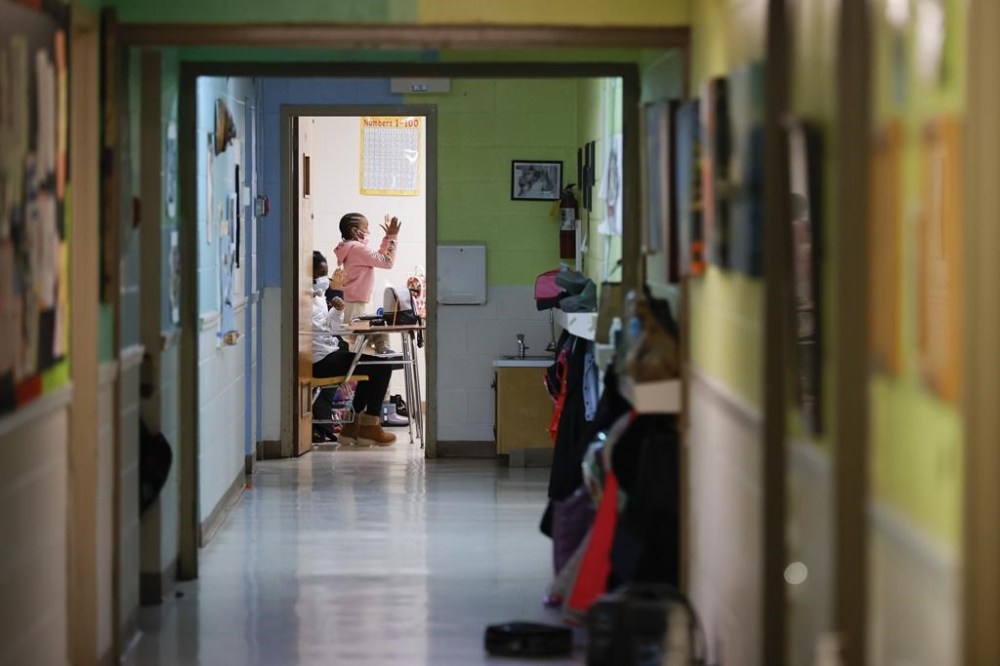
Instead, Cho’Zen attends a private, Afrocentric school — joining kids across the country whose families have embraced schools that affirm their Black heritage, in a country where instruction about race is increasingly under attack. At Cho’Zen’s school, Kilombo Academic & Cultural Institute in an Atlanta suburb, photos of Black historical figures hang on the walls. And every single student and teacher identifies as Black or biracial.
In recent years, conservative politicians around the country have championed bans on books or instruction that touch on race and inclusion. Books were banned in more than 5,000 schools in 32 states from June 2021 to June 2022, according to free-speech nonprofit PEN America. Instructional bans have been enacted in at least 16 states since 2021.
Even when a topic isn’t explicitly banned, some teachers say the debates have caused them to back away from controversy. The situation has caused more Black families to leave public schools, opting for homeschooling or private schools that embrace their identity and culture. Public school enrollment of Black students between pre-K and 12th grade has declined each year measured in federal data since 2007.
“I think it is important to teach those harsh moments in slavery and segregation, but tell the whole story,” said Salihah Hasan, a teaching assistant at Kilombo Institute. “Things have changed drastically, but there are still people in this world who hate Black people, who think we are still beneath them, and younger children today don’t understand that. But that is why it is important to talk about it.”
Kilombo goes further, focusing on the students’ rich heritage, from both Africa and Black America. “I want him to know his existence doesn’t start with slavery,” Salim said of her son.
The private, K-8 school occupies the basement of Hillside Presbyterian Church just outside Decatur, an affluent, predominantly white suburb. Families pay tuition on a sliding scale, supplemented by donations.
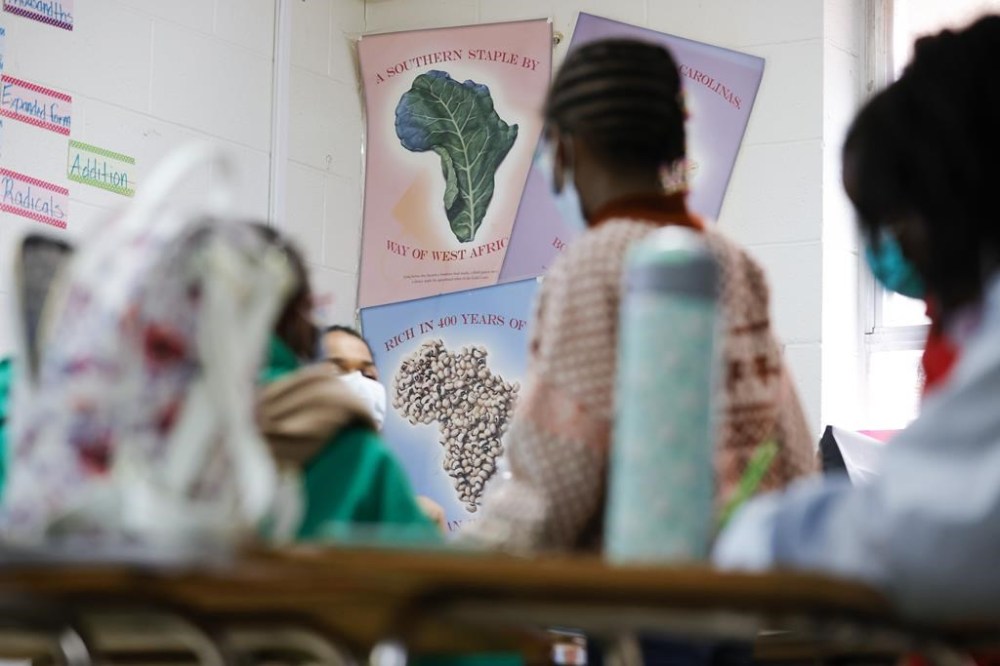
Classrooms feature maps of Africa and brown paper figures wearing dashikis, a garment worn mostly in West Africa. In one class, the students learn how sound travels by playing African drums.
The 18-year-old school has 53 students, up a third since the start of the pandemic. Initially, more parents chose the school because it returned to in-person learning earlier than nearby public schools. Lately, the enrollment growth has reflected parents’ increasing urgency to find a school that won’t shy away from Black history.
“This country is signaling to us that we have no place here,” said Mary Hooks, whose daughter attends Kilombo. “It also raises a smoke signal for people to come home to the places where we can be nourished.”
Notably, the student body includes multiple children of public school teachers.
Simone Sills, a middle school science teacher at Atlanta Public Schools, chose the school for her daughter in part because of its smaller size, along with factors such as safety and curriculum. Plus, she said, she was looking for a school where “all students can feel affirmed in who they are.”
Before Psalm Barreto, 10, enrolled in Kilombo, her family was living in Washington, D.C. She said she was one of a few Black children in her school.
“I felt uncomfortable in public school because it was just me and another boy in my class, and we stood out,” she said.
Racial differences are evident to babies as young as three months, research has shown, and racial biases show up in preschoolers. Kilombo provides a space for kids to talk about their race.
“I’m Blackity, Black, Black!” said Robyn Jean, 9, while spinning in a circle. Her sister, Amelya, 11, said their parents taught them about their Haitian American heritage — knowledge she thinks all children should have. “I want them to know who they are and where they come from, like we do,” Amelya said. “But in some schools, they can’t.”
Last year, Georgia passed a bill known as the Protect Students First Act, which prohibits schools from promoting and teaching divisive concepts about race. Elsewhere, bills that restrict or prohibit teaching about race- and gender-related topics passed in states including Florida, Idaho, Iowa, Oklahoma, and Tennessee. In other states, such as Arkansas, restrictions have come via executive orders.
Proponents say the restrictions aim to eliminate classroom discussions that make students feel shame or guilt about their race and the history and actions of their ancestors.
The bills have had a chilling effect. One-quarter of K-12 teachers in the U.S. say these laws have influenced their choice of curriculum or instructional practices, according to a report by the RAND Corporation, a global policy think tank.
At Kilombo, daily instruction includes conversations about race and culture. Founder Aminata Umoja uses a Black puppet named Swahili to welcome her students, ask how they are doing and start the day with morals and values rooted in their African heritage.
The puppet might say: “‘Let’s talk about iwa pele. What does that mean?’ and then one of the children will tell us that it means good character,” said Umoja, who teaches kindergarteners through second graders.
Teaching life skills and values, Umoja said, has its roots in freedom schools started during the Civil Rights Movement, in response to the inferior “sharecropper’s education” Black Americans were receiving in the South.
The school follows academic standards from Common Core for math and language arts and uses Georgia’s social studies standards to measure student success. But the curriculum is culturally relevant. It centers Black people, featuring many figures excluded in traditional public schools, said Tashiya Umoja, the school’s co-director and math teacher.
“We are giving children of color the same curriculum that white children are getting. They get to hear about their heroes, she-roes and forefathers,” she said.
The curriculum also focuses on the children’s African heritage. A math lesson, for instance, might feature hieroglyphic numerals. Social studies courses discuss events in Africa or on other continents alongside U.S. history.
When she was in public school, Psalm said she only learned about mainstream Black figures in history, such as Barack Obama, Martin Luther King Jr. and Harriet Tubman. Now, she said, she is learning about civil rights activist Ella Baker, journalist Ida B. Wells and pilot Bessie Coleman.
Said Psalm: “Honestly, I feel bad for any kids who don’t know about Black history. It’s part of who we are.”
___
Data journalist Sharon Lurye contributed reporting from New Orleans.
___
The Associated Press education team receives support from the Carnegie Corporation of New York. The AP is solely responsible for all content.