Drug overdoses in the US slightly increased last year. But experts see hopeful signs

Advertisement

Advertise with us

NEW ORLEANS (AP) — Drug overdose deaths in the U.S. went up slightly last year after two big leaps during the pandemic.

Read this article for free:


or

Already have an account? Log in here »

To continue reading, please subscribe:

Subscribe and receive a limited-edition Free Press branded hat or tote.

Digital Subscription

One year of digital access for only $205*

  • Enjoy unlimited reading on winnipegfreepress.com
  • Read the E-Edition, our digital replica newspaper
  • Access News Break, our award-winning app
  • Play interactive puzzles

*First annual payment billed as $205.00 + GST for one year. This annual subscription will automatically renew at $233.00 + GST every 52 weeks (10% off the regular annual price of $259.35). Offer available to new and qualified returning subscribers only. Cancel any time.

To continue reading, please subscribe:

Add Free Press access to your Brandon Sun subscription for only an additional

$1 for the first 4 weeks*

  • Enjoy unlimited reading on winnipegfreepress.com
  • Read the E-Edition, our digital replica newspaper
  • Access News Break, our award-winning app
  • Play interactive puzzles
Start now

*Your next Brandon Sun subscription payment will increase by $1.00 and you will be charged $17.95 plus GST for four weeks. After four weeks, your payment will increase to $24.95 plus GST every four weeks.

Hey there, time traveller!
This article was published 17/05/2023 (1226 days ago), so information in it may no longer be current.

NEW ORLEANS (AP) — Drug overdose deaths in the U.S. went up slightly last year after two big leaps during the pandemic.

Officials with the Centers for Disease Control and Prevention say the numbers plateaued for most of last year. Experts aren’t sure whether that means the deadliest drug overdose epidemic in U.S. history is finally reaching a peak, or whether it’ll look like previous plateaus that were followed by new surges in deaths.

“The fact that it does seem to be flattening out, at least at a national level, is encouraging,” said Katherine Keyes, a Columbia University epidemiology professor whose research focuses on drug use. “But these numbers are still extraordinarily high. We shouldn’t suggest the crisis is in any way over.”
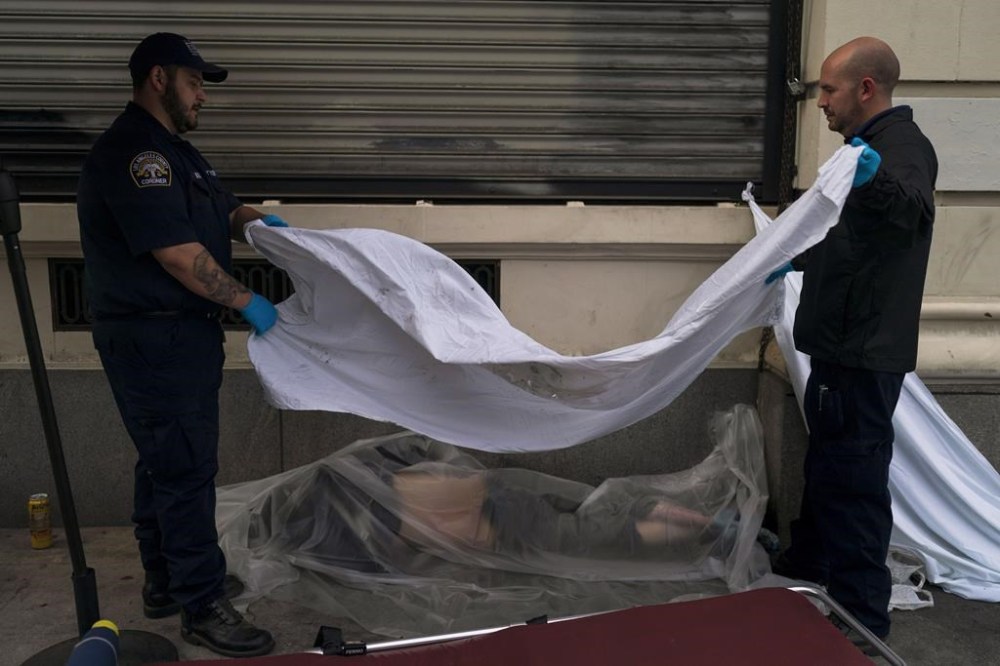
FILE - Forensic assistant Laurentiu Bigu, left, and investigator Ryan Parraz from the Los Angeles County coroner's office cover the body of a homeless man found dead on a sidewalk in Los Angeles on April 18, 2022. The 60-year-old man died from the effects of methamphetamine, according to his autopsy report. Drug overdose deaths in the U.S. went up slightly in 2022 after two big leaps during the pandemic. (AP Photo/Jae C. Hong, File)

An estimated 109,680 overdose deaths occurred last year, according to numbers posted Wednesday by the CDC. That’s about 2% more than the 107,622 U.S. overdose deaths in 2021, but nothing like the 30% increase seen in 2020, and 15% increase in 2021.

While the overall national number was relatively static between 2021 and 2022, there were dramatic changes in a number of states: 23 reported fewer overdose deaths, one — Iowa — saw no change, and the rest continued to increase.

Eight states — Florida, Indiana, Kentucky, Maryland, Michigan, Ohio, Pennsylvania and West Virginia — reported sizable overdose death decreases of about 100 or more compared with the previous calendar year.

Some of these states had some of the highest overdose death rates during the epidemic, which Keyes said might be a sign that years of concentrated work to address the problem is paying off. State officials cited various factors for the decline, like social media and health education campaigns to warn the public about the dangers of drug use; expanded addiction treatment — including telehealth — and wider distribution of the overdose-reversing medication naloxone.

Plus, the stigma that kept drug users from seeking help — and some doctors and police officers from helping them — is waning, said Dr. Joseph Kanter, the state health officer for Louisiana, where overdose deaths fell 4% last year.

“We’re catching up and the tide’s turning — slowly,” said Kanter, whose state has one of the nation’s highest overdose death rates.

Beginning in the mid-1990s, abuse of prescription opioid painkillers was to blame for deaths before a gradual turn to heroin, which in 2015 caused more deaths than prescription painkillers or other drugs. A year later, the more lethal fentanyl and its close cousins became the biggest drug killer.

Last year, most overdose deaths continued to be linked to fentanyl and other synthetic opioids. About 75,000, up 4% from the year before. There also was a 11% increase in deaths involving cocaine and a 3% increase in deaths involving meth and other stimulants.

Overdose deaths are often attributed to more than one drug; some people take multiple drugs and officials say inexpensive fentanyl is increasingly cut into other drugs, often without the buyers’ knowledge.

Research from Dr. Daniel Ciccarone, a drug policy expert at the University of California, San Francisco, suggests “there appears to be some substitution going on,” with a number of people who use illicit drugs turning to methamphetamines or other options to try to stay away from fentanyl and fentanyl-tainted drugs.

Ciccarone said he believes overdose deaths finally will trend down. He cited improvements in innovations in counseling and addiction treatment, better availability of naloxone and legal actions that led to more than $50 billion in proposed and finalized settlements — money that should be available to bolster overdose prevention.

“We’ve thrown a lot at this 20-year opioid overdose problem,” he said. ”We should be bending the curve downward.”

But he also voiced some caution, saying “we have been here before.”

Consider 2018, when overdose deaths dropped 4% from the previous year, to about 67,000. After those numbers came out, then-President Donald Trump declared “we are curbing the opioid epidemic.”

But overdose deaths then rose to a record 71,000 in 2019, then soared during the COVID-19 pandemic to 92,000 in 2020 and 107,000 in 2021.

Lockdowns and other pandemic-era restrictions isolated people with drug addictions and made treatment harder to get, experts said.

Keyes believes that 2022’s numbers didn’t get any worse partly because isolation eased as the pandemic ebbed. But there may be issues ahead, others say, like increased detection of veterinary tranquilizer xylazine in the illicit drug supply and proposals to scale back things like prescribing addiction medications through telehealth.

“What the past 20 years of this overdose crisis has taught us is that this really is a moving target,” Keyes said. “And when you think you’ve got a handle on it, sometimes the problem can shift in new and different ways.”

___

The Associated Press Health and Science Department receives support from the Howard Hughes Medical Institute’s Science and Educational Media Group. The AP is solely responsible for all content.


Report Error Submit a Tip

More Stories

Relief, reproach from law school staff after disgraced ex-dean’s arrest in France

Maggie Macintosh 5 minute read Preview

Relief, reproach from law school staff after disgraced ex-dean’s arrest in France

Maggie Macintosh 5 minute read Yesterday at 5:43 PM CDT

The overseas arrest of a disgraced former law dean who defrauded the University of Manitoba out of more than $600,000 is being met both with relief and renewed frustration in the local legal community.

Read
Yesterday at 5:43 PM CDT

Don’t miss these 10 concerts during a jam-packed season

Holly Harris 6 minute read Preview

Don’t miss these 10 concerts during a jam-packed season

Holly Harris 6 minute read 2:01 AM CDT

Shorter days and dipping temperatures also trumpet the launch of another jam-packed arts season, with a full slate of world-class concerts.

Here is a list of Top 10 concerts that have caught our eye from now until the snow flies, listed in chronological order:

1) Da-da-da-daaaah! The Winnipeg Symphony Orchestra kicks off its 79th season with one of the most iconic symphonies in the classical canon on Saturday at 7:30 p.m. at the Centennial Concert Hall. The first in its renamed Masterworks series (formerly Saturday Classics) features maestro Daniel Raiskin leading the players through Beethoven’s roiling Symphony No. 5, a.k.a. “fate knocking at the door,” as well as Tchaikovsky’s Symphony No. 5. The program that repeats Sunday at 2 p.m. also features Dark Nights, Bright Stars, Vast Universe from WSO’s newly minted composer-in-residence, Kelly-Marie Murphy; the work is inspired by the “night sky and themes of curiosity and discovery.” For further information, see wso.ca.

2) Manitoba has long been hailed as “the singing province,” with Winnipeg’s diverse choral groups promising to enthrall fans once again with their latest offerings. Local a cappella vocal ensemble Dead of Winter joins forces with the Juno-nominated Canadian Chamber Choir (Julia Davids, artistic director/conductor) in Where Waters Meet on Sunday, Oct. 4, at 3 p.m. at the Desautels Concert Hall. The collaborative program features works by founder/composer Andrew Balfour, who has Cree heritage, Carmen Braden (Yellowknife, N.W.T.), Sherryl Sewepagaham (Cree-Dene, Little Red River Cree Nation), and the late Cris Derksen (NorthTall Cree). The matinee performance also includes guest appearances by the University Singers and local Inuit throat singers Aleatra Sammurtok and Zeann Manernaluk. Check out deadofwinter.ca.

Read
2:01 AM CDT

Health Canada suspends plasma collection at Grifols Taylor Avenue clinic

Chris Kitching 6 minute read Preview

Health Canada suspends plasma collection at Grifols Taylor Avenue clinic

Chris Kitching 6 minute read Updated: Yesterday at 5:47 PM CDT

Health Canada has suspended all plasma collection at Grifols’ Taylor Avenue facility while the private company continues to face scrutiny after two people died following donations at its Winnipeg clinics.

The suspension began Wednesday, although Grifols paused plasma collection in Canada on Aug. 14, two days after the federal department gave the Taylor Avenue site a non-compliant rating.

“Health Canada issued the suspension because Grifols had not effectively implemented some corrective and preventive actions and, overall, it failed to demonstrate that the Taylor Avenue site has implemented an effective quality management system,” the department said in a statement.

The penalty was first proposed Aug. 13. The site’s operating licence was partially suspended, Grifols said in a statement.

Read
Updated: Yesterday at 5:47 PM CDT

Oilers stymie Jets again

Ken Wiebe 6 minute read Preview

Oilers stymie Jets again

Ken Wiebe 6 minute read Tuesday, Sep. 22, 2026

Were this a game that actually counted in the standings, the reaction from Winnipeg Jets head coach Scott Arniel probably wouldn’t have been nearly as composed.

The video evidence suggests the Edmonton Oilers had at least four players on the ice during a line change that turned into a two-on-one rush that finished with Zack Hyman setting up Viljami Marjala for a goal at 1:26 of overtime.

That left the Jets on the receiving end of a 2-1 overtime loss to sit with a pre-season record of 1-1-1.

“It was a pretty good jump,” said Arniel, who was more concerned about the shot from defenceman Dylan Samberg that helped spring the Oilers on the odd-man rush. “I’m not real keen on the slapper missing the net and going all the way down. I’m more concerned about that. It is what it is. Tough one for (Jets goaltender) Dom (DiVincentiis), because he was fantastic.”

Read
Tuesday, Sep. 22, 2026

Letters, Sept. 24

7 minute read 2:01 AM CDT

Poor choice

Manitoba’s move to end seasonal time changes appears to be an edict by extrapolation.

A voluntary online questionnaire produced 72,000 self‑selected responses, of which 58 per cent (41,760 people) preferred permanent daylight time. This is not a scientific poll, yet it is being used to set time policy for 1.4 million Manitobans — without legislative debate, committee review, or a vote in the Assembly.

If a one‑hour shift twice a year is considered “harmful,” then by the same logic we should question every activity involving time‑zone changes.

Driver, 62, killed in highway crash

1 minute read Yesterday at 10:25 AM CDT

One person was killed and a second was injured in a crash involving an SUV and semi-truck just outside Sanford on Tuesday morning.

RCMP said the semi-truck was eastbound on Highway 3 when it collided with the SUV, which was being driven south on Provincial Road 334 by a 62-year-old Sanford man, who died at the scene.

The collision happened shortly after 5 a.m.

Police said the semi-truck’s driver, a 58-year-old Morden man, was treated for non-life-threatening injuries.