Pediatric drug shortage led to dosing errors in Ontario children , research shows

Advertisement

Advertise with us

TORONTO - The shortage of pediatric medication in Canada last year led to a spike of dosing errors in children in Ontario, new research shows.

Read this article for free:


or

Already have an account? Log in here »

To continue reading, please subscribe:

Subscribe and receive a limited-edition Free Press branded hat or tote.

Digital Subscription

One year of digital access for only $205*

  • Enjoy unlimited reading on winnipegfreepress.com
  • Read the E-Edition, our digital replica newspaper
  • Access News Break, our award-winning app
  • Play interactive puzzles

*First annual payment billed as $205.00 + GST for one year. This annual subscription will automatically renew at $233.00 + GST every 52 weeks (10% off the regular annual price of $259.35). Offer available to new and qualified returning subscribers only. Cancel any time.

To continue reading, please subscribe:

Add Free Press access to your Brandon Sun subscription for only an additional

$1 for the first 4 weeks*

  • Enjoy unlimited reading on winnipegfreepress.com
  • Read the E-Edition, our digital replica newspaper
  • Access News Break, our award-winning app
  • Play interactive puzzles
Start now

*Your next Brandon Sun subscription payment will increase by $1.00 and you will be charged $17.95 plus GST for four weeks. After four weeks, your payment will increase to $24.95 plus GST every four weeks.

Hey there, time traveller!
This article was published 31/05/2023 (1225 days ago), so information in it may no longer be current.

TORONTO – The shortage of pediatric medication in Canada last year led to a spike of dosing errors in children in Ontario, new research shows.

The study, published Wednesday in the New England Journal of Medicine, examined the effect of the shortage of children’s ibuprofen and acetaminophen, which forced parents to crush up pills of the drugs intended for adults in order to treat their children.

Researchers found a twofold increase in calls to the Ontario Poison Centre for unintentional dosing errors of the medications for patients 18 years old or younger last fall, particularly in November 2022, compared to the four years prior.
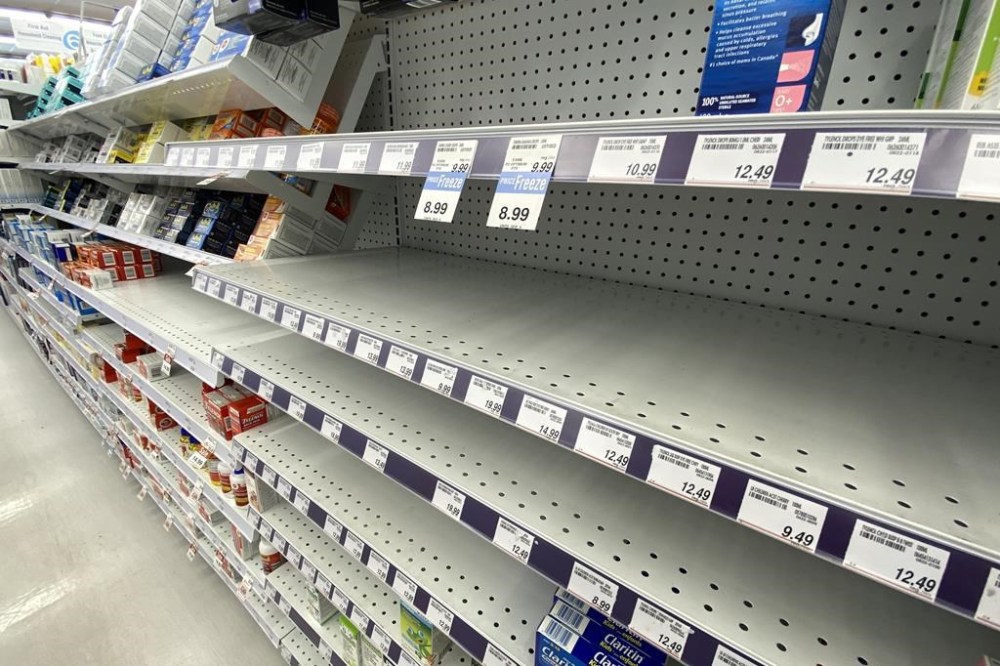
Empty shelves of children's pain relief medicine are seen at a Toronto pharmacy, Wednesday, August 17, 2022. The shortage of pediatric medication in Canada last year led to a spike of dosing errors in children in Ontario, new research shows. THE CANADIAN PRESS/Joe O'Connal

“What our research does is shine some light on the issue of drug shortages and the potential consequences associated with them,” said Dr. Jonathan Zipursky, the lead author of the study and a clinical pharmacologist and toxicologist at Sunnybrook Health Sciences Centre in Toronto.

“Fortunately, our findings didn’t show that there was excess harm to children.”

The team also used modelling techniques to project the expected number of calls while accounting for temporal trends and a surge in respiratory illnesses in children.

Last fall, hospitals across the country were overwhelmed with really sick children as a particularly virulent strain of influenza circulated alongside respiratory syncytial virus, or RSV. COVID-19 further complicated matters for children.

The surge forced children’s hospitals in Toronto, Ottawa, Hamilton and London, Ont., to cancel surgeries in order to free up staff and beds to deal with the problem.

Hospital officials said the lack of children’s medication had a profound effect on its emergency departments. Doctors said they would often show parents how to cut up pills meant for adults.

“Children weren’t coming into hospital more often for these drug dosing errors, but that doesn’t mean no harm was done,” Zipursky said.

Parents lived with high levels of anxiety over their children’s health and many children went without treatment for fevers, he added.

By January, the shortage abated after the federal government imported nearly two million units of ibuprofen and acetaminophen.

Zipursky said he got the idea for the study because he found himself in a similar situation as others with two young children.

“We were blindsided by the drug shortage and we found ourselves as parents looking for drugs from other places or trying to follow guidance to divide pills that were intended for adults,” he said.

Zipursky and researchers from Public Health Ontario, Health Canada, the Hospital for Sick Children, the Ontario Poison Centre, St. Michael’s Hospital and Sinai Health contributed to the study.

He said drug shortages remain a concern.

“I hope we don’t find ourselves in this situation again, although I’m not that optimistic,” he said.

Dividing up adult pills to try to treat children shows how desperate parents became.

“If anybody ever finds themselves in a situation where they’re dividing a dose for a child and they’re unsure what they’re doing, they need to speak to a pharmacist or speak to a health care professional,” Zipursky said.

This report by The Canadian Press was first published May 31, 2023.

Report Error Submit a Tip

More Stories

Michael Douglas comes to terms with fears, fame, father

Hillel Italie 6 minute read Preview

Michael Douglas comes to terms with fears, fame, father

Hillel Italie 6 minute read 2:01 AM CDT

NEW YORK — Michael Douglas, the award-winning actor and producer, recently turned 82. He is a cancer survivor, a recovered addict, a married man, the father and son of actors.

He is also an author, who begins his memoir with a message of thanks to his family — past and present and future — for the “sense of immortality.”

“Many times my father was asked, ‘Kirk, are you jealous of your son?’” he said during a recent interview at a Manhattan hotel, referring to his late father, fellow actor and sometime combatant Kirk Douglas.

“And he said, ‘Jealous?’ This is a sense of immortality, a continuity of generations.’”

Read
2:01 AM CDT

Infill development on minds of all three River Heights-Fort Garry candidates

Joyanne Pursaga 4 minute read Preview

Infill development on minds of all three River Heights-Fort Garry candidates

Joyanne Pursaga 4 minute read Yesterday at 1:07 PM CDT

A trio of candidates will compete to become the first new city councillor in River Heights-Fort Garry since 2009.

Coun. John Orlikow, who won the seat in a byelection, is not running for another term.

Georgina Sabesky, who served as Orlikow’s executive assistant for 17 years, is now one of the candidates vying for the council seat.

Sabesky said that job gave her ample knowledge of the ward.

Read
Yesterday at 1:07 PM CDT

Letters, Oct. 7

6 minute read Preview

Letters, Oct. 7

6 minute read Updated: 8:08 AM CDT

Wally Daudrich apparently claims that Duff Roblin joined the PC Party in the 1960s. He does not know the history of the party.

Read
Updated: 8:08 AM CDT

Manitoba Federation of Labour calls for independent review of Workers Compensation Board

Gabrielle Piché 5 minute read Preview

Manitoba Federation of Labour calls for independent review of Workers Compensation Board

Gabrielle Piché 5 minute read Yesterday at 9:54 PM CDT

A major labour association is calling for an independent Workers Compensation Board review as Manitoba leads the country in workplace injury rates.

Last year, 2.5 employees in every 100 reported a workplace injury serious enough to take time off, WCB tracking shows. The number is higher than any other province — just as it has been for the past three years, according to the Manitoba Federation of Labour.

(In 2025, the next highest time loss injury rate was in British Columbia: 2.04 people for every 100.)

“Our prevention work in Manitoba is failing Manitobans,” said Kevin Rebeck, president of the Manitoba Federation of Labour. “We need an independent review to help shine a light on, ‘What is happening on the prevention front of WCB?’”

Read
Yesterday at 9:54 PM CDT

Mayoral candidates Klein, Vogiatzakis continue to snipe over inducement allegations

Chris Kitching and Joyanne Pursaga 6 minute read Preview

Mayoral candidates Klein, Vogiatzakis continue to snipe over inducement allegations

Chris Kitching and Joyanne Pursaga 6 minute read Monday, Oct. 5, 2026

Winnipeg mayoral candidate Mike Vogiatzakis told reporters Monday he will contact the city clerk to report his allegation that rival Kevin Klein offered him a job to drop out of the race.

Vogiatzakis and Klein both doubled down a day after accusing each other of offering the other a position at city hall, if they were victorious in the Oct. 28 election, in exchange for a withdrawal.

“Do I want to get him charged? Not really. I don’t want to destroy anybody’s life,” Vogiatzakis told reporters.

“Kevin’s a good guy. I thought he was a friend of mine, but he’s not. Kevin uses leverage to get ahead, and he tried to use me as leverage.”

Read
Monday, Oct. 5, 2026

Man who exploited teen sentenced to 11 years in prison

Erik Pindera 4 minute read Preview

Man who exploited teen sentenced to 11 years in prison

Erik Pindera 4 minute read Yesterday at 2:00 AM CDT

A man who picked up a vulnerable 17-year-old child-welfare ward on the streets of Winnipeg and coerced her into providing sexual services for several months has been sent to prison for more than a decade.

After a trial, Hassan Kargbo, who’s in his early 30s, was found guilty of sexual exploitation, making child sexual abuse and exploitation material, receiving a material benefit from sexual services provided by a person under 18, procuring a person under 18 and advertising sexual services.

Provincial court Judge Julie Frederickson sentenced him to 11 years behind bars late last month.

“Mr. Kargbo picked up a young Indigenous girl walking over the Osborne Street bridge and quickly got her involved in drug use and escorting,” Frederickson said in a written decision.

Read
Yesterday at 2:00 AM CDT