‘Liberty, equality, fraternity’ for all? New riots make France confront an old problem
Advertisement
Read this article for free:
or
Already have an account? Log in here »
To continue reading, please subscribe:

Digital Subscription
One year of digital access for only $205*
- Enjoy unlimited reading on winnipegfreepress.com
- Read the E-Edition, our digital replica newspaper
- Access News Break, our award-winning app
- Play interactive puzzles
*First annual payment billed as $205.00 + GST for one year. This annual subscription will automatically renew at $233.00 + GST every 52 weeks (10% off the regular annual price of $259.35). Offer available to new and qualified returning subscribers only. Cancel any time.
To continue reading, please subscribe:
Add Free Press access to your Brandon Sun subscription for only an additional
$1 for the first 4 weeks*
- Enjoy unlimited reading on winnipegfreepress.com
- Read the E-Edition, our digital replica newspaper
- Access News Break, our award-winning app
- Play interactive puzzles
*Your next Brandon Sun subscription payment will increase by $1.00 and you will be charged $17.95 plus GST for four weeks. After four weeks, your payment will increase to $24.95 plus GST every four weeks.
Read unlimited articles for free today:
or
Already have an account? Log in here »
Hey there, time traveller!
This article was published 04/07/2023 (1169 days ago), so information in it may no longer be current.
PARIS (AP) — “Liberty, Equality, Fraternity”: The lofty ideals to which France has long aspired are embossed on coins and carved above school doors across the land. Yet they are the polar opposite of what some French people who are Black or brown saw in a shocking video of a police officer shooting and killing a 17-year-old delivery driver of north African descent during a traffic stop.
That kid, some said to themselves, could have been me — or my children, or my friends. Within hours, the first fires of anger and revenge were lighting up the night skies of Nanterre, the Paris suburb where the teenager, Nahel, was declared dead at 9:15 a.m. last Tuesday. His left arm and chest had been pierced from left to right by a single shot fired before the yellow Mercedes he was driving then slammed into barriers on Nelson Mandela Square.
From the town on the fringe of the French capital’s high-rise business district, with its disadvantaged housing projects, glaring wealth gaps, and melting-pot mix of races and cultural influences imported from France’s former colonies, the flames of fury quickly spread.
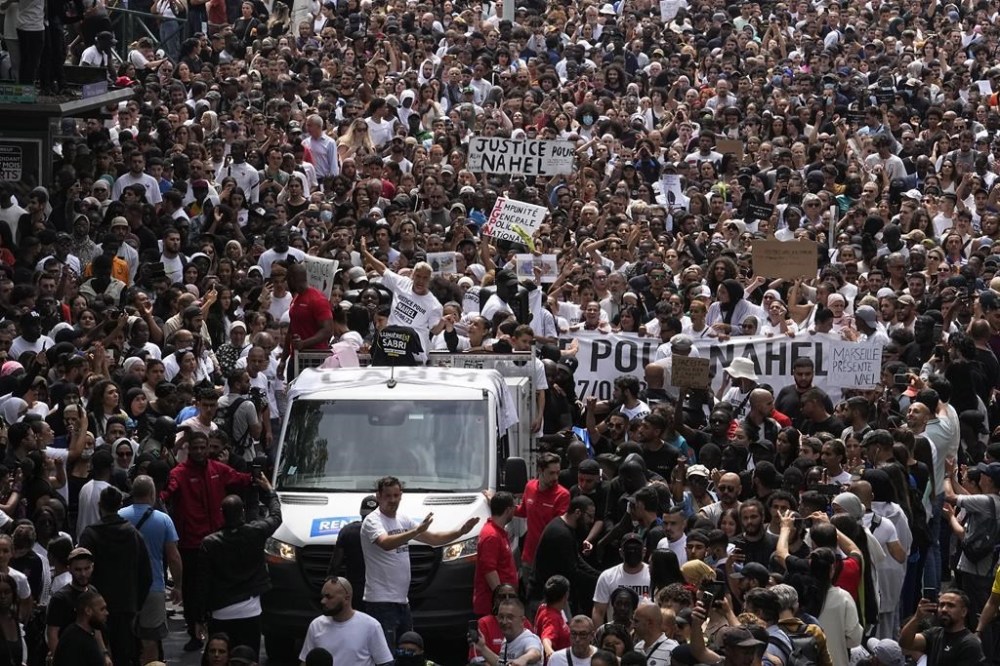
More than 200 cities and towns reported arson attacks on public buildings, vehicle fires, clashes with police, looting and other mayhem in six nights of unrest. The violence was nationwide — from blue-collar ports on France’s northern coast to southern towns overlooking the Pyrenees, from de-industrialized former mining basins to Nantes and La Rochelle on the western Atlantic coast, once hearts of the French slave trade.
After more than 3,400 arrests and signs that the violence is now abating, France is once again facing a reckoning — as it did after previous riots in mixed-race, disadvantaged neighborhoods in the 1980s, 1990s, 2000s and 2010s.
And the uncomfortable central question remains the same: What is France doing wrong that prevents chunks of its population, particularly among non-whites, from being able to buy into its promise of equality and fraternity for all?
THE PROBLEMS ARE BOTH OLD AND NEW
Among the factors being blamed and hotly disputed are problems both old and new: racism in police ranks and French society more broadly, poverty made more desperate by rising costs related to the war in Ukraine, decades of urban neglect, breakdowns in marriages and parental authority, and the ripples of the COVID-19 pandemic. Young teenagers whose schooling was interrupted by virus curfews and teaching shutdowns were among those smashing, burning, stealing and fighting with police — and reveling in the mayhem on social media.
For Yazid Kherfi, who spends his time driving from one housing project to the next, speaking to young people about how to avoid the route that he took into crime and prison, the violence was a cry of distress from a generation he says feels unloved and left by the wayside.
The minivan Kherfi uses has a quote from Martin Luther King painted on the back: “We must learn to live together as brothers or we will all perish together as fools.” But on his rounds, Kherfi says he frequently hears young people complain that police single them out because of their color.
“The police aren’t well trained to work in difficult neighborhoods. Some police are racist. There are violent police. They exist. I’m not saying all the police but it’s still a certain number,” he says. “Blacks and Arabs are stopped far more frequently than whites.”
“We are a long way from liberty, equality, fraternity,” he adds. “The reality is that people find all these situations very, very hard. It’s been like this for more than 40 years. So of course, every time there are riots in France, it’s linked to a young person’s death related to a policing operation. And the police rarely blames itself.”
From French President Emmanuel Macron down, government officials were quick to condemn the actions of the officer now incarcerated on a preliminary charge of voluntary homicide. Macron called the shooting “inexplicable and inexcusable.” The officer’s lawyer says his client feared, when the vehicle they’d stopped started moving again, that he and his colleague would be dragged along with it and crushed.
HOW TO TACKLE RACISM WHEN IT CAN’T BE MEASURED?
Measuring the scale of racism and racial inequality in France is complicated by its official policy of color blindness, with strict limits on data that can be collected. For critics, that guiding philosophy has made the state oblivious to discrimination. France’s census has no questions about race or ethnicity.
Still, inequalities are too glaring to be ignored. The government’s statistics agency found in 2020 that death rates among immigrants from sub-Saharan Africa doubled in France and tripled in the Paris region at the height of the COVID-19 pandemic — an acknowledgement of the virus’s punishing and disproportionate impact on Black immigrants and members of other systemically overlooked minority groups. Other research has also exposed racism in workplaces and hiring.
“For 40, 45 years there have been warning signs about discrimination,” says Abel Boyi, head of a group called “All Unique, All United” that aims to reconcile young people with France and its republican values.
Boyi, who is Black, decries the state’s colorblindness as “a French hypocrisy.” He says he regularly encounters young people of color and also white people from disadvantaged neighborhoods who apply for dozens of jobs but aren’t hired “because the family name sounds foreign, because the address isn’t a good one.”
“Unfortunately, when there’s an injustice, there’s always a radical fringe that tips into violence. We saw these young people, aged 12 to 19 … at 1, 2, 3 o’clock in the morning burning cars, stoning police officers, stoning buses. It’s terrible,” Boyi says. “The anger is righteous but the method is wrong.”
THE VISUALS ADDED FUEL TO THE FLAMES
The video of Nahel’s death also helps explains the rapid spread and sudden intensity of the violence. As was also the case with the footage of George Floyd’s killing in the United States, the images left some people wondering whether police abuses sometimes go unpunished because they aren’t captured on camera. Spray-painted graffiti in Nanterre read: “Without video, Nahel would be a statistic.”
Police officer Walid Hrar says, however, that the relationship between France’s forces of law and order and disadvantaged neighborhoods he works in isn’t as broken as the rioting made it seem.
He runs a volunteer group of officers, The Guardians of Fraternity, who meet with neighborhood kids to try to build understanding and help them see that behind their uniforms, they are people, too. “Sometimes, the talks are very hard, very stormy,” he acknowledges.
But Hrar, who is of Moroccan descent and Muslim, says the police force has “changed enormously” and become more diverse since he joined up.
That was in 2004. France was swept by rioting the following year. He has spent his career in Paris’ northern suburbs where that violence first erupted, when 15-year-old Bouna Traoré and 17-year-old Zyed Benna were electrocuted while hiding from police in a power substation in Clichy-sous-Bois.
One difference between then and now, Hrar says, is that the new generation of rioters seems to know no limits, trashing schools, town halls, police stations and other symbols of authority.
“With some, the breakdown is total, that is true,” Hrar says. “There is real groundwork that needs to be done.”

Another key difference: social networks. This generation weaned on TikTok and Snapchat not only celebrated mayhem in short videos but, the government says, sometimes organized on their networks, too. Memes and hashtags about looting quickly swamped references about justice for Nahel. Macron said some rioters seemed to be acting out “the video games that have intoxicated them.”
It all adds up to something toxic and dangerous, with deep cracks in the foundations of a country still unreconciled with its often violent colonial past and with engrained discrimination and inequalities that defy quick fixes.
“How do we bring together the multitude of histories into one common history that concerns us all, regardless of skin color and origin?” said Boyi. “That is France’s great challenge for the 21st century.”
—-
Paris chief correspondent John Leicester has reported from France for The Associated Press since 2002.