The architecture of ice cream BDI’s appeal combines modernism, sense of fun
Read this article for free:
or
Already have an account? Log in here »
To continue reading, please subscribe:

Digital Subscription
One year of digital access for only $205*
- Enjoy unlimited reading on winnipegfreepress.com
- Read the E-Edition, our digital replica newspaper
- Access News Break, our award-winning app
- Play interactive puzzles
*First annual payment billed as $205.00 + GST for one year. This annual subscription will automatically renew at $233.00 + GST every 52 weeks (10% off the regular annual price of $259.35). Offer available to new and qualified returning subscribers only. Cancel any time.
To continue reading, please subscribe:
Add Free Press access to your Brandon Sun subscription for only an additional
$1 for the first 4 weeks*
- Enjoy unlimited reading on winnipegfreepress.com
- Read the E-Edition, our digital replica newspaper
- Access News Break, our award-winning app
- Play interactive puzzles
*Your next Brandon Sun subscription payment will increase by $1.00 and you will be charged $17.95 plus GST for four weeks. After four weeks, your payment will increase to $24.95 plus GST every four weeks.
Read unlimited articles for free today:
or
Already have an account? Log in here »
Hey there, time traveller!
This article was published 10/07/2023 (1185 days ago), so information in it may no longer be current.
The Bridge Drive-In, located right next to the Elm Park pedestrian bridge on Jubilee Avenue, is a familiar physical landmark in our town. It’s also a temporal marker. Many Winnipeggers view the opening day of the popular ice cream joint as a hopeful sign that spring is on its way — even if they’re lining up in their parkas. And the day the BDI shuts down for the winter season always feels a little melancholy.
Landmarks
A monthly series that looks at the structure and spaces that shape Winnipeg.
Read more of Alison Gillmor’s Landmarks features here.
Designed by Winnipeg architect Leslie Stechesen, the BDI was constructed in 1958, just after Stechesen graduated from the school of architecture at the University of Manitoba.
As head of design with Libling Michener and as an independent practitioner, Stechesen later went on to much bigger projects, working on Grosvenor House, the Public Safety Building and the Manitoba Teachers’ Society building.
But the affection Winnipeggers hold for Stechesen’s little ice cream stand has always been outsized, lasting from the BDI’s mid-century origins to its current era of salted caramel and vegan soft serve.
The structure is straight-up and pared-down, basically a flat-roofed rectangular box of steel, glass and brick with an overhanging shelter for patrons.
JOHN WOODS / WINNIPEG FREE PRESS A 1960 study of Winnipeg buildings said of the BDI: ‘No other roadside concession in the city approaches the high quality of this one.’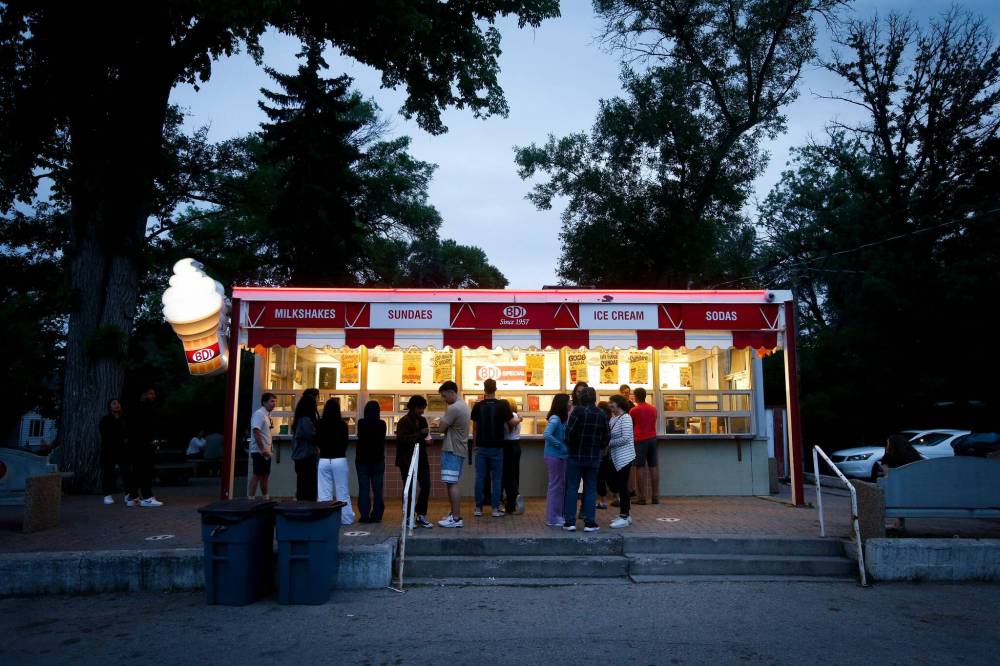
The design seems to be searching for the simplest form to fulfil its function. To (loosely) paraphrase Le Corbusier, the BDI could be considered “a machine for selling ice cream.”
It’s a nicely designed machine. In its description of the BDI, the Winnipeg Architecture Foundation quotes John W. Graham’s 1960 study of Winnipeg buildings: “No other roadside concession in the city approaches the high quality of this one.”
Citing the BDI’s simple lines and honest use of basic materials, particularly its exposed steel I-beams and trusses, the WAF points to the influence of the International Style, a movement generally characterized as rational, functional and sober-minded.
On top of those good International Style bones, though, there is a dressing of other modern styles, more vernacular and — crucially, for a structure that’s all about sweet summer treats — a little more lighthearted. With its bright, exuberant red-and-white colour scheme, its prominent signage and its designation as a “drive in,” the BDI also seems to suggest the Googie style, a movement named for Googie’s Coffee Shop on Sunset Boulevard in West Hollywood, designed in 1949 by John Lautner.
Andrew Burke, a professor of English at the University of Winnipeg who writes on the visual culture of modernity, sees layers of references in the BDI. As he suggests, “The building itself is in line with a certain kind of formal modernism, but it’s trying to have fun as well.”
Googie design is fun, all right. It’s visually catchy with a peppy vibe. Googie buildings might use punchy, hard-angled lines or swoopy curves. They often feature prominent signage, frequently neon, and sometimes make futuristic, space-age references.
JOHN WOODS / WINNIPEG FREE PRESS Satisfied BDI customers on the Elm Park Bridge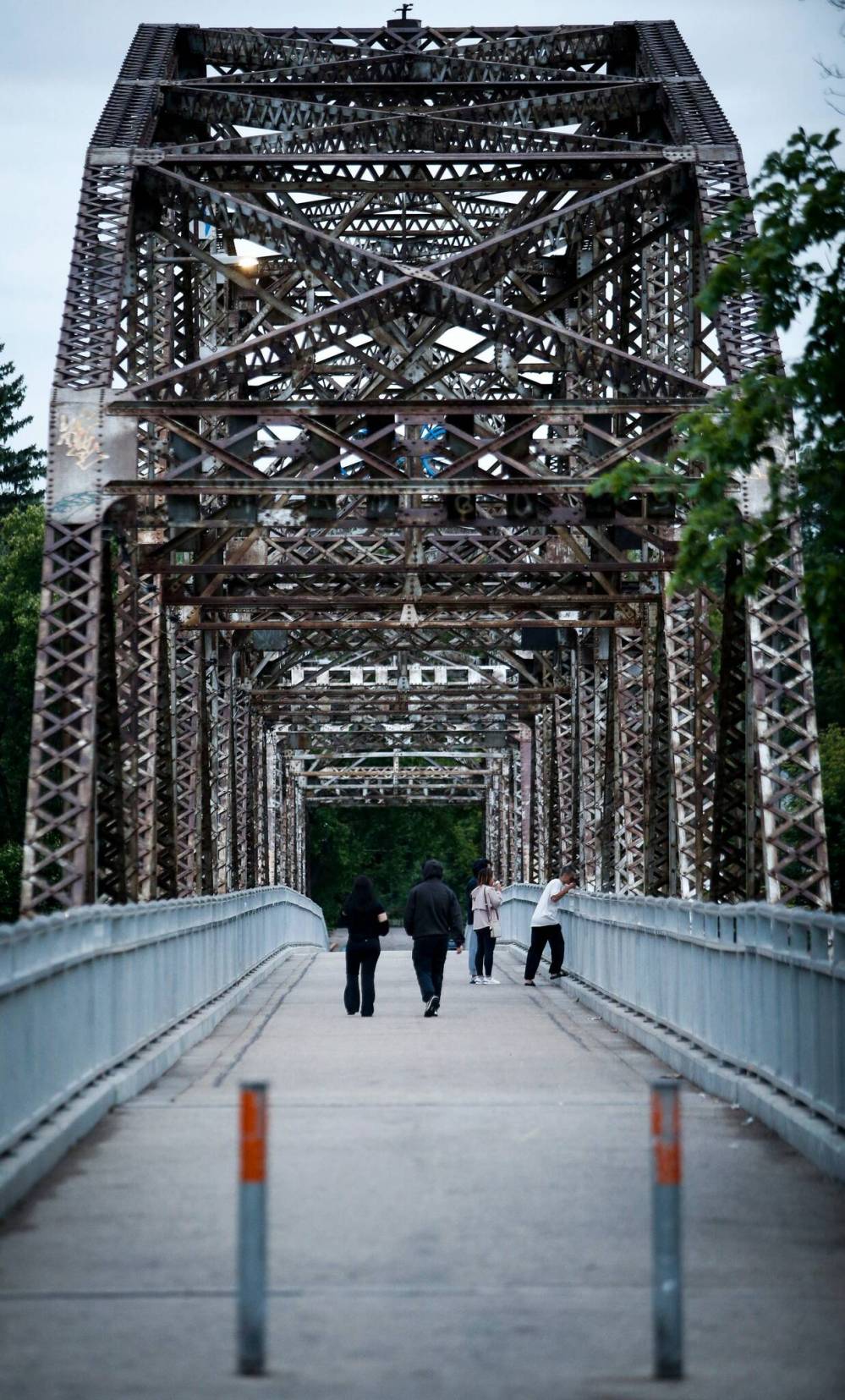
Designed for commercial appeal, the Googie style — along with such overlapping styles as Populuxe and Doo-Wop — was often seen in diners, car washes, bowling alleys, gas stations, roadhouse restaurants and drive-in theatres. It was associated with consumerism of a specifically postwar North American kind — usually involving some combination of gas, food and fun. It was closely connected to the rise of car culture and the notion of “building as brand.”
Historically, the BDI connects up to nearby landmarks along the Pembina Highway strip, many of them now gone and much missed, such as the cool Ringer’s Drugs sign, the whimsical Pancake House sign or the western-themed signage of the original Pony Corral Drive-Inn. Around the city, you could get a Googie kind of feel with the giant bowling pin sign at the Billy Mosienko Lanes on Main Street, the red neon letters spelling out the name of the Shanghai restaurant in Chinatown, or those vintage Safeway stores with their space-needle signage.
“They were signs of modernity — like, literally signs of modernity,” Burke points out. They advertised individual businesses, but, taken together, “these signs were also symbols — they told people that the city they were living in was a modern city, that it had all the ‘mod cons’ but also modern attractions.”
These signs served as visual indicators of “a brisk and busy metropolis,” as a 1958 visitors’ guide to Winnipeg proclaimed. They were also related to what Burke calls “the intensification of automobility.” Places like the BDI were meant to catch your eye as you zoomed past in your Buick Roadmaster.
“Any time you stumble on a little bit of the past inside the present, there’s this little rush that you get. With something like the BDI, it’s playing with the idea of time.”–Andrew Burke
“In the ’50s and into the ‘60s, Winnipeg truly becomes a city defined by the automobile, and designed for it,” Burke explains. “In a visual sense, these signs and markers are meant to be seen through a windshield. They are framed by the windshield, meant to be recognizable and decodable at a glance.”
The BDI’s distinctive red-and-white colour scheme is seen in its awning, which promises shakes, sundaes and sodas, and repeated in everything from its benches down to its cups. It now marks the business’s roving food truck.
The BDI also boasts a big light-up sign in the shape of an ice cream cone, slanting toward Jubilee. A recent 2017 addition to mark the business’s 60th anniversary, this new sign really leans into a Googie-style effect.
JOHN WOODS / WINNIPEG FREE PRESS The BDI sign adheres to a midcentury design style known as Googie.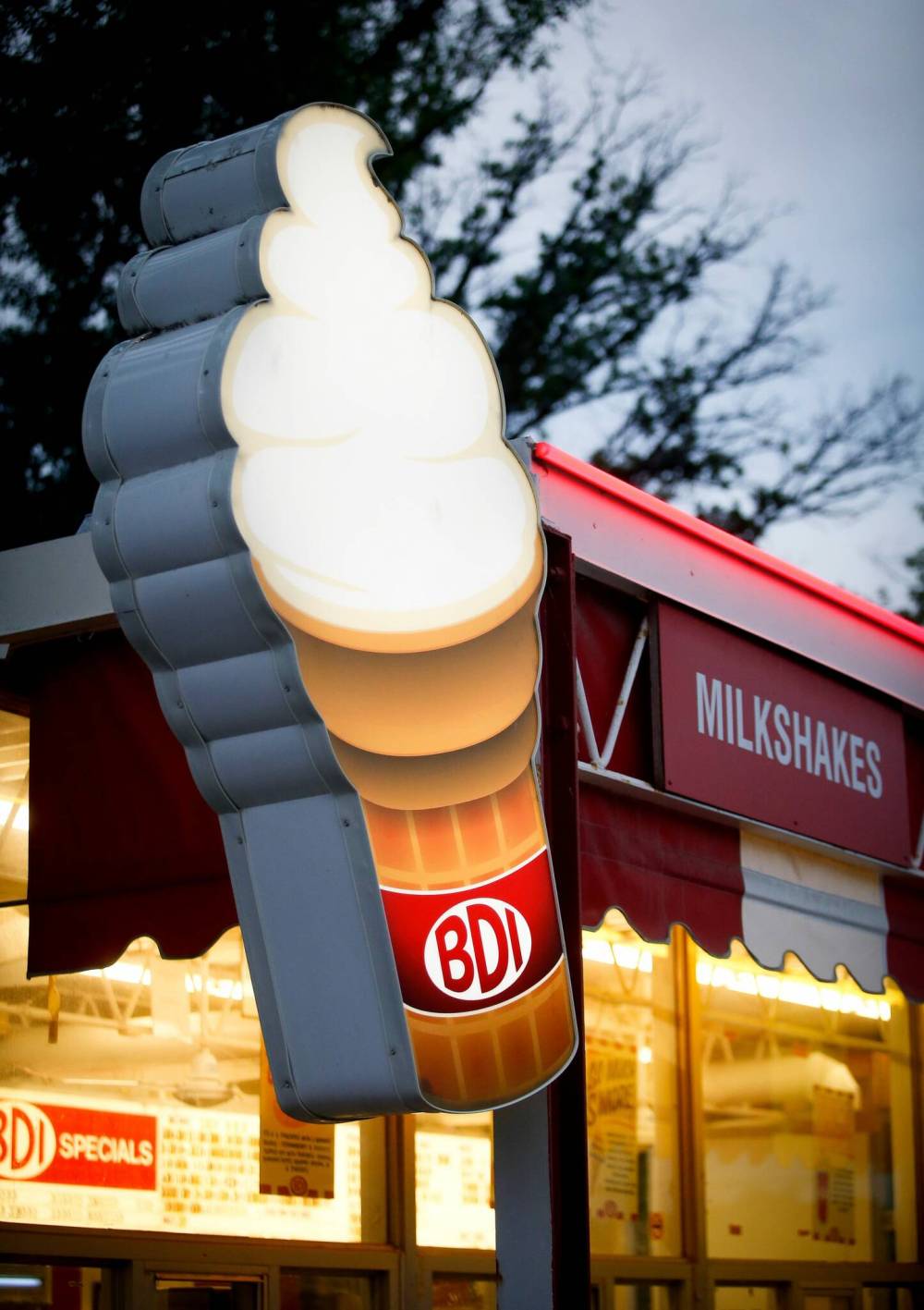
At night, the structure glows like a lantern, drawing in crowds looking to cool down after a hot summer day. The whole design functions as “a kind of landmark, saying ‘Turn here,’” Burke suggests.
The 1950s look might also appeal to notoriously nostalgia-prone Winnipeggers. “Any time you stumble on a little bit of the past inside the present, there’s this little rush that you get,” Burke suggests. “With something like the BDI, it’s playing with the idea of time.
“When it’s first built in the late ’50s, on the one hand, there’s a desire to be futuristic. And with the architectural design, it’s very modern,” Burke says, particularly compared with the wooden shacks often used for roadside food during that period.
“But with its awning, its signage, it quickly becomes a kind of retro-futurism. It is both firmly bounded by time in the late ’50s and somehow out of time. It’s anticipating a futurism that doesn’t really come to pass.
“It’s a bit of a Jetsons experience.”
There’s also the whole process of getting your ice cream, in which design again plays a part. Because of the continuous windows, there’s a literal transparency to the production.
“You can look inside,” Burke points out. “You stand at the counter and watch the ‘factory floor.’”
In the BDI’s early years, this would have involved what was then up-to-the-minute modern technology. Even now, it can be kind of fascinating to watch your Saltzberg going through all its creamy, crunchy cumulative stages.
JOHN WOODS / WINNIPEG FREE PRESS Lining up for BDI ice cream is considered an essential part of the experience.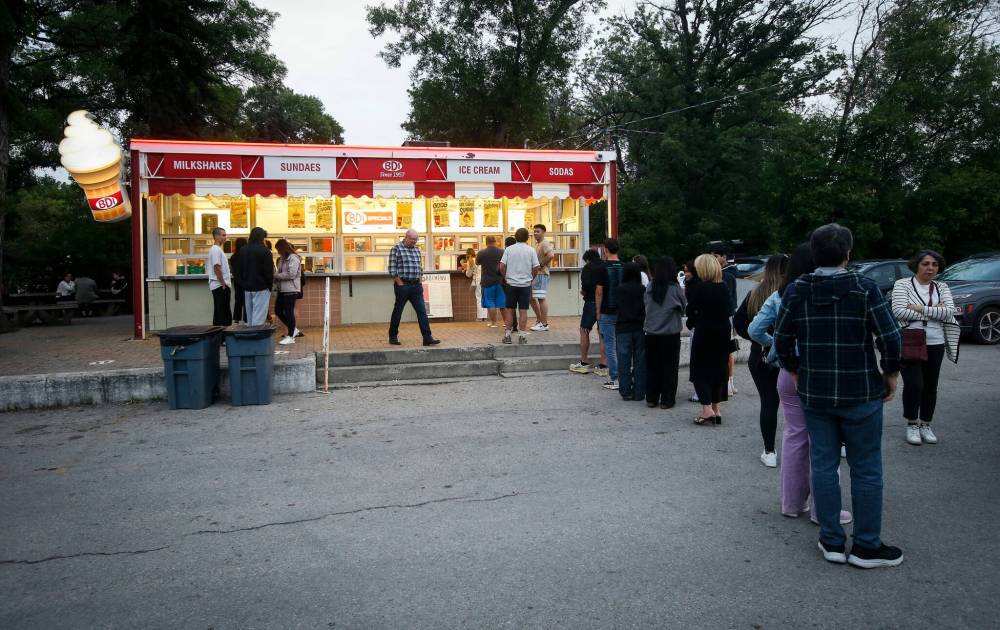
Because of the BDI’s happy design, even the standing-in-line part — which can involve patting other people’s dogs, changing (and rechanging) your mind about your order, chatting, posting to social media — even that can be kind of fun.
“With the foreshortened Winnipeg summer, we need to line up because we have only a couple of months of intensified demand,” Burke says. “So, of course that has to be part of the experience, lining up with other people who are also trying to make the most of their short summer.”
With design that calls up a midcentury moment but still remains fresh decades later, the BDI reminds us that summer may be brief, but it will always come again.
alison.gillmor@winnipegfreepress.com

Studying at the University of Winnipeg and later Toronto’s York University, Alison Gillmor planned to become an art historian. She ended up catching the journalism bug when she started as visual arts reviewer at the Winnipeg Free Press in 1992.
Our newsroom depends on a growing audience of readers to power our journalism. If you are not a paid reader, please consider becoming a subscriber.
Our newsroom depends on its audience of readers to power our journalism. Thank you for your support.