

Alzheimer’s has sent my mother back in time

Advertisement
Read this article for free:
or
Already have an account? Log in here »
To continue reading, please subscribe:

Digital Subscription
One year of digital access for only $205*
- Enjoy unlimited reading on winnipegfreepress.com
- Read the E-Edition, our digital replica newspaper
- Access News Break, our award-winning app
- Play interactive puzzles
*First annual payment billed as $205.00 + GST for one year. This annual subscription will automatically renew at $233.00 + GST every 52 weeks (10% off the regular annual price of $259.35). Offer available to new and qualified returning subscribers only. Cancel any time.
To continue reading, please subscribe:
Add Free Press access to your Brandon Sun subscription for only an additional
$1 for the first 4 weeks*
- Enjoy unlimited reading on winnipegfreepress.com
- Read the E-Edition, our digital replica newspaper
- Access News Break, our award-winning app
- Play interactive puzzles
*Your next Brandon Sun subscription payment will increase by $1.00 and you will be charged $17.95 plus GST for four weeks. After four weeks, your payment will increase to $24.95 plus GST every four weeks.
Read unlimited articles for free today:
or
Already have an account? Log in here »
My mother does a lot of time-travelling — time-shifting, the Alzheimer’s Society calls it.
I wonder how it feels to be in the present at one moment and then suddenly catapulted deep into the past. Is it a jolting experience or a smooth transition to go back and forth in time?
Mom will never be able to tell me. There is so much she can never tell me now.
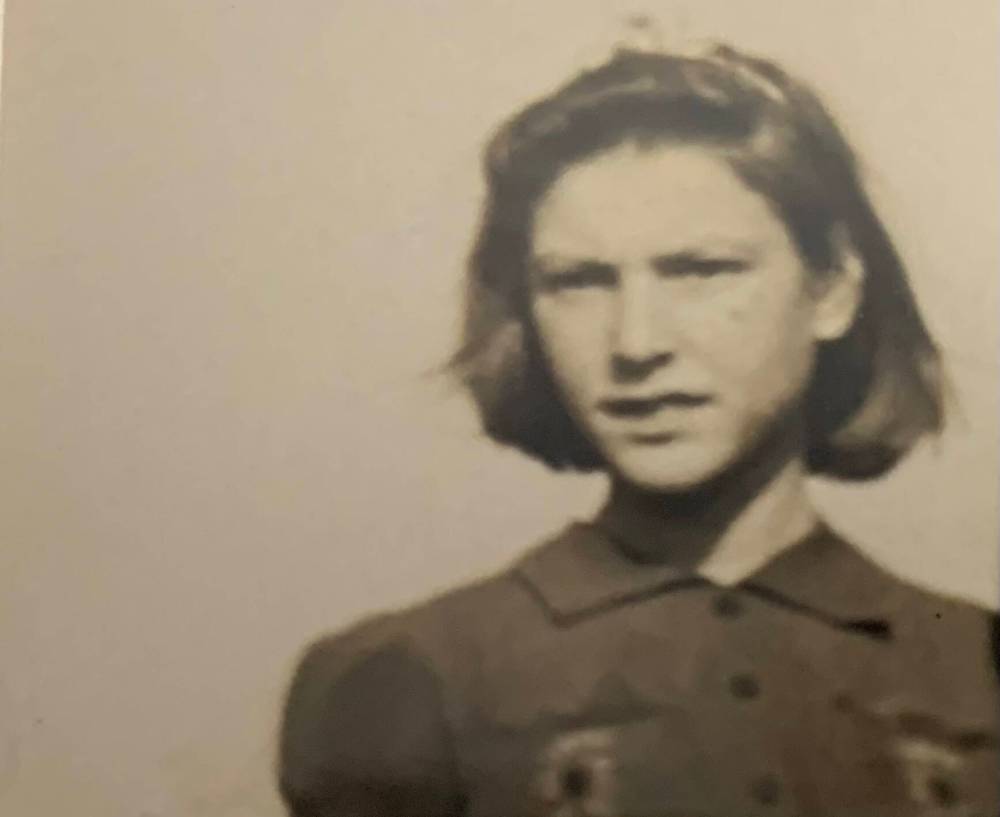
SUPPLIED
Vera Frampton as a teenager in Stone’s Cove, Newfoundland and Labrador, in the 1940s.
She can still recite her children’s names when prompted, but she doesn’t ask us about our lives. Instead, she talks about her younger siblings, their grandfather who was hard of hearing, the isolated place where they used to live whose inhabitants were resettled nearly 60 years ago.
It’s a phenomenon that’s familiar to the loved ones of people with progressive neurological disorders.
When I greeted my mother on a recent visit, she asked who I was, and I asked her name.
“I don’t think I have one of those,” she said nonchalantly, “though I probably have one around here somewhere.”
Her answer would have been funny were it not for the fact that after more than 20 years of Alzheimer’s, her own name was the one thing she never forgot.
I thought I had a firm grip on how vulnerable my mother has become until she ended up at emergency recently after an episode when she became weak and her heart was racing.
Holding her hand as she lay on her stretcher, I soon realized she was unfazed by being in the hospital because she wasn’t aware she was in a hospital.
At one point a young woman in extreme distress was wheeled into the cubicle next door as my mother was cheerfully singing the Newfoundland folk song The Squid Jiggin’ Ground:
“Says Barney, ‘The squids are on top of the water
I just felt me jiggers jig five fathoms down’
But a squid in the boat squirted right down his throat
Now he’s swearin’ like mad on the Squid Jiggin’ Ground”
But my mother’s equilibrium was shattered whenever a nurse appeared to check her vitals or do diagnostic tests.
The blood pressure cuff caused her to cry out in distress as it tightened on the thin skin of her arm. She clearly could not understand why the procedure was continuing despite her protestations.
During other pokings and proddings, her eyes widened in fear and she wept. I felt a piece of my heart break when she looked at me frantically and cried, “I want my daddy!”
I guess it is to be expected that her thoughts turned to the person who had been her childhood protector, even though he was lost at sea 71 years ago. How cruel a disease Alzheimer’s is, tricking your own brain into thinking someone might yet come to save the day.
I wondered if she thought that we — her daughters and sons-in-law — were somehow co-conspirators, authorizing and condoning the procedures she was having to endure. I consoled myself with the thought that she would not remember this trauma, her helplessness and terror, just as I would never be able to forget.
There were moments when I wondered if she would die in this spartan cubicle, pale and frail in her flowered, flannel nightgown and her white cotton compression socks — glasses and shoes left behind in the haste to get her to hospital.
So it was a relief to finally be able to return her to the carers at her retirement home with a prescription for antibiotics after a long and emotionally fraught day.
I am buoyed by the recent announcement from billionaire Bill Gates that advancements are being made on the Alzheimer’s front. In a blog post in June, he heralded the development of new blood tests that will detect Alzheimer’s early on and boost the effectiveness of dementia-slowing drugs.
“The good news is that our understanding of the disease is improving rapidly,” Gates writes, “and I expect to see plenty more breakthroughs in the months and years ahead.”
It’s a prediction I hope plays out in my lifetime, but sadly it is too late for my mother and the roughly half a million Canadians who are suffering now.

Barb Drummond, an author from Peace River, Alta., who writes about her late mother’s Alzheimer’s, once said, “In this journey, it wasn’t her forgetting that broke me. It was the glimpses of her remembering.”
That’s how I feel, too. I wish I could time-travel alongside Mom and lead her back into the circle of her loving childhood family, back to the snug harbour where she played as a girl and dreamed sweet dreams of life and the adventures to come.
But all I can do is try to be there when she needs me, to hold her hand and let her know she’s safe, wherever she may be.
Pam Frampton lives in St. John’s.
pamelajframpton@gmail.com
Pam Frampton is a columnist for the Free Press. She has worked in print media since 1990 and has been offering up her opinions for more than 20 years. Read more about Pam.
Pam’s columns are built on facts, but offer her personal views through arguments and analysis. Every column Pam produces is reviewed by an editing team before it is posted online or published in print — part of the Free Press‘s tradition, since 1872, of producing reliable independent journalism. Read more about Free Press’s history and mandate, and learn how our newsroom operates.
Our newsroom depends on a growing audience of readers to power our journalism. If you are not a paid reader, please consider becoming a subscriber.
Our newsroom depends on its audience of readers to power our journalism. Thank you for your support.
Pam Frampton is a columnist for the Free Press. She has worked in print media since 1990 and has been offering up her opinions for more than 20 years. Read more about Pam.
Pam’s columns are built on facts, but offer her personal views through arguments and analysis. Every column Pam produces is reviewed by an editing team before it is posted online or published in print — part of the Free Press‘s tradition, since 1872, of producing reliable independent journalism. Read more about Free Press’s history and mandate, and learn how our newsroom operates.
Our newsroom depends on a growing audience of readers to power our journalism. If you are not a paid reader, please consider becoming a subscriber.
Our newsroom depends on its audience of readers to power our journalism. Thank you for your support.
Advertisement Advertise With Us
Advertisement Advertise With Us