‘Native American’ or ‘Indigenous’? Journalism group rethinks name
Advertisement
Read this article for free:
or
Already have an account? Log in here »
To continue reading, please subscribe:

Digital Subscription
One year of digital access for only $205*
- Enjoy unlimited reading on winnipegfreepress.com
- Read the E-Edition, our digital replica newspaper
- Access News Break, our award-winning app
- Play interactive puzzles
*First annual payment billed as $205.00 + GST for one year. This annual subscription will automatically renew at $233.00 + GST every 52 weeks (10% off the regular annual price of $259.35). Offer available to new and qualified returning subscribers only. Cancel any time.
To continue reading, please subscribe:
Add Free Press access to your Brandon Sun subscription for only an additional
$1 for the first 4 weeks*
- Enjoy unlimited reading on winnipegfreepress.com
- Read the E-Edition, our digital replica newspaper
- Access News Break, our award-winning app
- Play interactive puzzles
*Your next Brandon Sun subscription payment will increase by $1.00 and you will be charged $17.95 plus GST for four weeks. After four weeks, your payment will increase to $24.95 plus GST every four weeks.
Read unlimited articles for free today:
or
Already have an account? Log in here »
Hey there, time traveller!
This article was published 08/08/2023 (1152 days ago), so information in it may no longer be current.
ATLANTA (AP) — The Native American Journalists Association is aiming to become more inclusive as its members vote on whether to rebrand as the Indigenous Journalists Association — a move inspired, in part, by evolving trends in cultural identity.
The group, with more than 950 members mostly in the United States, is expected to approve the change at its annual conference this week in Winnipeg, Canada. Voting on the new name, as well as branding that would replace a feather with an “ija” logo in stylized letters, runs through Thursday, Aug. 10.
Founded in part by Canadians in 1983, NAJA wants to foster inclusion with Indigenous journalists there as well as in Alaska and Hawaii, since “ Native American ” is a modern alternative for “ American Indian ” — referring specifically to the millions of descendants of the original inhabitants of what is now the Lower 48 states.
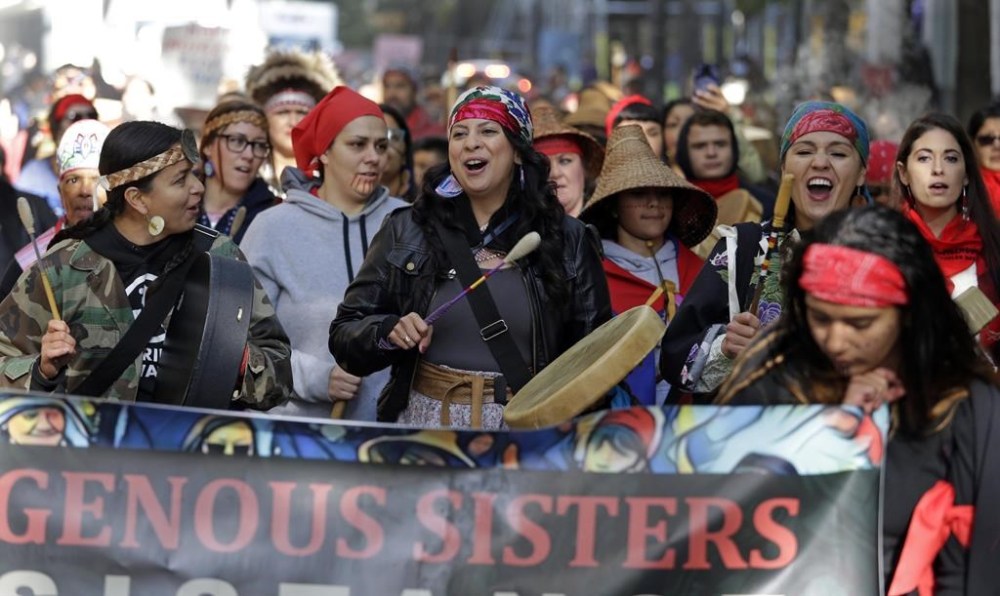
“Essentially, we’re going back to our roots and trying to create and provide support and resources for Indigenous journalists all across Turtle Island,” board member Jourdan Bennett-Begaye said, invoking the term some Indigenous people use to refer to the North American continent.
More broadly, the proposed change aligns with terminology used by the United Nations and many multinational organizations as the group also seeks allies among Indigenous journalists worldwide. The Māori people in New Zealand, the Sámi people in Arctic Scandinavia and Russia, and the Mapuche people in Patagonia all face similar issues, with journalists who cover climate change, conflicts over land and resources and missing and murdered women, she said.
The change also would reflect an evolution in how Indigenous people see themselves. They’re increasingly calling for “decolonizing” language, moving away from terms that were imposed on them, like “Indian” — a legacy of Christopher Columbus’ infamous cartographic blunder — and even, in some contexts, “American,” which derives from a mapmaker’s effort to honor another Italian explorer, Amerigo Vespucci.
“It’s part of this larger movement that’s happening in Indigenous people, just reclaiming everything that’s theirs that should be theirs,” Bennett-Begaye said. “Since contact, decisions have been made for us and not by us.”
Still, some NAJA members have raised concerns that if the association globalizes, its focus on issues particular to Native Americans might be lost. Board members have proposed creating regional chapters if that happens.
“Indigenous is inoffensive, but it also doesn’t do any of the kind of distinct sovereignty work, distinct political work, distinct cultural affiliation ″ that other words do, said Elizabeth Ellis, a historian at Princeton University and an enrolled citizen of the Peoria Tribe of Indians of Oklahoma. “It doesn’t tell you much beyond the fact that you’re existing in opposition to a history and ongoing legacy of colonization.”
Usage of the word “Indigenous” has soared in recent years, particularly after demonstrations against the Dakota Access Pipeline in 2016 forged the largest pan-Indigenous alliance in North American history. Standing Rock marked a before and after for Native American visibility in the media and popular culture, Ellis said.
But the proliferation of its usage doesn’t mean other terms should disappear, because they’re not always interchangeable, said Ellis. Indian, American Indian, Native American, Native, and even “NDN” — a tongue-in-cheek slang popular in social media — each have distinct meanings and are appropriate in different contexts.
Indian, for example, is a historical reference used to connote barbarism to justify enslaving Indigenous people during the colonial era — settlers equated it to savagery while seizing more land and federal policies invoked it as a racist concept in the 19th century, Ellis said. “Indian Law” remains embedded in the U.S. Constitution and in the official names of many Indigenous nations, so its usage in such contexts is inescapable.
“Indigenous” applies worldwide, including to anyone whose ancestors didn’t come from somewhere else, and whose communities have endured oppression of their people. But it doesn’t reflect the particular duality that many Native Americans experience as citizens of their tribal nations as well as the U.S., Ellis said.
This is why many Native Americans, when communicating with wider audiences, identify themselves first by their tribal affiliations, and increasingly, in their Indigenous language. Ellis intentionally introduces herself as Peewaalia, just as Bennett-Begaye tells people she’s Diné, a member of the Navajo Nation.
Young people in particular are driving these changes in language, Bennett-Begaye said.
“A lot of older folks, and across Indian Country, they still call themselves Indian. My late grandmother, she still calls herself Indian,” she said. “But young people … they see that as derogatory. They’re like, ‘We don’t call ourselves that.’ And I think that’s the cool part, like, young people owning their identity.”
As editor of Indian Country Today, Bennett-Begaye oversaw that media organization’s recent name change to ICT, prompted by conversations about identity that were happening across the United States after the police killing of George Floyd in 2020.
For older generations, ICT can still mean Indian Country Today, while for younger folks, it can mean Indigenous Cultures Today, or Indigenous Communities Today, she said. “We really left it up to interpretation for our readers and our audience.”
___
This story was first published on August 8, 2023. It was updated on August 10, 2023 to correct where the group was founded. It was founded in the U.S., in part by Canadians, not in Canada.