Some plants are more flammable than others. How gardeners can reduce the risks

Advertisement

Advertise with us

The deadly wildfires in Hawaii this month were fueled in part by plants, in particular invasive grasses that have taken over land once occupied by sugar and pineapple plantations.

Read this article for free:


or

Already have an account? Log in here »

To continue reading, please subscribe:

Subscribe and receive a limited-edition Free Press branded hat or tote.

Digital Subscription

One year of digital access for only $205*

  • Enjoy unlimited reading on winnipegfreepress.com
  • Read the E-Edition, our digital replica newspaper
  • Access News Break, our award-winning app
  • Play interactive puzzles

*First annual payment billed as $205.00 + GST for one year. This annual subscription will automatically renew at $233.00 + GST every 52 weeks (10% off the regular annual price of $259.35). Offer available to new and qualified returning subscribers only. Cancel any time.

To continue reading, please subscribe:

Add Free Press access to your Brandon Sun subscription for only an additional

$1 for the first 4 weeks*

  • Enjoy unlimited reading on winnipegfreepress.com
  • Read the E-Edition, our digital replica newspaper
  • Access News Break, our award-winning app
  • Play interactive puzzles
Start now

*Your next Brandon Sun subscription payment will increase by $1.00 and you will be charged $17.95 plus GST for four weeks. After four weeks, your payment will increase to $24.95 plus GST every four weeks.

Hey there, time traveller!
This article was published 22/08/2023 (1144 days ago), so information in it may no longer be current.

The deadly wildfires in Hawaii this month were fueled in part by plants, in particular invasive grasses that have taken over land once occupied by sugar and pineapple plantations.

Some plants are more flammable than others, says Michele Steinberg, wildfire division director at the National Fire Protection Association. But “there is no such thing as a fireproof plant,” she says — all plants can ignite under the right conditions.

Those conditions include improper pruning, insufficient watering, and poor sanitation practices that allow dry, dead plant parts to remain on the soil surface in high-risk areas.

This June 5, 2023, image provided by Jessica Damiano shows a “sunset orange glow” ice plant growing in Nassau County, N.Y. The plant’s water-filled, fleshy leaves make it a good choice for gardens in fire-prone areas. (Jessica Damiano via AP)

If you live in a fire-risk zone (or an area where climate change is increasing the fire risk) and are selecting plants for your garden, knowing which ones offer some fire resistance and which are more flammable will serve you well.

QUICKER TO CATCH FIRE

Plants that contain aromatic oils, resins, waxes or gummy sap are among the quickest to ignite, even if they’ve been well-watered and cared for. Those include acacia, bamboo, eucalyptus, Japanese honeysuckle, rosemary, Scotch broom and gas plant, which gets its name from the flammable vapor its flowers and leaves exude.

Trees with peeling, papery bark, like river birch, are generally more flammable than those without. And fine-needled evergreen shrubs and trees, like cedar, cypress, fir, juniper, pine and spruce, contain volatile saps and resins. Their dropped needles, left to dry on the ground – or the roof — further increase the fire risk. Redwoods, a notable exception, are considered fire-resistant due to the tannic acid in their bark.

Many grasses, such as the buffel, molasses and guinea types that fueled the Hawaii fires — as well as fountain and feather grasses — are considered highly flammable. Their ignitability increases when they are left to stand dry over winter or during periods of drought; excessive dry heat evaporates moisture from the soil and from them and many other kinds of plants, essentially turning them into kindling.

NATIVE vs. NON-NATIVE

As a group, “ native plants aren’t necessarily less flammable” than introduced species, Steinberg said.

But nonnative, invasive plants often pose higher fire risks because they spread readily, typically are left undisturbed by wildlife, outcompete native vegetation, and often tolerate heat, drought and heavy rains well. They can quickly cover fields, acres and even miles of land, where a spark, such as from lightning, can set them ablaze.

For the best fire resistance, select deciduous trees, like ash, crabapple, dogwood, locust, maple and oak, over fine-needled evergreens. Succulents with water-filled leaves, like ice plants and sedums, are slow burners, as are some groundcovers, like ajuga and creeping phlox.

WHAT TO LOOK FOR IN PLANTS

The Washington State University Extension Service has published valuable guidelines identifying these general plant characteristics as fire-resistant:

• High moisture content in leaves (these ignite and burn more slowly).
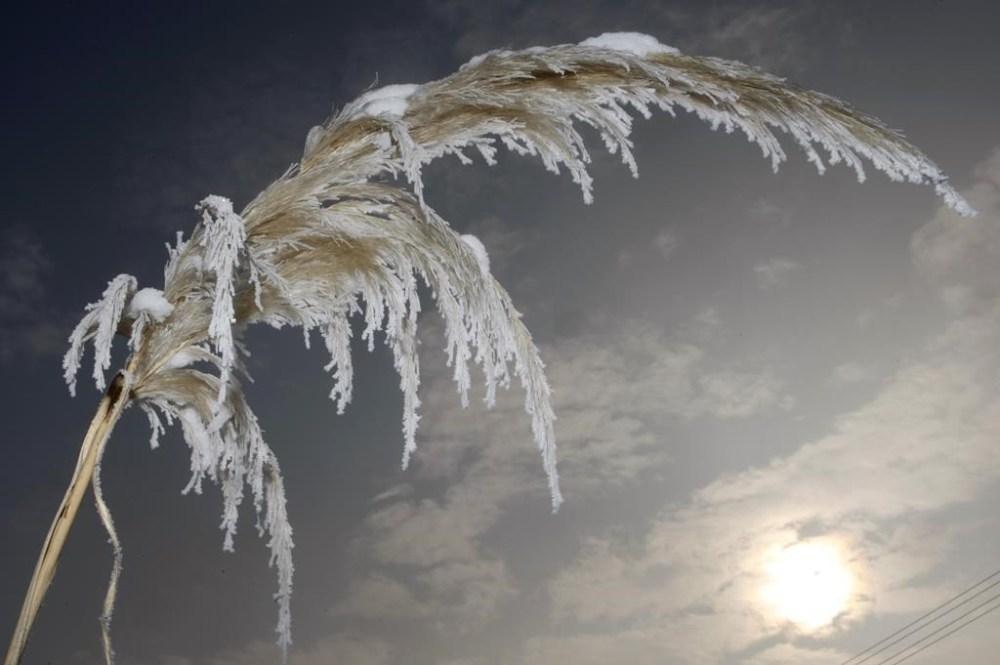
FILE - Pampas grass (Cortaderia selloana) covered with rime appears in Ludwigsburg, Germany on March 12, 2010. Experts say some plants are more flammable than others but all plants can ignite under the right conditions. Those conditions include improper pruning, insufficient watering, and poor sanitation practices that allow dry, dead plant parts to remain on the soil surface. (AP Photo/Thomas Kienzle, File)

• Little or no seasonal accumulation of dead vegetation.

• Open branching habits (they provide less fuel for fires).

• Fewer total branches and leaves (again, less fuel for fires).

• Slow-growing, so less pruning is required (to keep open structure as noted above).

• Non-resinous material on the plant (i.e., stems, leaves, or needles that are not resinous, oily or waxy).

—-

Jessica Damiano writes the award-winning Weekly Dirt Newsletter and regular gardening columns for The AP. Sign up here to get weekly gardening tips and advice delivered to your inbox.

—-

For more AP gardening stories, go to https://apnews.com/search?q=gardening#nt=navsearch

Report Error Submit a Tip

More Stories

Puzzles Palace

1 minute read Monday, Jul. 27, 2026

To solve our puzzles, please subscribe with this special offer: |

Dog feces vandalism shuts down food pantry

Kelly-Anne Riess 4 minute read Preview

Dog feces vandalism shuts down food pantry

Kelly-Anne Riess 4 minute read Yesterday at 6:54 PM CDT

A few shelves set up beneath a West End community notice board were meant to offer a place where neighbours could leave food for anyone who needed it.

Read
Yesterday at 6:54 PM CDT

Bjorck banking on patience that first NHL point will come

Mike McIntyre 6 minute read Preview

Bjorck banking on patience that first NHL point will come

Mike McIntyre 6 minute read Yesterday at 6:22 PM CDT

Viggo Bjorck believes it’s just a matter of time.

But the 18-year-old rookie forward for the Winnipeg Jets says he’s not worrying about his first NHL point after plenty of close calls and near misses so far.

The more important number is 3-0-1 — his team’s record at this point as they head into action on Friday night, hosting the Anaheim Ducks at Canada Life Centre to close out a busy stretch of five games in eight days.

“Just got to keep trying. Eventually it will come, I believe,” Bjorck said following his team’s optional skate on Thursday, which he participated in.

Read
Yesterday at 6:22 PM CDT

Release police HQ report: Klein

Joyanne Pursaga 5 minute read Preview

Release police HQ report: Klein

Joyanne Pursaga 5 minute read Yesterday at 8:49 PM CDT

Mayoral candidate Kevin Klein is lobbying the province to release the final report from the public inquiry into the Winnipeg Police Service headquarters before the upcoming municipal election.

Klein wrote to the provincial government to request that the information be shared promptly and before Winnipeg voters go to the polls on Oct. 28.

A Thursday CBC report stated the document is finished, “has been sent to the printer” and submitted to the province but isn’t expected to be publicly released until after Winnipeg’s Oct. 28 municipal election.

“It’s all about accountability. The report is done. People have waited (many) years,” said Klein.

Read
Yesterday at 8:49 PM CDT

Bombers still control post-season destiny

Taylor Allen 6 minute read Preview

Bombers still control post-season destiny

Taylor Allen 6 minute read Wednesday, Oct. 7, 2026

Jake Ceresna was confident he was putting pen to paper with a Grey Cup contender.

When the star defensive tackle signed with the Winnipeg Blue Bombers in free agency back in February, did he foresee any scenario in which they’d be under .500 at this point in the season and in danger of missing the playoffs?

“That’s a good question,” Ceresna admitted after Wednesday’s closed practice.

“Obviously, at the beginning of the year, you think you’re gonna go 18-0. But the reality of life is there’s roller-coasters. There’s going to be hard times, there’s going to be good times. We’re in the valley right now and we just have to come out of it and get back to the peak.”

Read
Wednesday, Oct. 7, 2026

See silver lining to your impossible crush

Maureen Scurfield 4 minute read Yesterday at 2:01 AM CDT

DEAR MISS LONELYHEARTS: I’m in love with my sister’s boyfriend, and neither one of them knows it. They’re both grad students and came back home from the province where they are studying to write and spend the summer in Manitoba.

Thankfully, they’ve gone back home because it was becoming too much for me to bear. My sister’s guy is perfect for me, but she already owns him and I’m too young to fight her for him.

Still, the two of them don’t realize the depth of my feelings. I don’t know how to behave when they get cosy around me and I feel so jealous I want to scream. I’m not sure what to do next.

This week I got an email from my artsy-fartsy sister with an invitation to come visit them in December and go to some fun plays and parties with them and their friends. They even promised my Christmas present from them will be my plane ticket.