College students are still struggling with basic math. Professors blame the pandemic
Advertisement
Read this article for free:
or
Already have an account? Log in here »
To continue reading, please subscribe:

Digital Subscription
One year of digital access for only $205*
- Enjoy unlimited reading on winnipegfreepress.com
- Read the E-Edition, our digital replica newspaper
- Access News Break, our award-winning app
- Play interactive puzzles
*First annual payment billed as $205.00 + GST for one year. This annual subscription will automatically renew at $233.00 + GST every 52 weeks (10% off the regular annual price of $259.35). Offer available to new and qualified returning subscribers only. Cancel any time.
To continue reading, please subscribe:
Add Free Press access to your Brandon Sun subscription for only an additional
$1 for the first 4 weeks*
- Enjoy unlimited reading on winnipegfreepress.com
- Read the E-Edition, our digital replica newspaper
- Access News Break, our award-winning app
- Play interactive puzzles
*Your next Brandon Sun subscription payment will increase by $1.00 and you will be charged $17.95 plus GST for four weeks. After four weeks, your payment will increase to $24.95 plus GST every four weeks.
Read unlimited articles for free today:
or
Already have an account? Log in here »
Hey there, time traveller!
This article was published 30/08/2023 (1118 days ago), so information in it may no longer be current.
FAIRFAX, Va. (AP) — Diego Fonseca looked at the computer and took a breath. It was his final attempt at the math placement test for his first year of college. His first three tries put him in pre-calculus, a blow for a student who aced honors physics and computer science in high school.
Functions and trigonometry came easily, but the basics gave him trouble. He struggled to understand algebra, a subject he studied only during a year of remote learning in high school.
“I didn’t have a hands-on, in-person class, and the information wasn’t really there,” said Fonseca, 19, of Ashburn, Virginia, a computer science major who hoped to get into calculus. “I really struggled when it came to higher-level algebra because I just didn’t know anything.”
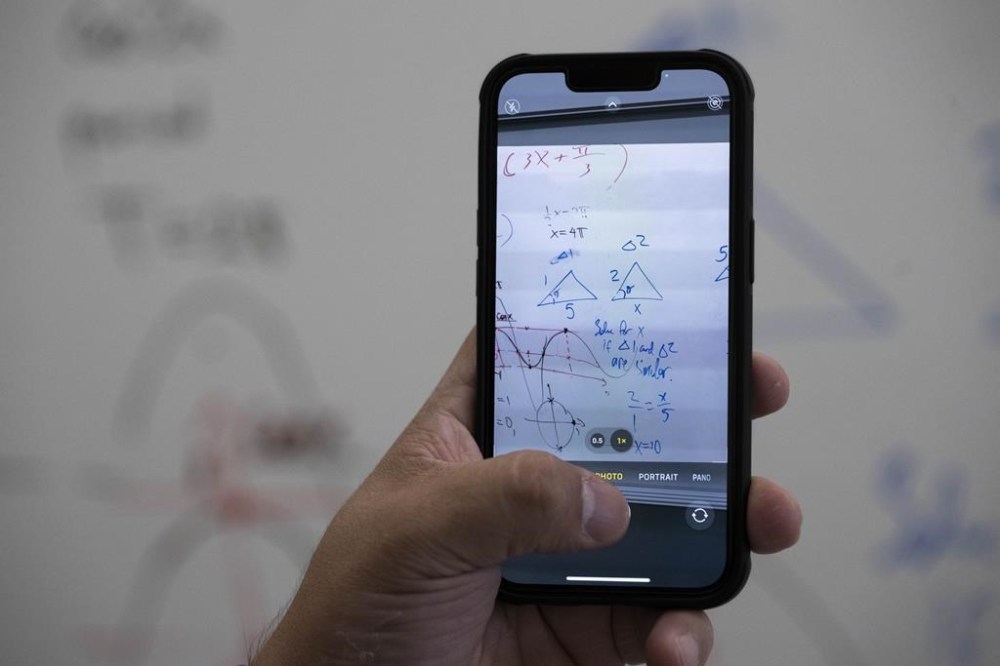
Fonseca is among 100 students who opted to spend a week of summer break at George Mason University brushing up on math lessons that didn’t stick during pandemic schooling. The northern Virginia school started Math Boot Camp because of alarming numbers of students arriving with gaps in their math skills.
Colleges across the country are grappling with the same problem as academic setbacks from the pandemic follow students to campus. At many universities, engineering and biology majors are struggling to grasp fractions and exponents. More students are being placed into pre-college math, starting a semester or more behind for their majors, even if they get credit for the lower-level classes.
Colleges largely blame the disruptions of the pandemic, which had an outsize impact on math. Reading scores on the national test known as NAEP plummeted, but math scores fell further, by margins not seen in decades of testing. Other studies find that recovery has been slow.
At George Mason, fewer students are getting into calculus — the first college-level course for some majors — and more are failing. Students who fall behind often disengage, disappearing from class.
“This is a huge issue,” said Maria Emelianenko, chair of George Mason’s math department. “We’re talking about college-level pre-calculus and calculus classes, and students cannot even add one-half and one-third.”
For Jessica Babcock, a Temple University math professor, the magnitude of the problem hit home last year as she graded quizzes in her intermediate algebra class, the lowest option for STEM majors. The quiz, a softball at the start of the fall semester, asked students to subtract eight from negative six.
“I graded a whole bunch of papers in a row. No two papers had the same answer, and none of them were correct,” she said. “It was a striking moment of, like, wow — this is significant and deep.”
Before the pandemic, about 800 students per semester were placed into that class, the equivalent of ninth grade math. By 2021, it swelled to nearly 1,400.
“It’s not just that they’re unprepared, they’re almost damaged,” said Brian Rider, Temple’s math chair. “I hate to use that term, but they’re so behind.”
Researchers say math learning suffered for various reasons. An intensely hands-on subject, math was hard to translate to virtual classrooms. When students fell behind in areas like algebra, gaps could go unnoticed for a year or more as they moved to subjects such as geometry or trigonometry. And at home, parents are generally more comfortable helping with reading than math.
As with other learning setbacks, math issues are most pronounced among Black, Latino, low-income and other vulnerable students, said Katharine Strunk, who led a study on learning delays in Michigan and is now dean of the graduate school of education at the University of Pennsylvania.
“Those are the students who were most impacted by the pandemic, and they’re the ones who are going to suffer the longer-term consequences,” she said. “They’re not going to have the same access.”
Colleges say there’s no quick fix. Many are trying to identify gaps sooner, adopting placement tests that delve deeper into math skills. Some are adding summer camps like George Mason’s, which helped participants increase placement test scores by 59% on average.
In lieu of traditional remedial classes, which some research finds to be ineffective, more schools are offering “corequisite” classes that help students shore up on the basics while also taking higher courses like calculus.
Penn State tackled the problem by expanding peer tutoring. Professors report that students who participate have scored 20% higher on exams, said Tracy Langkilde, dean of Penn State’s College of Science.
What’s becoming a persistent problem at some colleges has been a blip for others. At Iowa State University, known for its engineering program, students entering in 2020 were far more likely to be placed in lower-level math classes, and grades fell. That group of students has had continued trouble, but numbers improved for the following year’s class, said Eric Weber, math department chair.
At Temple, there’s been no rebound. Professors tried small changes: expanded office hours, a new tutoring center, pared-down lessons focused on the essentials.
But students didn’t come for help, and they kept getting D’s and F’s. This year, Babcock is redesigning the algebra course. Instead of a traditional lecture, it’ll focus on active learning, an approach that demands more participation and expands students’ role in the learning process. Class will be more of a group discussion, with lots of problems worked in-class.
“We really want students to feel like they’re part of their learning,” Babcock said. “We can’t change their preparation coming in, but we can work to meet their needs in the best way possible.”
George Mason also is emphasizing active learning. Its new placement test helps students find gaps and fill them in before taking it again, with up to four attempts. During the school year, students struggling in math can switch to slower-paced versions that take two terms instead of one.
At math camp, Fonseca felt he was making up ground. He studied hard, doing practice problems on the train ride to camp. But when he got to the placement test’s algebra portion, he made the same mistakes. His final score again placed him in pre-calculus.
The setback would have meant spending at least one extra semester catching up on math at George Mason. In the end, Fonseca decided to start at Northern Virginia Community College. After two years, he plans to transfer to one of Virginia’s public four-year universities.
A couple weeks after camp, Fonseca again found himself taking a placement test, this time for the community college.

“I managed to use the knowledge of the boot camp, and I got into calculus,” he said. “I didn’t have any expectation I’d do that.”
___
The Education Reporting Collaborative, a coalition of eight newsrooms, is documenting the math crisis facing schools and highlighting progress. Members of the Collaborative are AL.com, The Associated Press, The Christian Science Monitor, The Dallas Morning News, The Hechinger Report, Idaho Education News, The Post and Courier in South Carolina, and The Seattle Times.
___
The Associated Press education team receives support from the Carnegie Corporation of New York. The AP is solely responsible for all content.