Spicy food challenges have a long history. Have they become too extreme?

Advertisement

Advertise with us

NEW YORK (AP) — A tortilla chip maker's decision to pull its extremely spicy product sold as a “One Chip Challenge” from store shelves following the death of a Massachusetts teen has renewed attention on the popularity — and risks — of similar dares marketed by brands and spread widely online.

Read this article for free:


or

Already have an account? Log in here »

To continue reading, please subscribe:

Subscribe and receive a limited-edition Free Press branded hat or tote.

Digital Subscription

One year of digital access for only $205*

  • Enjoy unlimited reading on winnipegfreepress.com
  • Read the E-Edition, our digital replica newspaper
  • Access News Break, our award-winning app
  • Play interactive puzzles

*First annual payment billed as $205.00 + GST for one year. This annual subscription will automatically renew at $233.00 + GST every 52 weeks (10% off the regular annual price of $259.35). Offer available to new and qualified returning subscribers only. Cancel any time.

To continue reading, please subscribe:

Add Free Press access to your Brandon Sun subscription for only an additional

$1 for the first 4 weeks*

  • Enjoy unlimited reading on winnipegfreepress.com
  • Read the E-Edition, our digital replica newspaper
  • Access News Break, our award-winning app
  • Play interactive puzzles
Start now

*Your next Brandon Sun subscription payment will increase by $1.00 and you will be charged $17.95 plus GST for four weeks. After four weeks, your payment will increase to $24.95 plus GST every four weeks.

Hey there, time traveller!
This article was published 11/09/2023 (1114 days ago), so information in it may no longer be current.

NEW YORK (AP) — A tortilla chip maker’s decision to pull its extremely spicy product sold as a “One Chip Challenge” from store shelves following the death of a Massachusetts teen has renewed attention on the popularity — and risks — of similar dares marketed by brands and spread widely online.

Spicy food challenges have been around for years. From local chile pepper eating contests to restaurant walls of fame for those who finished extra hot dishes, people around the world have been daring each other to eat especially fiery foods, with some experts pointing to the internal rush of competition and risk-taking.

But extremely spicy products created and marketed solely for the challenges — and possible internet fame — is a more recent phenomenon, and teens are particularly exposed to them because of social media, associate professor of psychology at Florida International University Elisa Trucco says.
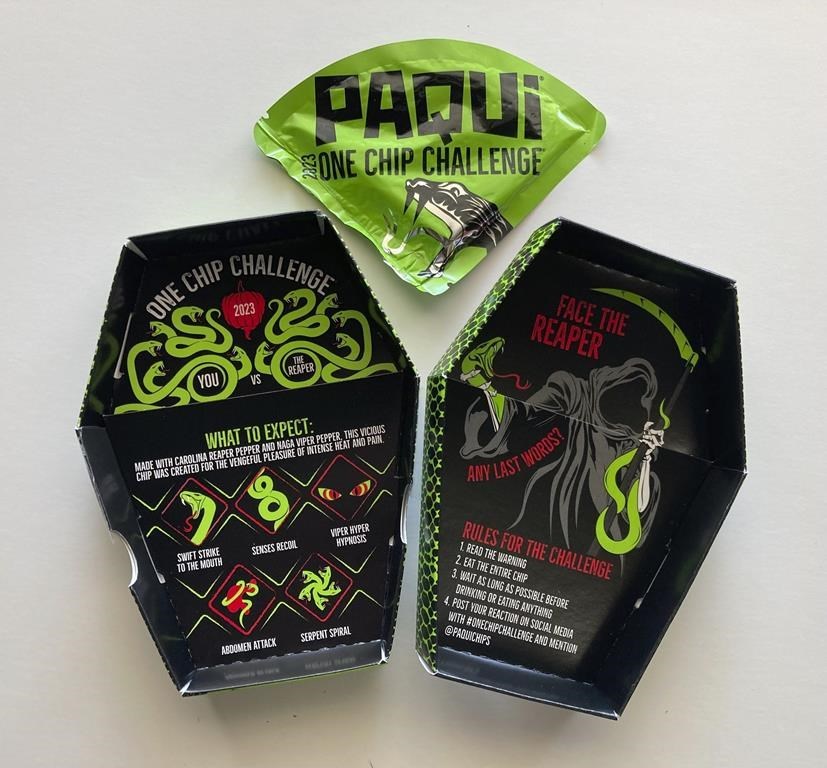
A package of Paqui OneChipChallenge spicy tortilla chips is seen on Thursday, Sept. 7, 2023, in Boston. Authorities are raising the alarm about a OneChipChallenge social media trend that encourages people to avoid seeking relief from eating and drinking for as long as possible after eating the chips, days after a Massachusetts teenager died hours after taking part in the challenge. The dare is popular on social media sites, with scores of people including children unwrapping the packaging, eating the chips and reacting to the heat. (AP Photo/Steve LeBlanc)

There’s a “glamorization of these challenges on social media,” Trucco said. “You see a lot of ‘likes’ or comments (indicating) social status or popularity from these challenges, but you don’t see a lot of the negative consequences — like the trips to the E.R. or other injuries.”

Alexander DePaoli, an associate teaching professor of marketing at Northeastern University, added that people may put themselves through discomfort and share it online for a sense of “in-group belonging,” similar to offline challenges as a game of truth or dare.

A YouTube series called “Hot Ones,” for example, rose to internet fame several years ago with videos of celebrities’ reactions to eating spicy wings. Meanwhile, restaurants nationwide continue to offer in-person challenges — from Buffalo Wild Wings’ “Blazin’ Challenge” to the “Hell Challenge” of Wing King in Las Vegas. In both challenges, patrons over 18 can attempt to eat a certain amount of wings doused in extra hot sauce in limited time without drinking or eating other food.

Chile pepper eating contests are also regularly hosted around the world. Last year, Gregory Foster ate 10 Carolina Reaper chillies, which Guinness World Records has named the hottest in the world, at a record time of 33.15 seconds in San Diego, California.

In most cases, people will choose to participate in challenges that they are trained for or don’t consider to be truly dangerous. But a line is crossed when someone gets hurt, DePaoli noted.

While the autopsy results for 10th-grader Harris Wolobah are still pending, the teen’s family allege that the One Chip Challenge is responsible for his Sept. 1 death. The product, manufactured by Paqui, instructs participants to eat an eponymously named chip and then see how long they can go without consuming other food and water.

Sales of the chip seem largely driven by people posting videos on social media of them or their friends taking the challenge. They show people, including teens and children, eating the chips and then reacting to the heat. Some videos show people gagging, coughing and begging for water.

Since Wolobah’s death, Paqui has asked retailers to stop selling the product and some health experts have pointed to potential dangers of eating such spicy products under certain circumstances, particularly depending on the amount of capsaicin, a component that gives chile peppers their heat.
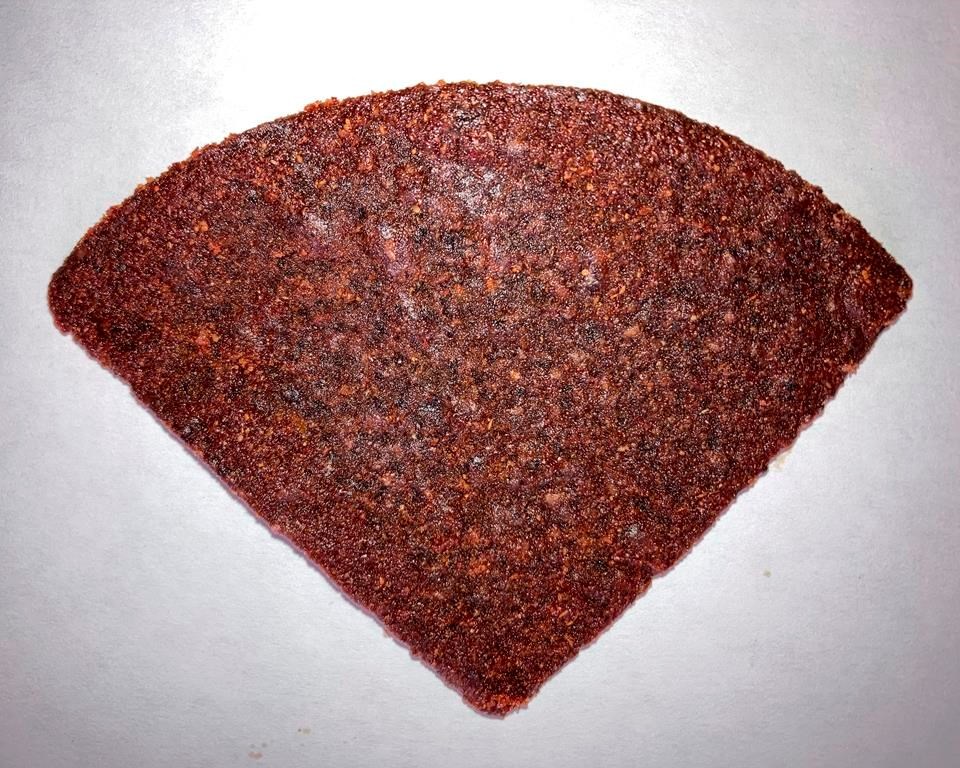
A Paqui One Chip Challenge chip is displayed in Boston, Friday, Sept. 8, 2023. The death of a Massachusetts teenager after his family said he ate an extremely spicy tortilla chip has led to an outpouring of concern about the social media challenge and prompted retailers to pull the product from their shelves at the manufacturer's request. (AP Photo/Steve LeBlanc)

But there are plenty of similar products that remain online and on store shelves, including Red Hot Reaper’s One Chip Challenge, Blazing Foods’ Death Nut Challenge and Tube of Terror Challenge as well as Wilder Toys’ Hot Ones Truth or Dab sauce game. The Associated Press reached out to each company after Paqui pulled its own product, but did not receive a response.

DePaoli said it’s not unusual for companies to engage in viral marketing.

“It is unusual, however, to have something where the brand actually wants you to put something into your body,” he said. Companies “don’t want to be liable for that.”

Despite warnings or labels specifying adult-use only, the products can still get into the hands of young people who might not understand the risks, Trucco added.

“There’s a reason why these challenges are appealing,” she said. “This type of marketing sells.”
Report Error Submit a Tip

More Stories

Letters, Sept. 29

7 minute read 2:00 AM CDT

Public servants and elections

We currently are in the midst of elections, mostly on the municipal level. Voters are reviewing policies and promises in anticipation of new programs and commitments that hopefully will enhance their daily life.

While those seeking political office live in anxiety during this time as they await their electoral fate, so too do many civil servants as election results will also determine their futures.

It is these civil servants who we rarely think of at election time.

Letters, Sept. 28

7 minute read Yesterday at 2:00 AM CDT

Other options are closer

Every Winnipeg driver learns this lesson eventually: keep your eyes on the horizon too long and the pothole gets you. Manitoba’s energy debate has the same problem. We keep looking far down the road for the next big project and missing what’s close at hand.

Scott Forbes (Time for 21st-century leadership at MB Hydro, Think Tank, Sept. 24) makes a strong case for more wind and storage. But much of this debate is still measured in thousands of megawatts, generated far from where the power is used.

The more immediate opportunity is close to home.

Canada resorting to its tried and true playbook

Niigaan Sinclair 5 minute read Preview

Canada resorting to its tried and true playbook

Niigaan Sinclair 5 minute read Yesterday at 6:00 AM CDT

In 1846, Britain faced an emergency influenced by the Irish famine, so leaders repealed the country’s “Corn Laws” and restrictions on imported food and grain, transitioning to a system of free trade.

This created a crisis in the then Province of Canada, which had relied on British “preferential” status to prop up its agricultural and resource industries.

As a result, Canada looked south for new markets and eventually negotiated a free trade agreement with the United States.

This required land to be acquired and converted for industrial use quickly, so Canada quickly dispatched Commissioner William Robinson to negotiate with Indigenous communities along Lake Huron and Lake Superior for land.

Read
Yesterday at 6:00 AM CDT

Uncaring hubby fell flat at first hurdle

Maureen Scurfield 4 minute read Yesterday at 2:00 AM CDT

DEAR MISS LONELYHEARTS: I re-rented my favourite summer cabin this fall because I’m trying to finish my thesis. My husband of just over a year was very annoyed with me for going on my own, but didn’t say much about it because I paid.

I thought we were both OK with this arrangement, until I got the flu up at the lake very badly and couldn’t keep anything down. I felt faint. I phoned him and he said he was at a party with the guys. I could hear music and girls laughing.

He wouldn’t come for me, so at 4 a.m. when I was getting even more sick and scared, I drove back to the city unannounced.

I went straight to my parents’ house and pretty much fell through the door. Mom said to me when she grabbed me: “This is not right. You could have died in the ditch. Where is your husband?”

Jets pick up netminder as relatively new 23-man roster announced

Mike McIntyre 7 minute read Preview

Jets pick up netminder as relatively new 23-man roster announced

Mike McIntyre 7 minute read Updated: Yesterday at 9:25 PM CDT

Let’s get the caveats out of the way: Nothing is set in stone, nor written in permanent ink, and what you see right now could change in the blink of an eye.

With that being said, allow us to introduce you to the 2026-27 Winnipeg Jets — where change is very much in the air.

The 23-man roster submitted to the NHL offices by Monday’s 4 p.m. deadline includes seven players who were not on the team at this time last year. In fact, there could be as many as 10 new faces in the opening-night lineup on Friday against Boston when you factor in three regulars didn’t start the 2025-26 campaign due to injury.

That’s a lot of turnover, which isn’t surprising for a team that finished 26th overall in the standings and was — to most fans and pundits — too old and too slow.

Read
Updated: Yesterday at 9:25 PM CDT

Dealing now with increasing judicial dangers

Ben Wickstrom 5 minute read 2:00 AM CDT

For years, the Manitoba Association of Crown Attorneys (“MACA”) has been engaged in a dispute with the Manitoba government over the workload of its lawyers. That dispute is expected to come to a head at the end of November, when two weeks of grievance hearings are scheduled.

We remain hopeful that we can reach an agreement with our employer. But if we cannot, our union’s lawyers are prepared to make our case. As those hearings approach, we want to explain how we got here, what is at stake, and why this dispute matters beyond the working conditions of our members.

These problems are longstanding and predate the election of Manitoba’s current government. Our concern with the current government is not that it created these problems, but that it is now responsible for addressing them.

Despite the evidence before it, the government has not meaningfully addressed the workload concerns we have raised throughout its time in office.