What to know about the Social Security cost-of-living adjustment

Advertisement

Advertise with us

NEW YORK (AP) — Tens of millions of older Americans will see a modest increase in benefits this January when a new cost-of-living adjustment is added to Social Security payments.

Read this article for free:


or

Already have an account? Log in here »

To continue reading, please subscribe:

Subscribe and receive a limited-edition Free Press branded hat or tote.

Digital Subscription

One year of digital access for only $205*

  • Enjoy unlimited reading on winnipegfreepress.com
  • Read the E-Edition, our digital replica newspaper
  • Access News Break, our award-winning app
  • Play interactive puzzles

*First annual payment billed as $205.00 + GST for one year. This annual subscription will automatically renew at $233.00 + GST every 52 weeks (10% off the regular annual price of $259.35). Offer available to new and qualified returning subscribers only. Cancel any time.

To continue reading, please subscribe:

Add Free Press access to your Brandon Sun subscription for only an additional

$1 for the first 4 weeks*

  • Enjoy unlimited reading on winnipegfreepress.com
  • Read the E-Edition, our digital replica newspaper
  • Access News Break, our award-winning app
  • Play interactive puzzles
Start now

*Your next Brandon Sun subscription payment will increase by $1.00 and you will be charged $17.95 plus GST for four weeks. After four weeks, your payment will increase to $24.95 plus GST every four weeks.

Hey there, time traveller!
This article was published 12/10/2023 (1087 days ago), so information in it may no longer be current.

NEW YORK (AP) — Tens of millions of older Americans will see a modest increase in benefits this January when a new cost-of-living adjustment is added to Social Security payments.

The 3.2% raise is intended to help meet higher prices for food, fuel, and other goods and services. The average recipient will see an increase of about $54 per month, according to government estimates. That’s a smaller percentage than last year, because consumer prices have eased, and the COLA is tied to the Bureau of Labor Statistics Consumer Price Index.

Still, Kathleen Romig, director of Social Security and Disability Policy at the Center on Budget and Policy Priorities, says increased Medicare premiums will “absorb a disproportionate share of the COLA for most people.” One premium is rising by an estimated 6%, or roughly $9.90 a month.
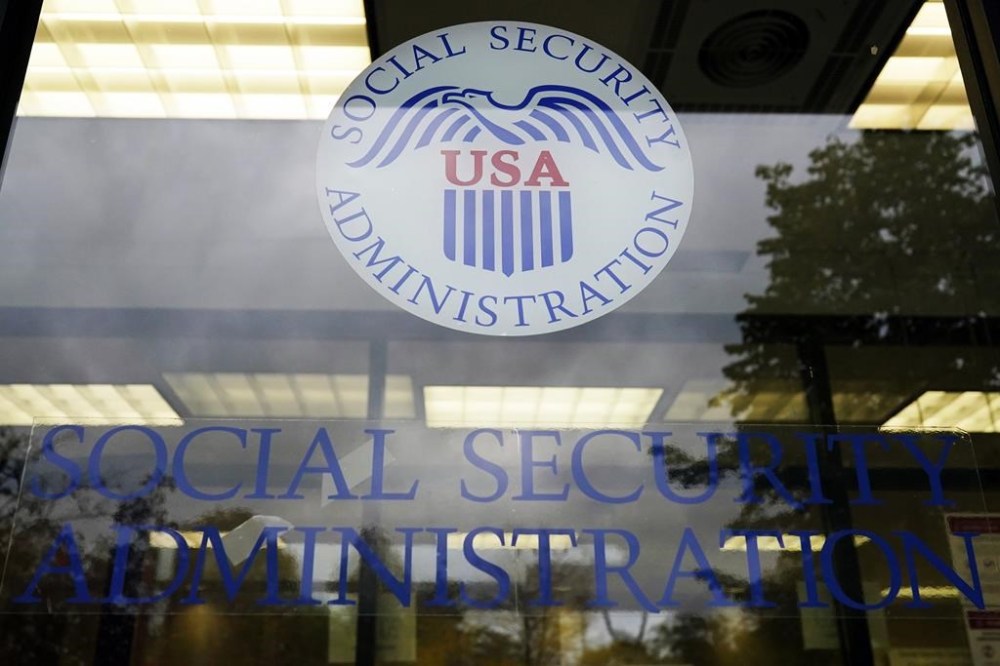
FILE - The U.S. Social Security Administration office is seen in Mount Prospect, Ill., Oct. 12, 2022. About 71 million people including retirees, disabled people and children receive Social Security benefits. (AP Photo/Nam Y. Huh, File)

“Seniors and people with disabilities tend to spend a greater share of their incomes on health care, and medical prices are rising faster than overall inflation,” she said, adding that most people will still get higher benefit checks overall.

Here’s what to keep in mind:

HOW DOES SOCIAL SECURITY WORK?

The Social Security program pays roughly $1.4 trillion in benefits to more than 71 million people each year, including low-income individuals with disabilities.

The short answer is that taxes fund Social Security. The government uses taxes from working people to pay benefits to people who have already retired, people who are disabled, the survivors of workers who have died, and dependents of beneficiaries.

While the money is used to pay people currently receiving benefits, any unused money goes to the Social Security trust fund. Some of the money in the trust, together with the Social Security contributions of people in the workforce, pay for future benefits.

To determine what amount of Social Security you’ll receive, the government calculates a percentage of your highest wages from your top 35 years of earning, factoring in when you choose to start receiving benefits.

HOW IS THE COST OF LIVING ADJUSTMENT CALCULATED?

The COLA is calculated according to the Bureau of Labor Statistics’ Consumer Price Index, but there are calls to use a different index — one that measures price changes based on the spending patterns of the elderly — like healthcare, food and medicine costs.

“Seniors tend to spend more on medical care in general, including some out of pocket expenses like prescription drug costs, that can be very significant,” said Mark Hamrick, Senior Economic Analyst at Bankrate. “Of course, food, shelter, and energy costs are all still elevated. Those are thing most people cannot go without.”

IS THE TRUST RUNNING OUT OF MONEY?

Future problems with the fund have long been predicted, largely because of demographic shifts. As birthrates decline, fewer people become workers, which results in fewer payments of payroll taxes. Meanwhile, more Baby Boomers are retiring and collecting Social Security.

The annual Social Security and Medicare trustees report released in March said the program’s trust fund will be unable to pay full benefits beginning in 2033. If the trust fund is depleted, the government will be able to pay only 77% of scheduled benefits, the report said.

“If you think about the modest decrease this year, the reality is that people would be looking at a more than 20% cut, if the administration fails to address the shortfall,” Hamrick said. “The gospel is, ‘You can’t touch Social Security.’ The longer this problem is unresolved, the less optimal the solutions become.”

___

The Associated Press receives support from Charles Schwab Foundation for educational and explanatory reporting to improve financial literacy. The independent foundation is separate from Charles Schwab and Co. Inc. The AP is solely responsible for its journalism.


Report Error Submit a Tip

More Stories

Khan should’ve taken high road: Goertzen

Carol Sanders 5 minute read Preview

Khan should’ve taken high road: Goertzen

Carol Sanders 5 minute read Yesterday at 6:39 PM CDT

The veteran Progressive Conservative who championed Obby Khan’s leadership bid says the former Blue Bomber dropped the ball by dissing his Tory teammates before he stepped down.

“I wouldn’t recommend it, and I didn’t recommend it,” Kelvin Goertzen (Steinbach) said in an interview Friday.

Khan resigned as PC leader and quit the caucus Monday saying some members were secretly plotting his ouster, even after he won a confidence vote on Sept. 25.

On Tuesday, Khan lashed out in a CJOB interview, naming the alleged plotters, saying constituents deserved to know which of their elected representatives “lacked moral integrity.” Khan told the Free Press he was “deeply emotionally hurt,” and felt stabbed in the back.

Read
Yesterday at 6:39 PM CDT

Free Press staff 2 minute read 2:01 AM CDT

Advance voting for civic and school board elections begins next week.

Voters can cast early ballots for the Oct. 28 election in certain locations from Monday through Oct. 23.

Eligible voters can use their address to search for a convenient location.

Early votes can be cast at the council building at city hall (510 Main St.) every day, except weekends and Thanksgiving, from Monday to Oct. 23.

A spiritual vision will help anchor a health civic outlook

John Longhurst 5 minute read 2:01 AM CDT

We have an election coming up. With that in mind, the Free Press asked some of their columnists to write about the challenges ahead and how the city can become better.

For Tom Brodbeck, the main challenge is finances — and how candidates will pay for their many promises for fixing roads, improving public safety and making transit better.

Rebecca Chambers said that the concerns of inner-city residents need to be taken seriously by those who aspire to work at city hall.

Niigaan Sinclair said the most pressing issue in Winnipeg isn’t construction projects, light-rail transit, public safety, taxes or social services. For him, it’s the city’s relationship with Indigenous people.

Mayoral candidate Vogiatzakis criticized for living outside Winnipeg

Malak Abas 4 minute read Preview

Mayoral candidate Vogiatzakis criticized for living outside Winnipeg

Malak Abas 4 minute read Updated: Yesterday at 6:03 PM CDT

A mayoral hopeful took heat from other candidates Friday for living outside Winnipeg while running in the civic election.

Mike Vogiatzakis’s primary residence is in the Rural Municipality of St. Andrews, about 25 kilometres north of Winnipeg — a community with its own mayor and councillors.

But the funeral director said he owns a home in Winnipeg where he divides his time, and he would move to the city full-time if elected mayor.

“It doesn’t matter where a person lives. Why are we dividing St. Andrews and Manitoba and Winnipeg? I’ve met the criteria to run for mayor,” Vogiatzakis said Friday morning.

Read
Updated: Yesterday at 6:03 PM CDT

You’re a solid, loyal sister, so worry not

Maureen Scurfield 5 minute read Yesterday at 2:00 AM CDT

DEAR MISS LONELYHEARTS: I ran into my sister’s husband at the bar recently. He was drinking with a bunch of people from his work. I noticed he was sitting close to a young woman, with his arm around her.

I just nodded without a smile as I slowly passed them. I kept on going, but he knew I saw them together. A few minutes later he came over — obviously drunk — and said, “You’re a good girl! You won’t say anything to your sister, will you?” Ha! I looked at him and said, “Of course I’m going to say something!”

My loyalty will always be to my sister. I phoned my sis in my car and blabbed. She tried to laugh it off, but she’s gone silent since — not answering my calls or messages. So apparently now I’m the troublemaker? That’d be just her style! What should I do?

— Worried About Us, North Kildonan

International flavour: Canadian investors may want to make like Ottawa, diversify beyond U.S.

Joel Schlesinger 6 minute read Preview

International flavour: Canadian investors may want to make like Ottawa, diversify beyond U.S.

Joel Schlesinger 6 minute read 2:01 AM CDT

Canada is learning the hard way about the dangers of putting too many eggs in its U.S. economic basket.

Much has been made about the need to diversify our economy away from the United States.

Diversification is understandably beneficial. The more varied streams of revenue a nation has, the less affected the economy will be when one of those sources is interrupted.

The same can be said about investment portfolios.

Read
2:01 AM CDT