Few community college students go on to earn 4-year degrees. Some states have found ways to help

Advertisement

Advertise with us

After delaying college for two years because of the COVID-19 pandemic, Jaden Todd wasn’t sure a four-year school was the right place to start.

Read this article for free:


or

Already have an account? Log in here »

To continue reading, please subscribe:

Subscribe and receive a limited-edition Free Press branded hat or tote.

Digital Subscription

One year of digital access for only $205*

  • Enjoy unlimited reading on winnipegfreepress.com
  • Read the E-Edition, our digital replica newspaper
  • Access News Break, our award-winning app
  • Play interactive puzzles

*First annual payment billed as $205.00 + GST for one year. This annual subscription will automatically renew at $233.00 + GST every 52 weeks (10% off the regular annual price of $259.35). Offer available to new and qualified returning subscribers only. Cancel any time.

To continue reading, please subscribe:

Add Free Press access to your Brandon Sun subscription for only an additional

$1 for the first 4 weeks*

  • Enjoy unlimited reading on winnipegfreepress.com
  • Read the E-Edition, our digital replica newspaper
  • Access News Break, our award-winning app
  • Play interactive puzzles
Start now

*Your next Brandon Sun subscription payment will increase by $1.00 and you will be charged $17.95 plus GST for four weeks. After four weeks, your payment will increase to $24.95 plus GST every four weeks.

Hey there, time traveller!
This article was published 09/11/2023 (1060 days ago), so information in it may no longer be current.

After delaying college for two years because of the COVID-19 pandemic, Jaden Todd wasn’t sure a four-year school was the right place to start.

“I was extremely concerned that I forgot how to learn,” he said.

Community college appealed as a stepping stone, but he also had heard stories of students who had to start over when they transferred because their credits didn’t count at the new school.
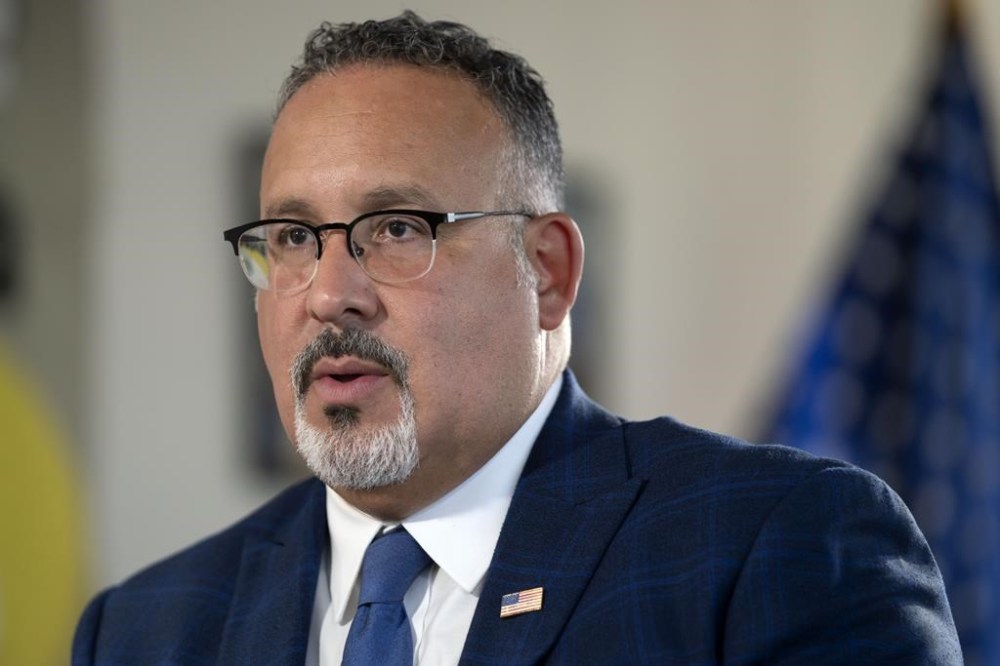
FILE - Education Secretary Miguel Cardona speaks during an interview with The Associated Press in his office at the Department of Education, Sept. 20, 2023, in Washington. Partnerships between two- and four-year colleges and universities could help more community college students go on to earn bachelor’s degrees, according to data released Thursday, Nov. 9, by the U.S. Education Department. “Our current higher education system stacks the deck against community college students who aspire to earn four-year degrees,” Cardona said. (AP Photo/Mark Schiefelbein, File)

Todd, 21, was relieved to wind up at Northern Virginia Community College’s ADVANCE program, a partnership with George Mason University that put him on a clear path to his goal of a bachelor’s degree in computer science.

Such established arrangements between two- and four-year colleges and universities have shown promise in helping more community college students go on to earn bachelor’s degrees, according to data released Thursday by U.S. Education Department.

Only 13% of federal financial aid recipients who enrolled in community college in 2014 received a bachelor’s degree within eight years, the data found.

Hundreds of thousands of those who enroll annually at the more affordable two-year schools plan to transfer to a four-year program at a college or university, but obstacles get in the way. Frequently, students lack the guidance they need to navigate the transfer, and their credits don’t transfer the way they planned.

“Our current higher education system stacks the deck against community college students who aspire to earn four-year degrees,” Education Secretary Miguel Cardona said ahead of a gathering of 200 higher education leaders convened Thursday by his department to examine state and school transfer policies.

The new data tracked roughly 620,000 federal financial aid recipients. The outcomes are especially concerning for Black, Hispanic and low-income students, who are more likely to start at community colleges.

Colleges in New Jersey, New York and Illinois graduated the most transfer students, with schools in South Dakota, Delaware, Indiana and New Mexico recording the lowest numbers.

“One of the things that I think has really played a pivotal role in transfer student success is our goal to make as much information transparent,” said Alicia Alvero, associate vice chancellor for academic and faculty affairs at the City University of New York.

CUNY relies on an online transfer explorer, known as T-Rex, that makes it easier for students to see which of their courses will transfer between campuses, Alvero said.

The State University of New York is experimenting with artificial intelligence to let students map courses between any of the community and four-year campuses in the system, said Dan Knox, a director at the National Association of System Heads, an organization of 48 public higher education systems across the country formed to advance innovation in higher education.

“At SUNY, that’s 30 community colleges and … 64 campuses in total, so the choice sets in a system that large for students are just overwhelming,” Knox said.

“It’s just very tough to map all that out manually,” he said.
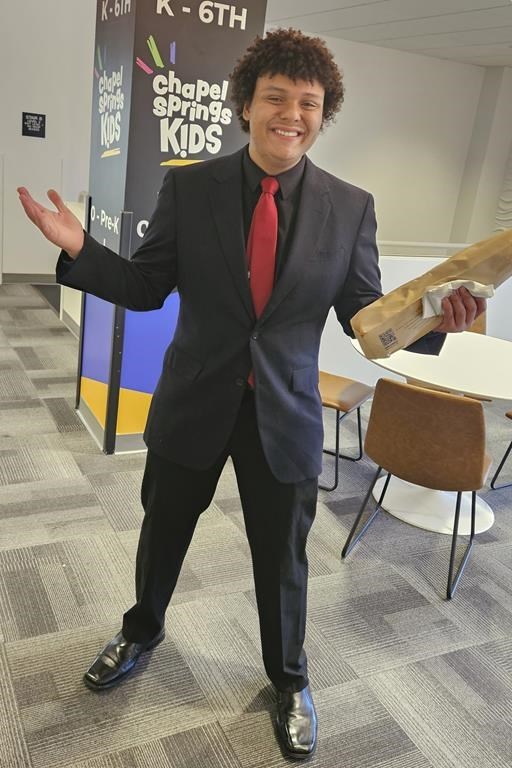
Northern Virginia Community College student Jaden Todd, 21, poses for a photo in his suit in June 2023, on campus in Annandale, VA. Todd has plans to transfer to George Mason University to finish a degree in computer science. (Matthew Todd via AP)

The Education Department data also found widely varying results when it looked at pairings between two- and four-year institutions in each state to evaluate how often community college students graduated from the four-year institutions they would most likely attend.

Among the highest-performing pairings were those with established partnerships designed to ease the transfer process, like the one at George Mason.

Todd, a 2020 high school graduate in Woodbridge, Virginia, said he liked that the co-enrollment program set from the start the classes he would take in community college and at George Mason. He’d heard of others paying thousands for tuition only to lose credits and find themselves behind when they transferred.

“I mean, I could spend $15,000 a year and want to try another college out,” he said.

Researchers said evaluating why certain pairings do better than others would help improve transfer systems as a whole. The findings are expected to guide higher education leaders who are struggling with declining enrollment and students concerned about adding to the $1.77 trillion in student loan debt.

“We have never before had national data that look at how well students do when they move among colleges and universities,” said James Kvaal, undersecretary of education, “so this study we’ve done, looking at people who get student aid, is really groundbreaking and has shed new light onto the role that both community colleges and four-year colleges play in helping their students get that college degree.”

The summit also is expected to address statewide policies such as assigning codes to courses to create consistency across schools and guaranteed admission for certain students.

___

The Associated Press education team receives support from the Carnegie Corporation of New York. The AP is solely responsible for all content.

Report Error Submit a Tip

More Stories

Brandonmeat packer thriving on its own

Abiola Odutola 3 minute read Preview

Brandonmeat packer thriving on its own

Abiola Odutola 3 minute read Yesterday at 2:01 AM CDT

BRANDON — Canada Packers has strengthened its business and laid the foundation for future growth during its first year as an independent company, its president says.

The Brandon-based pork producer, separated from Maple Leaf Foods in October 2025, established its own leadership, strategy, systems, culture and identity while continuing operations across its hog production farms and regional hog barns in southern and eastern Manitoba.

The company’s first year was focused on building a successful standalone business while continuing to serve customers, communities and shareholders, president Dennis Organ said.

“Market conditions over the past year have been more challenging than we anticipated when we became a separate entity,” he said in an email. “Despite that, we continued to execute against our priorities, including increasing processing volumes, maintaining disciplined operations and strengthening the business.”

Read
Yesterday at 2:01 AM CDT

Puzzles Palace

1 minute read Monday, Jul. 27, 2026

To solve our puzzles, please subscribe with this special offer: |

Blown lead spoils Jets opener

Mike McIntyre 7 minute read Preview

Blown lead spoils Jets opener

Mike McIntyre 7 minute read Friday, Oct. 2, 2026

Younger. Faster. Stronger.

They may still be a long ways from a finished product, but it’s safe to say the new-look Winnipeg Jets made a mostly favourable first impression on Friday night in front of a sold-out crowd at Canada Life Centre.

Sure, a 4-3 overtime loss to a hard-nosed Boston Bruins outfit is going to sting a little, especially since the home team was just 98 seconds away from a regulation victory.

But if the Jets can bottle up this kind of energy and effort, they should enjoy plenty of success over the course of the 84-game campaign.

Read
Friday, Oct. 2, 2026

Few community college students go on to earn 4-year degrees. Some states have found ways to help

Carolyn Thompson, The Associated Press 5 minute read Preview

Few community college students go on to earn 4-year degrees. Some states have found ways to help

Carolyn Thompson, The Associated Press 5 minute read Thursday, Nov. 9, 2023

After delaying college for two years because of the COVID-19 pandemic, Jaden Todd wasn’t sure a four-year school was the right place to start.

“I was extremely concerned that I forgot how to learn,” he said.

Community college appealed as a stepping stone, but he also had heard stories of students who had to start over when they transferred because their credits didn't count at the new school.

Todd, 21, was relieved to wind up at Northern Virginia Community College's ADVANCE program, a partnership with George Mason University that put him on a clear path to his goal of a bachelor’s degree in computer science.

Read
Thursday, Nov. 9, 2023

Broadening prediction-market gambling a bad idea

Editorial 4 minute read Preview

Broadening prediction-market gambling a bad idea

Editorial 4 minute read Yesterday at 2:01 AM CDT

Let’s make a prediction: sooner or later, when Canadian governments find a way to take their own cut of the action, prediction-contract gambling on everything from sports to entertainment to political decisions is going to come to Canada.

And that’s a horrible, dangerous, pernicious idea.

Unless you have particular access to information — either inside information or strategic information based on skills or education — you’re not likely to make money at it. In fact, structurally, you’re likely to lose. In prediction markets, you basically pay an amount, plus fees from the company involved, to bet on whether something will or will not happen within a certain time frame. The amount you pay for your contract depends on how other people are also betting.

As Wealthsimple describes it, “You buy whichever side you think is right. Prices move with demand, so if the market leans towards one outcome, the more that side costs. If a lot of people are backing the TSX to finish above 38,000, yes gets more expensive and no gets cheaper.”

Read
Yesterday at 2:01 AM CDT

A day on the campaign trail: Winnipeg's mayor, seeking a second term, does double duty

Malak Abas 12 minute read Preview

A day on the campaign trail: Winnipeg's mayor, seeking a second term, does double duty

Malak Abas 12 minute read Friday, Oct. 2, 2026

In the weeks leading up to the civic election, Scott Gillingham has been performing a juggling act: he’s running to be Winnipeg’s 45th mayor, while still serving as its 44th.

“If someone asks me about the campaign, I’m going to answer them. But I think for most people, I’m the mayor of Winnipeg, even if I’m showing up as a candidate,” Gillingham, 58, says. “I try to do all I can to maintain that distinction.”

The Free Press joined Gillingham on a recent rainy September Saturday on the campaign trail, where he served in both roles during an event-laden day. City council’s final meeting before the Oct. 28 election was days earlier.

In Winnipeg, it’s rare for an incumbent to be defeated. But Gillingham knows his win in 2022 wasn’t exactly a landslide — he won with 27.5 per cent of the vote — and he’s been thinking about his second term ever since.

Read
Friday, Oct. 2, 2026