Number of American workers hitting the picket lines more than doubled last year as unions flexed
Advertisement
Read this article for free:
or
Already have an account? Log in here »
To continue reading, please subscribe:
Digital Subscription
One year of digital access for only $1.44 a week*
- Enjoy unlimited reading on winnipegfreepress.com
- Read the E-Edition, our digital replica newspaper
- Access News Break, our award-winning app
- Play interactive puzzles
*Billed as $5.77 plus GST every four weeks. After 52 weeks, price increases to the regular rate of $19.95 plus GST every four weeks. Offer available to new and qualified returning subscribers only. Cancel any time.
To continue reading, please subscribe:
Add Free Press access to your Brandon Sun subscription for only an additional
$1 for the first 4 weeks*
- Enjoy unlimited reading on winnipegfreepress.com
- Read the E-Edition, our digital replica newspaper
- Access News Break, our award-winning app
- Play interactive puzzles
*Your next Brandon Sun subscription payment will increase by $1.00 and you will be charged $17.95 plus GST for four weeks. After four weeks, your payment will increase to $24.95 plus GST every four weeks.
Read unlimited articles for free today:
or
Already have an account? Log in here »
Hey there, time traveller!
This article was published 15/02/2024 (978 days ago), so information in it may no longer be current.
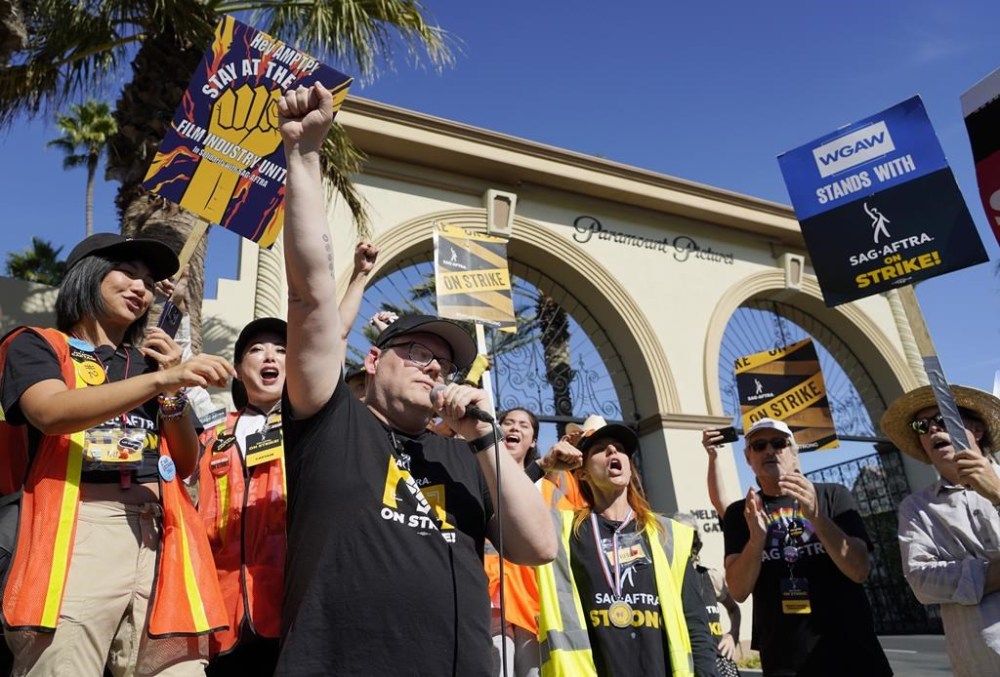
NEW YORK (AP) — Auto workers held waves of walkouts. Hollywood actors and writers picketed for months. And healthcare, education and hospitality employees also withheld their labor while calling for improved pay and job conditions.
The number of U.S. workers on strike more than doubled last year. According to an annual report from the Labor Action Tracker, a collaboration between researchers at Cornell University and the University of Illinois, those involved in work stoppages climbed 141% in 2023 to a total of 539,000 striking workers — up from 224,000 in 2022.
This jump can be largely credited to big, high-profile work stoppages, the Thursday report notes. Strikes from unions such as United Auto Workers, Screen Actors Guild-American Federation of Television and Radio Artists, Coalition of Kaiser Permanente Unions and United Teachers Los Angeles accounted for nearly 65% of the striking workers.
Johnnie Kallas, an assistant professor at the University of Illinois who founded the Labor Action Tracker in 2021, noted that the U.S. hasn’t seen this many striking workers for several years — and pointed to 2023’s strength across the private sector, in particular.
“The last time roughly this many workers went on strike was in 2018 and 2019, fueled by educator strikes,” Kallas said in a prepared statement. “But this year, large strikes were much more dispersed this past year throughout numerous private sector industries.”
The Labor Action Tracker documented 470 work stoppages last year (up 9% from 2022). That resulted in more than 24 million strike days across all involved workers.
The majority (62%) of all strikes last year were less than five days long. But about half of 2023’s total striking workers were on the picket line for more than a month, Thursday’s report notes.
“The strike has always been at the core of labor bargaining power,” Alexander Colvin, dean of Cornell University’s School of Industrial and Labor Relations, stated. “This rise in strike action after many years of diminished activity indicates a union resurgence that is shifting the balance of power back toward labor.”
Top demands from those participating in 2023’s work stoppages included better pay, improved health and safety and increased staffing. And the amount of strikes and lockouts with a first contract demand more than doubled compared to 2022, the Labor Action Tracker found.
According to Thursday’s report, accommodation and food services saw more work stoppages than any other industry last year, accounting for 33.4% of the total strikes and lockouts. But the information industry had the highest number of striking workers and strike days — making up for 34.5% of all workers on strike and 83.8% of strike days.
Despite the spike in labor activity, union membership rates actually fell slightly last year. Last month, the U.S. Bureau of Labor Statistics said 10% of hourly and salaried workers were members of unions in 2023 — marking an all-time low.
These numbers show that unionization rates didn’t keep pace with overall hiring. Experts note organizing gains have continued to be offset by nonunion job growth, as well as losses in more heavily unionized sectors.