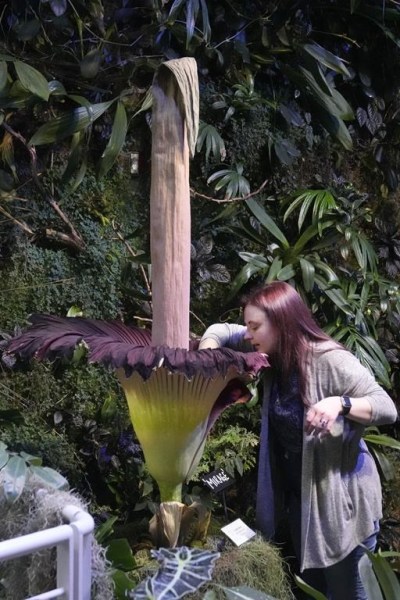
Visitors line up to see and smell a corpse flower’s stinking bloom in San Francisco
Advertisement
Read this article for free:
or
Already have an account? Log in here »
To continue reading, please subscribe:

Digital Subscription
One year of digital access for only $205*
- Enjoy unlimited reading on winnipegfreepress.com
- Read the E-Edition, our digital replica newspaper
- Access News Break, our award-winning app
- Play interactive puzzles
*First annual payment billed as $205.00 + GST for one year. This annual subscription will automatically renew at $233.00 + GST every 52 weeks (10% off the regular annual price of $259.35). Offer available to new and qualified returning subscribers only. Cancel any time.
To continue reading, please subscribe:
Add Free Press access to your Brandon Sun subscription for only an additional
$1 for the first 4 weeks*
- Enjoy unlimited reading on winnipegfreepress.com
- Read the E-Edition, our digital replica newspaper
- Access News Break, our award-winning app
- Play interactive puzzles
*Your next Brandon Sun subscription payment will increase by $1.00 and you will be charged $17.95 plus GST for four weeks. After four weeks, your payment will increase to $24.95 plus GST every four weeks.
Read unlimited articles for free today:
or
Already have an account? Log in here »
Hey there, time traveller!
This article was published 28/02/2024 (955 days ago), so information in it may no longer be current.
SAN FRANCISCO (AP) — Crowds lined up in San Francisco on Wednesday to see — and smell — the blooming of an endangered tropical flower that releases a pungent odor when it opens once every several years.
An Amorphophallus titanum, also known as a corpse flower, began blooming Tuesday afternoon at the California Academy of Sciences, a research institution and museum.
The plant blooms for one to three days once every seven to 10 years. During the bloom, it releases a powerful smell described by some as rotting food or sweaty socks.
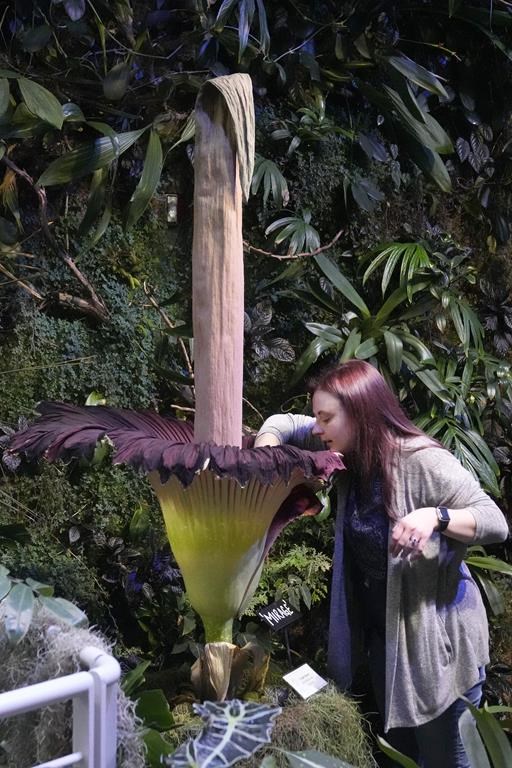
“It’s kind of imitating the smell of kind of a dead carcass to kind of get all the flies to come and interact with it, pick up pollen, and then take that pollen to another flower that it might investigate due to its smell,” said Lauren Greig, a horticulturist, California Academy of Sciences.
It was the first bloom for the corpse flower named Mirage, which was donated to the California Academy of Sciences in 2017. It’s been housed in the museum’s rainforest exhibit since 2020.
Bri Lister, a data scientist who lives in San Francisco, moved some meetings and waited in line for about an hour to catch a whiff of the plant.
“In certain directions, I definitely picked up on the sweaty socks, sweaty gym clothes, but probably luckily not full-on rotting meat, but definitely a smellier plant than average,” Lister said.
Monica Becker took her child out of school to see the flower in person after watching it on the academy’s livestream.
“When we heard it bloomed, we were like, we got it, we got to go, first thing in the morning when they open. So here we are,” Becker said.
The Amorphophallus titanum is native to the Indonesian island of Sumatra. It is listed as endangered by the International Union for Conservation of Nature, with only less than 1,000 individual plants left in the wild.