Half a million seniors had trouble getting specialized health services: StatCan
Advertisement
Read this article for free:
or
Already have an account? Log in here »
To continue reading, please subscribe:

Digital Subscription
One year of digital access for only $205*
- Enjoy unlimited reading on winnipegfreepress.com
- Read the E-Edition, our digital replica newspaper
- Access News Break, our award-winning app
- Play interactive puzzles
*First annual payment billed as $205.00 + GST for one year. This annual subscription will automatically renew at $233.00 + GST every 52 weeks (10% off the regular annual price of $259.35). Offer available to new and qualified returning subscribers only. Cancel any time.
To continue reading, please subscribe:
Add Free Press access to your Brandon Sun subscription for only an additional
$1 for the first 4 weeks*
- Enjoy unlimited reading on winnipegfreepress.com
- Read the E-Edition, our digital replica newspaper
- Access News Break, our award-winning app
- Play interactive puzzles
*Your next Brandon Sun subscription payment will increase by $1.00 and you will be charged $17.95 plus GST for four weeks. After four weeks, your payment will increase to $24.95 plus GST every four weeks.
Read unlimited articles for free today:
or
Already have an account? Log in here »
Hey there, time traveller!
This article was published 20/03/2024 (909 days ago), so information in it may no longer be current.
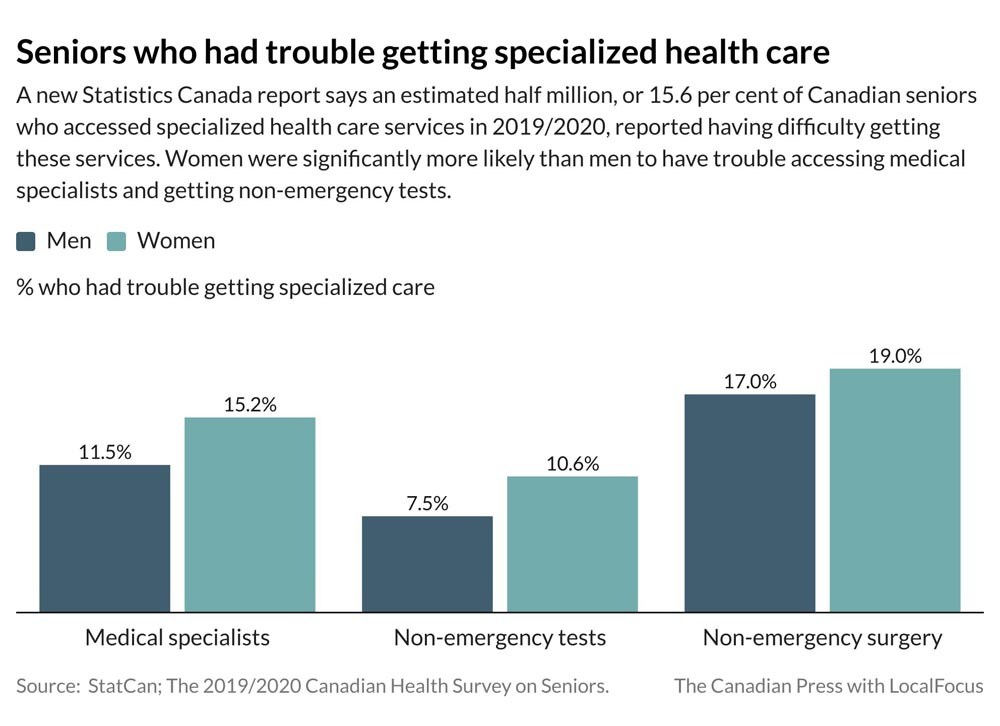
A new Statistics Canada report says half a million seniors had trouble getting specialized care.
StatCan estimated more than 4.5 million people 65 and older visited medical specialists, got non-emergency tests or had non-emergency surgeries in 2019 and 2020.
More than 15 per cent of the seniors reported having difficulty while they were trying to access those services.

Common barriers included trouble getting a referral, difficulty getting an appointment, long wait times and services not being available at the time they were needed.
The report says older women were less likely than older men to visit medical specialists and receive tests.
It also says seniors with a lower education level weren’t as likely to use specialized health-care services.
The report says that seniors who had ongoing physical illness or mental health issues were more likely to use specialized health services than older Canadians who were relatively healthy.
StatCan says the study highlights the importance of considering gender, overall physical and mental health, as well as psychosocial factors when assessing the use of specialized health services.
The agency used a representative sample of 39,047 Canadians age 65 and older to identify the patterns related to health-care service use.
This report by The Canadian Press was first published March 20, 2024.
Canadian Press health coverage receives support through a partnership with the Canadian Medical Association. CP is solely responsible for this content.
History
Updated on Wednesday, March 20, 2024 12:28 PM CDT: Adds photo