When red-hot isn’t enough: New government heat risk tool sets magenta as most dangerous level
Advertisement
Read this article for free:
or
Already have an account? Log in here »
To continue reading, please subscribe:

Digital Subscription
One year of digital access for only $205*
- Enjoy unlimited reading on winnipegfreepress.com
- Read the E-Edition, our digital replica newspaper
- Access News Break, our award-winning app
- Play interactive puzzles
*First annual payment billed as $205.00 + GST for one year. This annual subscription will automatically renew at $233.00 + GST every 52 weeks (10% off the regular annual price of $259.35). Offer available to new and qualified returning subscribers only. Cancel any time.
To continue reading, please subscribe:
Add Free Press access to your Brandon Sun subscription for only an additional
$1 for the first 4 weeks*
- Enjoy unlimited reading on winnipegfreepress.com
- Read the E-Edition, our digital replica newspaper
- Access News Break, our award-winning app
- Play interactive puzzles
*Your next Brandon Sun subscription payment will increase by $1.00 and you will be charged $17.95 plus GST for four weeks. After four weeks, your payment will increase to $24.95 plus GST every four weeks.
Read unlimited articles for free today:
or
Already have an account? Log in here »
Hey there, time traveller!
This article was published 22/04/2024 (901 days ago), so information in it may no longer be current.
WASHINGTON (AP) — Forget about red hot. A new color-coded heat warning system relies on magenta to alert Americans to the most dangerous conditions they may see this summer.
The National Weather Service and the Centers for Disease Control and Prevention on Monday — Earth Day — presented a new online heat risk system that combines meteorological and medical risk factors with a seven-day forecast that’s simplified and color-coded for a warming world of worsening heat waves.
“For the first time we’ll be able to know how hot is too hot for health and not just for today but for coming weeks,” Dr. Ari Bernstein, director of the National Center for Environmental Health, said at a joint news conference by government health and weather agencies.
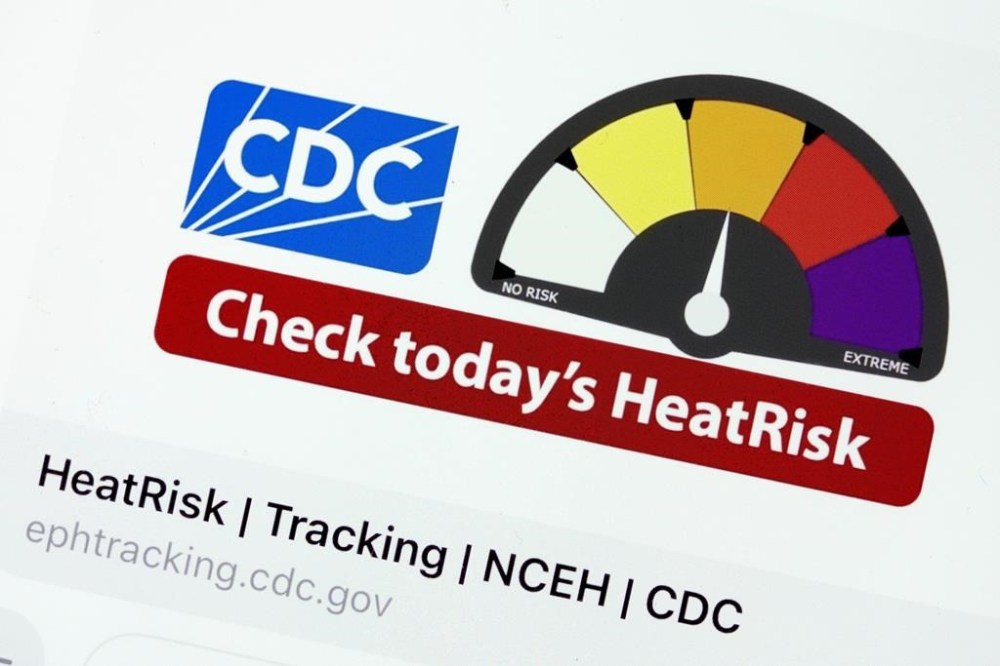
Magenta is the worst and deadliest of five heat threat categories, hitting everybody with what the agencies are calling “rare and/or long-duration extreme heat with little to no overnight relief.” It’s a step higher than red, considered a major risk, which hurts anyone without adequate cooling and hydration and has impacts reverberating through the health care system and some industries. Red is used when a day falls within the top 5% hottest in a particular location for a particular date; when other factors come into play, the alert level may bump even higher to magenta, weather service officials said.
On the other hand, pale green is little to no risk. Yellow is minor risk, mostly to the very young, old, sick and pregnant. Orange is moderate risk, mostly hurting people who are sensitive to heat, especially those without cooling, such as the homeless.
The five categories rest on strict science-set numerical thresholds, like the Saffir Simpson hurricane scale that is familiar for its Category 1 through 5 terminology, though the heat version is specific to location, said National Weather Service Director Ken Graham. The thresholds were calculated using local weather data, local climatology that shows what people are used to at certain locations at each time of year, and localized heath and medical data for when heat illnesses and deaths show up in the area, he said.
“Heat is a threat to our health,” CDC Director Dr. Mandy Cohen said. She said last year more than 120,000 people were taken to the emergency room in the United States because of heat. Last year was one of the deadliest years in decades for heat, according to government records.
Heat is by far the No. 1 weather cause of death in the United States, said National Oceanic and Atmospheric Administration chief Rick Spinrad, citing CDC data of 1,200 deaths per year. Last year was the hottest year on record globally.
Both the weather service and CDC will put versions of the tool on their websites. Enter a ZIP code on the CDC dashboard to get more focus on health risks and air quality and zoom in on the weather service map online for more detailed forecasts and explanations. Both versions include heat risk for the next seven days and there is a Spanish edition. The CDC site is https://www.cdc.gov/heatrisk and the weather service version is https://www.wpc.ncep.noaa.gov/heatrisk/
There are numerous other meteorological indexes for heat, Graham said. Those include the heat index, which factors in humidity; wet bulb globe temperature, which is aimed at outdoors heat stress in the sun; and universal thermal climate index, which brings in radiation and other urban heat factors.
“This is a way to simplify that,” Graham said. “You’ve got to be able to simplify the stuff so that people actually want to look at it first of all and most importantly understand it.”
A version of the heat risk map has been in use in California and other parts of the West for about a decade, he said.
Health officials Cohen and Bernstein said even as heat gets worse with climate change, society can try to reduce deaths by better warnings and better planning. Doctors should talk with people before the summer begins about what vulnerable people should do in advance before heat waves, they said. For example, some heart medications interact with outdoor heat and people shouldn’t stop taking their medications, but they could take other precautions, as can teenagers with asthma, said Bernstein, a pediatrician by training.
Those precautions will be needed soon, Graham said.
The Weather Service’s seasonal forecast for May and June shows likely above-average temperatures for much of the United States, Graham said. “So as summer approaches, it’s going to be as hot as ever and even more so if we get above average.”
“Heat waves are getting hotter, longer, more frequent and you’re getting less relief at night,” Graham said, citing numerous studies in the past decade. “So it’s becoming increasingly serious.”
__

Read more of AP’s climate coverage at http://www.apnews.com/climate-and-environment
___
Follow Seth Borenstein on X at @borenbears
______
The Associated Press’ climate and environmental coverage receives financial support from multiple private foundations. AP is solely responsible for all content. Find AP’s standards for working with philanthropies, a list of supporters and funded coverage areas at AP.org.