Kickstart your soil for a healthier planet
Wastenot Farms’ nutrient-dense worm manure locks in carbon

Advertisement
Read this article for free:
or
Already have an account? Log in here »
To continue reading, please subscribe:

Digital Subscription
One year of digital access for only $205*
- Enjoy unlimited reading on winnipegfreepress.com
- Read the E-Edition, our digital replica newspaper
- Access News Break, our award-winning app
- Play interactive puzzles
*First annual payment billed as $205.00 + GST for one year. This annual subscription will automatically renew at $233.00 + GST every 52 weeks (10% off the regular annual price of $259.35). Offer available to new and qualified returning subscribers only. Cancel any time.
To continue reading, please subscribe:
Add Free Press access to your Brandon Sun subscription for only an additional
$1 for the first 4 weeks*
- Enjoy unlimited reading on winnipegfreepress.com
- Read the E-Edition, our digital replica newspaper
- Access News Break, our award-winning app
- Play interactive puzzles
*Your next Brandon Sun subscription payment will increase by $1.00 and you will be charged $17.95 plus GST for four weeks. After four weeks, your payment will increase to $24.95 plus GST every four weeks.
Read unlimited articles for free today:
or
Already have an account? Log in here »
Hey there, time traveller!
This article was published 11/05/2024 (857 days ago), so information in it may no longer be current.
Jocelyn Molyneux hit a pivotal point early on in her career and knew she wanted to do things differently during the brief time she worked for a large waste management company in downtown Toronto. It was 2011 and she had just completed her master’s degree in environmental science and management at Toronto Metropolitan University. “I was really excited to have the opportunity to make an impact working in recycling until I learned the truth about where the waste material was actually going — to a landfill facility in Michigan,” said Molyneux.
During that time Molyneux was adding worms to her backyard composter. “The worms were essentially transforming the waste into healthy soil. That for me was a lightbulb moment because I realized these worms could be workers. I asked myself, why aren’t we doing this on a commercial scale? That’s what I set out to do.”
Molyneux moved out of the city to live on a farm an hour north of Toronto. “I think I was switched at birth because I was born and raised in downtown Toronto, but my aunt lived in the country and had horses and that was where I loved to be.” By 2013 she started her own soil manufacturing business, Wastenot Farms. “I am a professional worm farmer. I have about two million red wiggler worms which process organic by-products — food waste, coffee grounds, agricultural waste — and they excrete the best all-natural plant food and soil products.” The highly concentrated natural soil additives are rich in beneficial microbes and are sold under the brand, Jocelyn’s Soil Booster. The company’s target market is mainly individuals who want to get their plants off chemicals, she says, and grow their plants in a healthy way aligned with Mother Nature.

Wastenot Farms
Wastenot Farm’s product line is designed to boost healthy soil that will grow healthy plants.
In addition to an army of worms, Molyneux’s team comprises Alana Maule who has a degree in molecular biology and genetics along with Catharina Sobotta who has a degree in water resources engineering. These three young scientists are passionate about creating positive environmental change through regenerative techniques.
“Our ability to use microbiology, in large part thanks to the worms, allows us to produce artisanal compost that brings health back to the soil, helps to grow carbon in the soil, and empowers people to grow healthier food as well,” says Molyneux.
How exactly? The process begins by sourcing local food waste from Wastenot Farms’ clients. Unlike other organic waste collection services, Wastenot does not mix the incoming waste stream. “The coffee grounds we pick up are kept separate from the post-consumer restaurant food waste that we pick up and all the other input streams,” says Molyneux. The food waste is fed to the worms which break it down over a period of three months, transforming it into worm manure that is rich in accessible minerals with diverse beneficial microbes. The organic worm manure is dried, screened and bagged. The worm manure can be added to indoor or outdoor plants. Only a small amount is needed — nine parts potting soil to one part Jocelyn’s Soil Booster worm manure.
When worm manure is added to the soil, says Molyneux, plants and microbes work synergistically to rebuild soil structure and contribute to the development of carbon-rich humus. “When there is healthy living soil with biology, carbon gets locked into the soil where it belongs.”
“This is a tool we have right now to solve the climate crisis,” says Molyneux. “It’s not a billion-dollar fantasy, engineering or geological carbon capture and storage in the ground. It is storing carbon in the ground but it is through Mother Nature. Research has shown that when we grow our food with regenerative principles, it is higher in beneficial compounds and lower in heavy metals and toxins. Chemical agriculture has killed the biology in soil and therefore plants are not getting the full range of macro and micronutrients they require to produce secondary and tertiary metabolites and phytochemicals which are all those beneficial nutrients that as humans and animals we all need.”
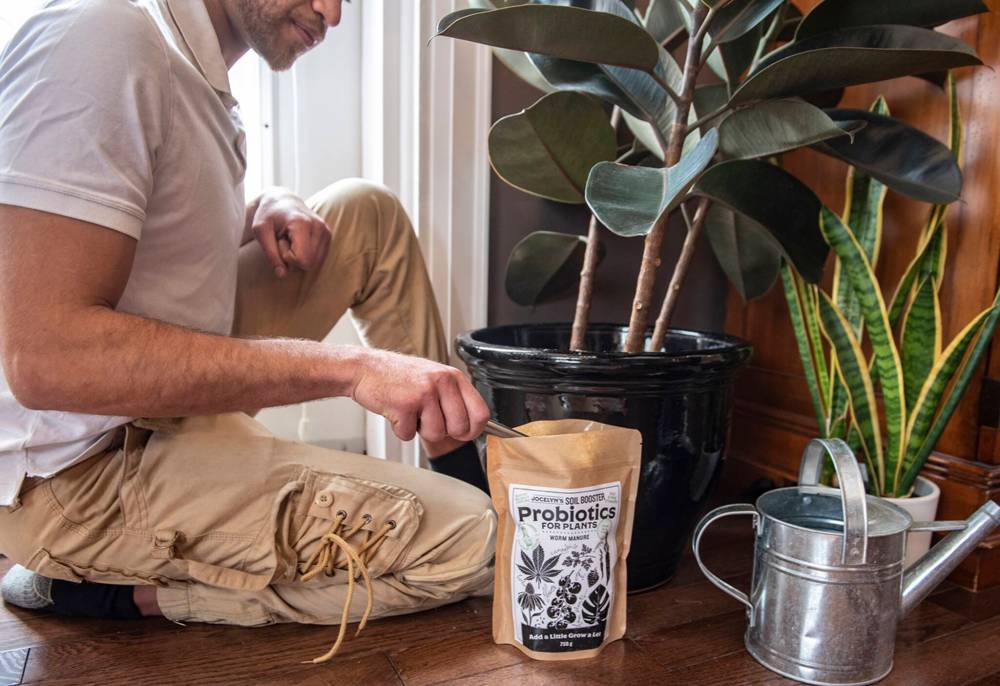
Wastenot Farms
Jocelyn’s Soil Booster worm manure, a natural soil additive with beneficial microbes, can be used for indoor or outdoor plants.
Molyneux’s hope is that backyard growers and small market gardeners will switch to regenerative agriculture when they see the value of looking after the health of their soil. “And then I hope we put upward pressure on our food production systems and governments to implement these techniques on a larger scale,” she says. “That ultimately is what we need to do to take care of the soil ecosystem and help solve the climate crisis.”
Molyneux is seeing increased demand for Wastenot Farms’ regenerative products which are sold online through her company’s website and at more than a dozen Healthy Planet retail locations in Greater Toronto and are now available on Amazon. The pandemic, of course, was a major disruption but it also helped forge a new direction for her company. “For the first seven years of the business, we were focused on providing a compost collection service for about fifty offices. Forward-thinking clients included World Wildlife Fund and the David Suzuki Foundation. I was on the road every day of the week picking up food waste and then the pandemic hit. Within an eight-hour work day on March 13, 2020, I lost all my contracts because all the offices closed.”
Not only did Molyneux lose all her business revenue, but she also lost all the food for the worms. “We very quickly had to pivot and switched to horse manure because that was readily available.” The silver lining was that during that time, so many people were working from home and began taking a closer look at the environment. “There was a huge uptick of interest in growing plants during COVID.”

There is also growing demand for peat-free products. “The interest is huge,” says Molyneux. The whole Jocelyn’s Soil Booster brand is a line of products that enable and empower Canadians to regenerate their soil and it is peat-free. We can barely keep our potting soil in stock.” Jocelyn’s Raw & Regenerative Potting Soil is a peat-free, living potting soil that uses upcycled waste to replicate the same physical properties and water-holding capacity as peat, but without the destruction of peat bogs to extract peat for horticultural use. It can be used for indoor or outdoor container plants or garden beds.
In addition to potting soil and worm manure, Jocelyn’s Soil Booster products also include an activated and inoculated biochar plant food that is mixed with worm manure.

Carmen Cheung
Jocelyn Molyneux, professional worm farmer, in her drying house where she reaps the benefits from two million red wiggler worms.
“Soil microbes are like the Uber Eats delivery system of the soil,” says Molyneux. “Plants get on demand delivery of the nutrients they need at the right time. Your soil is going to retain moisture better and that is because it’s the biology that creates the porosity, so you don’t have to water as much. You will have healthier food, bigger plants, and more blooms. So as a grower, why wouldn’t you get your plants off chemicals and do this?”
colleenizacharias@gmail.com
For advice, ideas and tips to keep your outdoor and indoor plants growing, sign up to receive Winnipeg Gardener, a free monthly digital newsletter Colleen Zacharias writes for the Free Press at: winnipegfreepress.com/newsletter/winnipeg-gardener

Carmen Cheung
Jocelyn Molyneux, owner of Jocelyn’s Soil Booster, sees a bright future for transforming food waste into healthy soil.
Colleen Zacharias
Gardening columnist
Colleen Zacharias writes about many aspects of gardening including trends, plant recommendations, and how-to information that is uniquely relevant to Prairie gardeners. She has written a column for the Free Press since 2010 and pens the monthly newsletter Winnipeg Gardener. Read more about Colleen.
Every piece of reporting Colleen produces is reviewed by an editing team before it is posted online or published in print — part of the Free Press‘s tradition, since 1872, of producing reliable independent journalism. Read more about Free Press’s history and mandate, and learn how our newsroom operates.
Our newsroom depends on a growing audience of readers to power our journalism. If you are not a paid reader, please consider becoming a subscriber.
Our newsroom depends on its audience of readers to power our journalism. Thank you for your support.
Colleen Zacharias
Gardening columnist
Colleen Zacharias writes about many aspects of gardening including trends, plant recommendations, and how-to information that is uniquely relevant to Prairie gardeners. She has written a column for the Free Press since 2010 and pens the monthly newsletter Winnipeg Gardener. Read more about Colleen.
Every piece of reporting Colleen produces is reviewed by an editing team before it is posted online or published in print — part of the Free Press‘s tradition, since 1872, of producing reliable independent journalism. Read more about Free Press’s history and mandate, and learn how our newsroom operates.
Our newsroom depends on a growing audience of readers to power our journalism. If you are not a paid reader, please consider becoming a subscriber.
Our newsroom depends on its audience of readers to power our journalism. Thank you for your support.
Advertisement Advertise With Us
Advertisement Advertise With Us