Doctors, patients want options to reduce dialysis waste adding to climate change
Advertisement
Read this article for free:
or
Already have an account? Log in here »
To continue reading, please subscribe:

Digital Subscription
One year of digital access for only $205*
- Enjoy unlimited reading on winnipegfreepress.com
- Read the E-Edition, our digital replica newspaper
- Access News Break, our award-winning app
- Play interactive puzzles
*First annual payment billed as $205.00 + GST for one year. This annual subscription will automatically renew at $233.00 + GST every 52 weeks (10% off the regular annual price of $259.35). Offer available to new and qualified returning subscribers only. Cancel any time.
To continue reading, please subscribe:
Add Free Press access to your Brandon Sun subscription for only an additional
$1 for the first 4 weeks*
- Enjoy unlimited reading on winnipegfreepress.com
- Read the E-Edition, our digital replica newspaper
- Access News Break, our award-winning app
- Play interactive puzzles
*Your next Brandon Sun subscription payment will increase by $1.00 and you will be charged $17.95 plus GST for four weeks. After four weeks, your payment will increase to $24.95 plus GST every four weeks.
Read unlimited articles for free today:
or
Already have an account? Log in here »
Hey there, time traveller!
This article was published 18/05/2024 (866 days ago), so information in it may no longer be current.
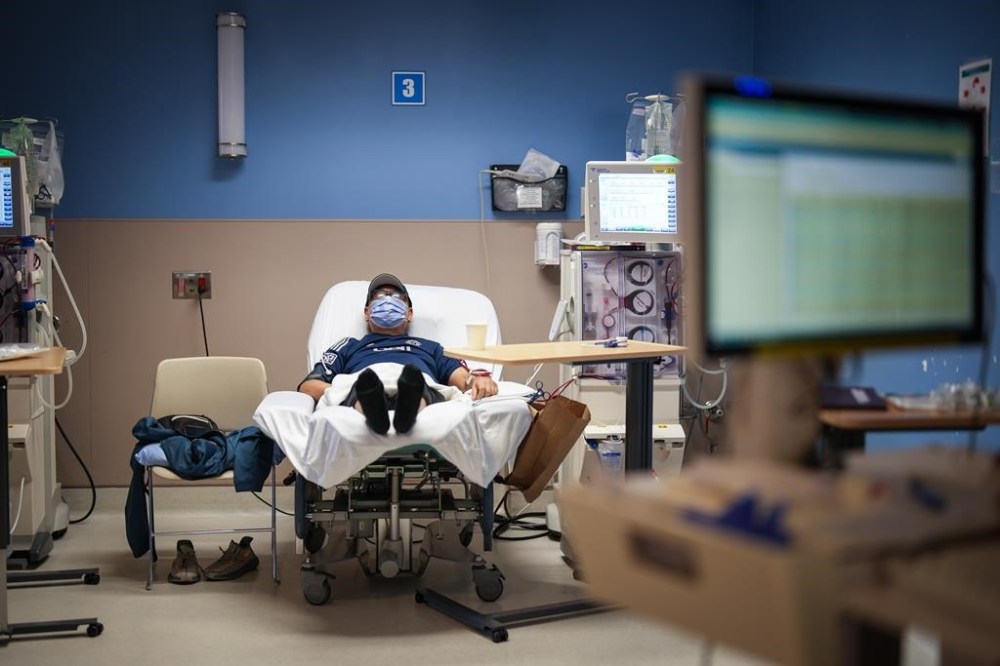
VANCOUVER – Francis Silva watches the blood flow through astraw-like tube in his left arm to a dialysis machine where it’s cleaned of toxins and returned to his body through a second tube.
The 60-year-old chef endures the four-hour process every Tuesday, Thursday and Sundayat St. Paul’s Hospital where a 42-bed unit is dedicated to lifesaving hemodialysis but is also the source of a significant amount of medical waste that a group of nephrologists wants to curb across the country.
“Last year when I had a heart operation, it just got worse,” Silvasaid of his kidney problems, for which he tried to find a bright side. “I need the rest. I’ve been standing for eight hours.”
Down the hall, carts are loaded with blue plastic bins full of dialysis supplies that include plastic tubing in plastic and paper packaging. A supply room contains plastic jugs of solution that will be mixed with purified water and piped into the dialysis machines lined up against a wall.
A nearby room is stocked with boxes of more supplies including plastic saline bags — at least two per patient for each dialysis session.
Patient care manager Laila Aparicio points to a garbage bin filled with waste.
“We came here about 10 minutes ago and it was empty,” Apariciosaid. “It would be awesome if we were able to decrease that as much as possible to reduce the environmental impact.”
In another room, hoses in the wall pump hundreds of litres of purified water into a dialysis machine where it is mixed with electrolyte solutions. Toxins from blood are removed, as is excess water from a patient’s body, and the wastewater is piped into the city’s sewer system.
“Downstairs, there are huge tanks, three of them, that provide highly purified water, lots of it,” said Aparicio.
The clinic does about 800 dialysis treatments a week, with two nurses assigned to each patient.
Dr. Caroline Stigant, a nephrologist at Royal Jubilee Hospital in Victoria and a leading advocate for sustainable kidney care, said each hemodialysis treatment uses up to 500 litres of water and large amounts of energy.
“A single hemodialysis treatment’s carbon emissions are comparable to that of an average vehicle driven 100 kilometres,” said Stigant.
She said more than 20,000 patients in Canada undergo the therapy. There are no established recycling programs for dialysis or medical waste in Canada, she added.
Biohazardous waste, including tubing in some cases, as well as blood-soaked gauze, is sent to a facility to be autoclaved — sterilized with high temperature steam — and thenshredded and landfilled, Stigant said.
The Canadian Society of Nephrology has a planning committee to find ways to reduce waste. One goal is to develop a carbon footprint calculator to collect data on the environmental impact of kidney care.
Stigant, the committee’s inaugural chair, said kidney diseases are on the rise, producing more waste that contributes to climate change. In turn, climate change can increase the risk of kidney diseases, since dehydration during extreme heat is especially risky for vulnerable populations.
“There’s a global environmental evolution in nephrology and kidney care. And it’s huge work, not just for nephrologists. It’s for administrators, it’s for funders of the system, it’s for patients to be involved in, it’s for industry as well,” she said.
“We believe that we need a redesign of the systems that we’re using in kidney care, in part because no patient wants to be on dialysis. They’re tethered to a machine.”
She said it’s crucial to promote healthy living to prevent conditions including high blood pressure and diabetes, which are most commonly associated with kidney diseases. Early diagnosis is also important because by the time symptoms develop, a patient has likely lost 80 per cent of their kidney function, added Stigant, medical lead for planetary health at BC Renal, the agency responsible for kidney care in British Columbia.
Greater access to kidney transplants is also key, before patients end up needing dialysis, Stigant said. “Their general well-being, their outcome, is also what’s best for the environment.”
Patients who have dialysis at home with supplies that are typically shipped to them once a month must put their plastic and cardboard waste at the curbside, and that could include blood-soaked material, said Stigant. She said some patientspay municipalities for extra bags or take their garbage to a relative’s home.
“When people come in for their home dialysis training, they’ll say, ‘What about all this garbage? Does this all get thrown away?’ ” she said.
“They find the waste embarrassing, they find it very costly to deal with. And that’s something that the system hasn’t, to date, reimbursed.”
One of Stigant’s patients burns the waste produced by his peritoneal dialysis — another form of therapy for kidney failure in which a catheter is inserted into the abdominal cavity, or peritoneum. It can be done daily and produces smaller but still challenging amounts of waste.
“He lives in a rural area and there’s no garbage collection. He’s an elderly man and so it’s too burdensome for him to sort it into recyclable and non-recyclable.”
Home-based peritoneal dialysis generates 211,000 kilograms of recyclable polypropylene plastic, or PVC, annually in Canada, along with 55,600 kilograms of recyclable polypropylene, the thin peel-away plastic, according to a study Stigant co-authored and published last November in Kidney International Reports.
Stigant said that in Australia, recyclable plastic items are picked up each time peritoneal dialysis supplies are delivered.
“This is something we would love to implement locally.”
“We’re really in our infancy of managing the waste properly. But it has to involve reducing the burgeoning number of people with disease risk factors and even those living with impaired kidney function. The world is facing this very rapidly increasing condition.”
Nancy Verdin, a home dialysis patient in Red Deer, Alta., is a member of the nephrologists’ sustainability committee and said she struggles with the large amount of wastefrom hemodialysis she’s received for 26 years.
The 63-year-old who’s had three failed kidney transplants said some of the waste can’t be recycled in her city because it accepts only numbered plastics.

“I have to separately package and then decide, am I going topay the shipping costs to send it to Edmonton?” she said of more recycling options there.
“I don’t drive any more. So that means I have to get someone to help me take it to a delivery site. And everything costs money.”
This report by The Canadian Press was first published May 18, 2024.
Canadian Press health coverage receives support through a partnership with the Canadian Medical Association. CP is solely responsible for this content.
Note to readers: This is a corrected story. A previous version that moved May 18 mentioned biohazardous waste in a hospital garbage bin. In fact, it was not definitively determined to be biohazardous waste.