Botanists are scouring the US-Mexico border to document a forgotten ecosystem split by a giant wall
Advertisement
Read this article for free:
or
Already have an account? Log in here »
To continue reading, please subscribe:

Digital Subscription
One year of digital access for only $205*
- Enjoy unlimited reading on winnipegfreepress.com
- Read the E-Edition, our digital replica newspaper
- Access News Break, our award-winning app
- Play interactive puzzles
*First annual payment billed as $205.00 + GST for one year. This annual subscription will automatically renew at $233.00 + GST every 52 weeks (10% off the regular annual price of $259.35). Offer available to new and qualified returning subscribers only. Cancel any time.
To continue reading, please subscribe:
Add Free Press access to your Brandon Sun subscription for only an additional
$1 for the first 4 weeks*
- Enjoy unlimited reading on winnipegfreepress.com
- Read the E-Edition, our digital replica newspaper
- Access News Break, our award-winning app
- Play interactive puzzles
*Your next Brandon Sun subscription payment will increase by $1.00 and you will be charged $17.95 plus GST for four weeks. After four weeks, your payment will increase to $24.95 plus GST every four weeks.
Read unlimited articles for free today:
or
Already have an account? Log in here »
Hey there, time traveller!
This article was published 19/05/2024 (850 days ago), so information in it may no longer be current.
JACUMÉ, México (AP) — Near the towering border wall flanked by a U.S. Border Patrol vehicle, botanist Sula Vanderplank heard a quail in the scrub yelp “chi-ca-go,” a sound the birds use to signal they are separated from a mate or group.
Then silence.
A quail on the Mexican side called back, triggering a back-and-forth soundtrack that was both fitting and heartbreaking in an ecosystem split by an artificial barrier.
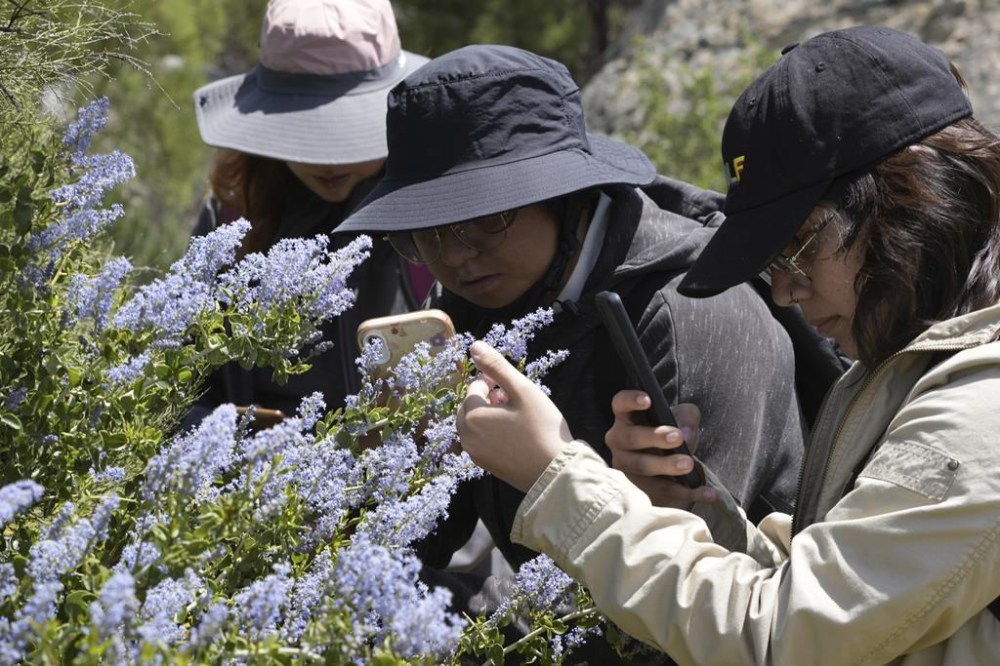
Vanderplank was among several botanists and citizen scientists participating in the Border Bioblitz near the Mexican community of Jacumé, about 60 miles (100 kilometers) east of Tijuana.
Roughly 1,000 volunteers armed with the iNaturalist app on their smartphones are documenting as many species as possible along the U.S.-Mexico border in May. Uploading photos to the app helps identify plants and animals, and records the coordinates of the location.
The hope is the information could lead to more protections for the region’s natural richness, which is overshadowed by news of drug trafficking and migrant smuggling.
On a recent day, Bioblitz volunteers scrutinized a bright yellow blooming carpet of common Goldfields, a sharp contrast to the imposing steel bollards of the border wall topped with rolls of razor wire. Some navigated their way around piles of empty water jugs, a gray hoodie and empty cans of tuna fish left under the branches of native flora like the Tecate Cypress.
“There’s a fabulous amount of biodiversity here that’s traditionally been overlooked,” Vanderplank, of the binational program Baja Rare, said.
The efforts started in response to former President Donald Trump adding hundreds of miles of border walls that toppled untold numbers of saguaro cactuses in Arizona and passed through the biodiversity hotspot of Baja California.
“When the border wall construction began, we realized how little hard data we had, especially when it came to plants and small organisms,” Vanderplank said. “We don’t know what all we could lose.”
Since then, there has been a groundswell of initiatives to document the borderland’s flora and fauna as climate change coupled with habitat loss, pollution and development have hammered the world’s biodiversity. One estimate in 2019 warns that a million plant and animal species face extinction within decades, a rate of loss 1,000 times greater than expected.
The United Nations is expected hold a high-level meeting in Colombia of signatories to the Convention on Biological Diversity in October aiming to protect 30% of land, freshwater and oceans considered important for biodiversity by 2030, known as 30 by 30. Representatives from nearly 200 countries are expected to present plans on how they will meet conservation targets agreed upon in 2022.
Currently, 17% of terrestrial and 10% of marine areas are protected.
Baja California peninsula, which borders California and is home to Tijuana with one of Mexico’s highest homicide rates, has more than 4,000 species of plants. A quarter of them are endemic and at least 400 plants are considered rare with little to no protection.
Flora and fauna that have gone extinct or are in danger of disappearing in the U.S., like the California red-legged frog, are thriving south of the border, producing specimens that are being used to bring back populations.
But the region’s crime deters many U.S. scientists from crossing the border. Mexico also is restricting permits for botanists and not allowing seeds to be collected, further curtailing the work, scientists say.
Bioblitz organizers work with local communities and say they take people only to areas deemed safe.
“You have to be really careful because of the violence,” said Jon Rebman, a curator of botany at the San Diego Natural History Museum, who has named 33 new plants for science from the southern California and Baja California region.
“It’s scary from that standpoint, yet those are the areas where we really need more information because there’s hardly any protected area on the south side,” he said.
Using the museum’s collection, Rebman made a list of 15 plant species endemic to Baja California and not seen since being collected nearly a century ago. He created a binational team to find them. So far, they have located 11.
Rebman also discovered two new plants to science in 2021 in a canyon off a Tijuana highway: the new species, Astragalus tijuanensis, and a new variety of the Astragalus brauntonii named lativexillum.
“I was worried they would go extinct before we even got them named,” Rebman said. “That tells you what type of area we’re working in.”
Tijuana-based botanist Mariana Fernandez of Expediciones Botánicas periodically checks on the plants. Working with Rebman, she is pushing Baja California to adopt more protections for its native plants. Currently only a fraction are on Mexico’s federal protection list.
She hopes the state will step in, while she also tries to build support by taking Tijuana residents and Baja officials on hikes.

“People are amazed that these things exist in Tijuana, and I hope to show more and more people so they can see the beauty, because we need that,” Fernandez said. “It’s important to not be impeded by the barriers that humans create.”
As border security increases with the number of people being displaced by natural disasters, violence and wars at record levels worldwide, more migrants are traipsing out to areas like the stretch near Jacumé. The tiny community of about 100 families includes members of the Kumeyaay tribe and sits across the border from an equally sparsely populated desert near the California town of Jacumba Hot Springs. Population: about 1,000.
The area has seen thousands of asylum seekers who wait for an opportunity to cross, usually in the cloak of darkness, and then camp again on the U.S. side after turning themselves in to U.S. Border Patrol agents.
Fernandez was among the botanists helping Bioblitz volunteers on the Mexican side near a crumbling crossing station from the 1920s.
“I never would have thought that there would be so much biodiversity on the border,” said Jocelyn Reyes, a student of Fernandez at La Universidad Autónoma de Baja California who stopped every few feet to hover over a plant and photograph its details. “It’s so interesting and makes you realize there’s so much worth saving.”