When violence and trauma visit American places, a complex question follows: Demolish, or press on?
Advertisement
Read this article for free:
or
Already have an account? Log in here »
To continue reading, please subscribe:

Digital Subscription
One year of digital access for only $205*
- Enjoy unlimited reading on winnipegfreepress.com
- Read the E-Edition, our digital replica newspaper
- Access News Break, our award-winning app
- Play interactive puzzles
*First annual payment billed as $205.00 + GST for one year. This annual subscription will automatically renew at $233.00 + GST every 52 weeks (10% off the regular annual price of $259.35). Offer available to new and qualified returning subscribers only. Cancel any time.
To continue reading, please subscribe:
Add Free Press access to your Brandon Sun subscription for only an additional
$1 for the first 4 weeks*
- Enjoy unlimited reading on winnipegfreepress.com
- Read the E-Edition, our digital replica newspaper
- Access News Break, our award-winning app
- Play interactive puzzles
*Your next Brandon Sun subscription payment will increase by $1.00 and you will be charged $17.95 plus GST for four weeks. After four weeks, your payment will increase to $24.95 plus GST every four weeks.
Read unlimited articles for free today:
or
Already have an account? Log in here »
Hey there, time traveller!
This article was published 17/06/2024 (839 days ago), so information in it may no longer be current.
PITTSBURGH (AP) — Last week in Parkland, Florida, wrecking equipment began demolishing the building at Marjory Stoneman Douglas High School where a gunman’s rampage in 2018 ended with 17 people dead. As the rumble of destruction echoed, people in the community set to explaining exactly why ripping the building down was so meaningful — and so crucial.
From former student Bryan Lequerique: “It’s something that we all need. It’s time to bring an end to this very hurtful chapter in everyone’s lives.” And Eric Garner, a broadcasting and film teacher, said: “For 6 1/2 years we have been looking at this monument to mass murder that has been on campus every day. … So coming down, that’s the monumental event.”
Parkland. Uvalde. Columbine. Sandy Hook. A supermarket in Buffalo. A church in South Carolina. A synagogue in Pittsburgh. A nightclub in Orlando, Florida. When violence comes to a public place, as it does all too often in our era, a delicate question lingers in the quiet afterward: What should be done with the buildings where blood was shed, where lives were upended, where loved ones were lost forever?
Which is the appropriate choice — the defiance of keeping them standing, or the deep comfort that can come with wiping them off the map? Is it best to keep pain right in front of us, or at a distance?
How different communities have approached the problem
This question has been answered differently over the years.
The most obvious example in recent history is the decision to preserve the concentration camps run by Nazi Germany during World War II where millions of Jews and others died — an approach consistent with the post-Holocaust mantras of “never forget” and “never again.” But that was an event of global significance, with meaning for both the descendants of survivors and the public at large.
For individual American communities, approaches have varied. Parkland and others chose demolition. In Pittsburgh, the Tree of Life synagogue, site of a 2018 shooting, was torn down to make way for a new sanctuary and memorial.
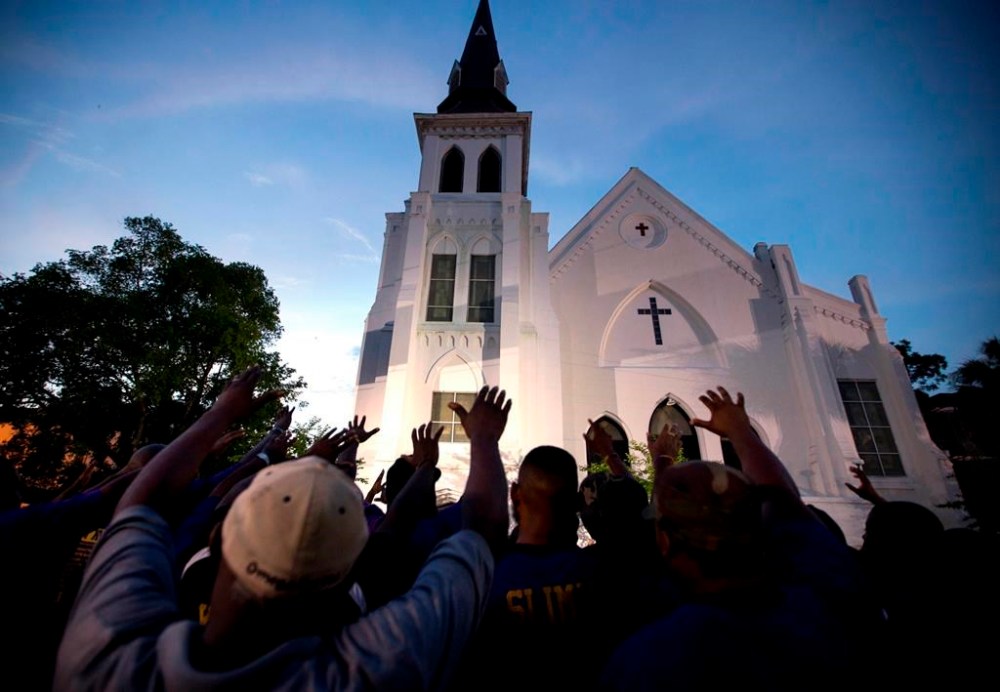
But the Tops Friendly Markets in Buffalo, New York, and the Emanuel African Methodist Episcopal Church in Charleston, South Carolina, where racist mass shootings happened, both reopened. And Columbine High School still stands, though its library, where so much bloodshed occurred, was replaced after much impassioned debate. “Finding a balance between its function as a high school and the need for memorialization has been a long process,” former student Riley Burkhart wrote earlier this year in an essay.
What goes into these decisions? Not only emotion and heartbreak. Sometimes it’s simply a question of resources; not all school districts can afford to demolish and rebuild. Sometimes it’s about not wanting to give those who might support the shooter a place to focus their attention.
“Denying such opportunities for those who celebrate the persecution and deaths of those different from themselves is a perfectly sound reason to tear down buildings where mass killings occurred,” Daniel Fountain, a professor of history at Meredith College in North Carolina, said in a email.
Perhaps the most significant driving force, though, is the increasing discussion in recent years about the role of mental health.
“There are changing norms about things like trauma and closure that are at play that today encourage the notion of demolishing these spaces,” said Timothy Recuber, a sociologist at Smith College in Massachusetts and author of “Consuming Catastrophe: Mass Culture in America’s Decade of Disaster.”
For many years, he said, “the prevailing idea of how to get past a tragedy was to put your head down and push past it. Today, people are more likely to believe that having to return to the scene of the crime, so to speak, is liable to re-inflict harm.”
In Pittsburgh’s Squirrel Hill neighborhood, a fence masks the site where the Tree of Life synagogue stood until it was razed earlier this year, more than five years after a gunman killed 11 people in the deadliest antisemitic attack in U.S. history.
David Michael Slater grew up across the street from the synagogue. He understands the ambivalence that can come with choosing whether to knock down.
“It’s easy to see why decision-makers might have chosen one path or the other. And to me, it seems presumptuous for anyone not part of, or directly affected by, the choice to quibble with it,” said Slater, who retired this month after 30 years of teaching middle and high school English. “That said, the decision to demolish such sites, when seen in the context of our escalating culture of erasure, should raise concern.”
The power of memory cuts both ways
From World War II to 9/11, the politics of American memory are powerful — and nowhere more intricate than in the case of mass shootings. The loss of loved ones, societal disagreements over gun laws and differing approaches to protecting children create a landscape where the smallest of issues can give rise to dozens of passionate and angry opinions.
To some, keeping a building standing is the ultimate defiance: You are not bowing to horror nor capitulating to those who caused it. You are choosing to continue in the face of unimaginable circumstances — a robust thread in the American narrative.
To others, the possibility of being retraumatized is central. Why, the thinking goes, should a building where people met violent ends continue to be a looming — literally — force in the lives of those who must go on?
It stands to reason, then, that a key factor in deciding the fates of such buildings coalesces around one question: Who is the audience?
“It’s not a simple choice of should we knock it down or renovate or let it be,” said Jennifer Talarico, a psychology professor at Lafayette College in Pennsylvania who studies how people form personal memories of public events.
“If we’re interested in the memories of the people who directly experienced the event, that physical space will serve as a specific and powerful reminder. But if we’re talking about remembering or commemorating an event for other people, those who did not experience it, that’s a slightly different calculus,” Talarico said. “Remembering and forgetting are both powerful forces.”

Ultimately, of course, there is a middle ground: eliminating the building itself but erecting a lasting memorial to those who were lost, as Uvalde and other communities have chosen. In that way, the virtues of mental health and memory can both be honored. Life can go on — not obliviously, but not impeded by a daily, visceral reminder of the heartbreak that once visited.
That approach sits well with Slater, who has contemplated such tragedies both from the standpoint of his hometown synagogue and the classrooms where he spent decades teaching and keeping kids safe.
“Like every problem in life that matters, simple answers are hard to come by,” Slater said. “If what replaces the Tree of Life, or Parkland, or the next defiled place of worship or learning or commerce, can be made to serve both as proof of our indomitable spirit and as memorialized evidence of what we strive to overcome, perhaps we can have the best of both worst worlds.”
___
Ted Anthony, director of new storytelling and newsroom innovation at The Associated Press, has been writing about American culture for 35 years and covered the Columbine High School shootings. Follow him at https://x.com/anthonyted