Summer camps are for getting kids outdoors, but more frequent heat waves force changes
Advertisement
Read this article for free:
or
Already have an account? Log in here »
To continue reading, please subscribe:

Digital Subscription
One year of digital access for only $205*
- Enjoy unlimited reading on winnipegfreepress.com
- Read the E-Edition, our digital replica newspaper
- Access News Break, our award-winning app
- Play interactive puzzles
*First annual payment billed as $205.00 + GST for one year. This annual subscription will automatically renew at $233.00 + GST every 52 weeks (10% off the regular annual price of $259.35). Offer available to new and qualified returning subscribers only. Cancel any time.
To continue reading, please subscribe:
Add Free Press access to your Brandon Sun subscription for only an additional
$1 for the first 4 weeks*
- Enjoy unlimited reading on winnipegfreepress.com
- Read the E-Edition, our digital replica newspaper
- Access News Break, our award-winning app
- Play interactive puzzles
*Your next Brandon Sun subscription payment will increase by $1.00 and you will be charged $17.95 plus GST for four weeks. After four weeks, your payment will increase to $24.95 plus GST every four weeks.
Read unlimited articles for free today:
or
Already have an account? Log in here »
Hey there, time traveller!
This article was published 24/06/2024 (820 days ago), so information in it may no longer be current.
OREGONIA, Ohio (AP) — At the end of their weeklong sleepaway camp, a hush falls over the boisterous kids at YMCA’s Camp Kern as they prepare for a treasured annual tradition: after songs and skits around a bonfire, they write down their favorite memories on slips of paper. Most years, they toss them into the flames, and the ash that rises and then falls over their heads is meant to symbolize the joy they shared.
But this year, it was too hot for a bonfire.
Even as the sun went down, on a day when the high hit 92 degrees Fahrenheit (33 Celsius) with oppressive humidity, kids wiped sweat from their foreheads, flocked to water coolers to refill bottles and fanned themselves to try to get a breeze going. At the end of the night, they burned their memory notes in a small bucket.
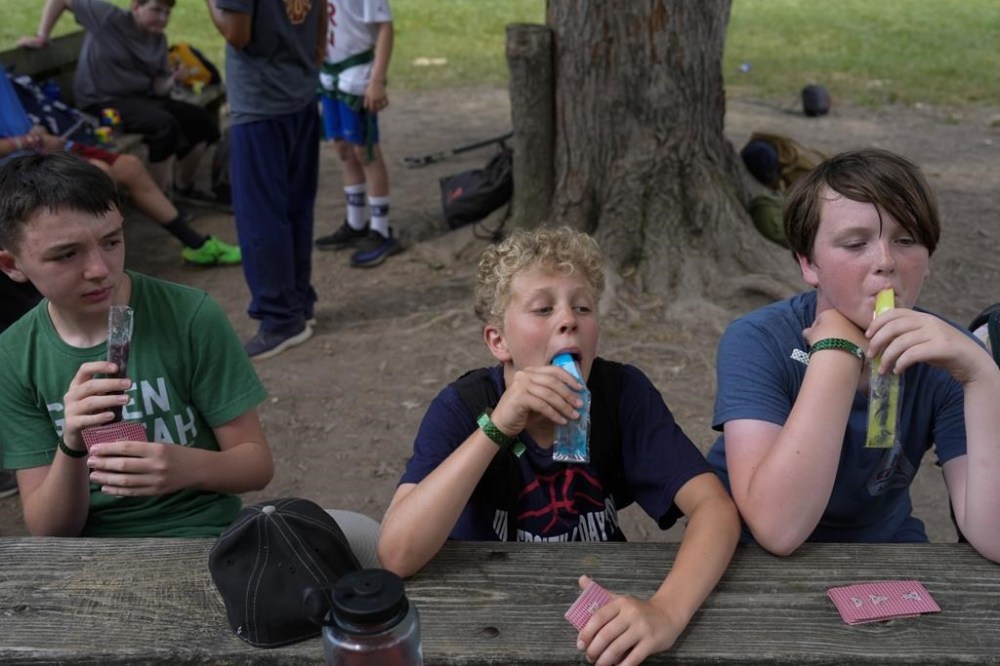
It’s just one way American summer camps have had to adapt as climate change fuels extreme heat events that can start earlier in the season and keep heat lingering well into the night. Camp administrators, counselors and experts say such camps are a great way for kids to develop social skills, learn outside of the classroom and connect with nature. But running them is getting harder and more expensive as camps look for ways to better provide access to water and cooling and better prepare staff to take care of young people.
“Extreme heat is serious. We have to really focus on carefully and thoughtfully planning the program to adapt to these situations,” said Tom Rosenberg, president and CEO of the American Camp Association, a nonprofit that provides research and resources to improve camps. He said the ACA has had climate change on its radar for many years as an issue that affects camp programming.
In 2011, for example, a dozen Girl Scouts were treated for heat-related illnesses at a camp in Connecticut. In 2015, two children were hospitalized with heat exhaustion in a Florida summer camp. And a 15-year-old Boy Scout died in Texas in 2017 after collapsing from heatstroke during a group hike while pursuing a camping merit badge.
The U.S. has over 20,000 unique camp operations that serve 26 million campers, according to a study funded by the ACA and conducted in partnership with the University of Michigan’s Economic Growth Institute.
It’s all the more important for camps to be on their guard because children are more vulnerable to heat than adults, said Grace Robiou, director of the Environmental Protection Agency’s Office of Children’s Health Protection. “General good health includes being outside,” she said, but children’s growing bodies can warm faster than adult bodies do. They’re also not as self-aware, and often need an adult to tell them to stay hydrated and cool.
“If you’re overheating, you can guarantee that the kids you are watching or playing with or supervising are getting overheated as well,” said Dr. Alison Tothy, a pediatric emergency medicine physician at the University of Chicago’s children’s hospital who spends her summers working as a camp doctor in upstate New York. “It’s just something that we’ve now put on our list of reasons why someone might be sick. And I don’t think that we were doing that as much, even a few years ago.”
The physical activities kids do at camp can involve a lot of exertion. After climbing an obstacle course or a rock wall, some of the kids at Camp Kern said they were ready to go inside — even Alex Reiff, 12, who thought it was the best thing he did that week. “When you climb, you feel like you’re getting active,” he said, then added, “I was sweating.”
Seeking reprieve, Reiff and his bunkmates have been cranking the air conditioning in their cabin when they’re inside, something kids at other camps in more rustic accommodations across the U.S. don’t have the option of doing. Many kids at Camp Kern have taken to carrying around handmade paper, folding fabric or electric fans. Some campers simply poured water on their heads. And nearly all eagerly rushed forward at the offer of brightly colored popsicles on a day reporters visited.
Todd Brinkman, the executive director of Camp Kern, said their strategy has generally been to add breaks and indoor sessions, incorporate as many water-based activities as they can and give kids choices. In the past the camp had set pool hours, but they’ve added more lifeguards and swim instructors to keep the pool open all day. They’ve also enhanced some of the water features aimed at smaller children. But water can’t solve all heat problems. Rosenberg said a national lifeguard shortage and the rising cost of insurance in the face of extreme weather have made it more expensive to provide water activities at camps. And Robiou said poor air quality and extreme heat are often linked, worsening problems like childhood asthma, and being in the pool or a lake doesn’t change that.
Just being near water doesn’t necessarily negate the heat. Kids at Camp Kern who went on a raft trip said it was one of the hottest experiences they had that week.
“We just, like, sat in the sun in a big canoe, basically,” said Madelynn Medve, 11.
The young adults who help staff the camp aren’t immune to the blistering temperatures either. Lizzy Johnson, 24, is now a counselor at Camp Kern after going there as a camper growing up. When she looks back, social bonds and fun activities are the memories she treasures. However, she’s also watched and participated in the camp’s evolution, helping organizers trade outdoor experiences like cookouts for indoor or water-based ones like arts and crafts or pool parties.
“I definitely don’t remember any of the heat, I remember all the things that we did,” she said of her own childhood at camp. “But I never remember being this uncomfortable.”
___
Associated Press visual journalist Joshua A. Bickel contributed from Oregonia, Ohio. News researcher Rhonda Shafner contributed from New York.
___
The Associated Press’ climate and environmental coverage receives financial support from multiple private foundations. AP is solely responsible for all content. Find AP’s standards for working with philanthropies, a list of supporters and funded coverage areas at AP.org.