

Is college worth it? Poll finds only 36% of Americans have confidence in higher education
Advertisement
Read this article for free:
or
Already have an account? Log in here »
To continue reading, please subscribe:
Monthly Digital Subscription
$0 for the first 4 weeks*
- Enjoy unlimited reading on winnipegfreepress.com
- Read the E-Edition, our digital replica newspaper
- Access News Break, our award-winning app
- Play interactive puzzles
*No charge for 4 weeks then price increases to the regular rate of $19.00 plus GST every four weeks. Offer available to new and qualified returning subscribers only. Cancel any time.
Monthly Digital Subscription
$4.75/week*
- Enjoy unlimited reading on winnipegfreepress.com
- Read the E-Edition, our digital replica newspaper
- Access News Break, our award-winning app
- Play interactive puzzles
*Billed as $19 plus GST every four weeks. Cancel any time.
To continue reading, please subscribe:
Add Free Press access to your Brandon Sun subscription for only an additional
$1 for the first 4 weeks*
*Your next subscription payment will increase by $1.00 and you will be charged $16.99 plus GST for four weeks. After four weeks, your payment will increase to $23.99 plus GST every four weeks.
Read unlimited articles for free today:
or
Already have an account? Log in here »
Hey there, time traveller!
This article was published 08/07/2024 (516 days ago), so information in it may no longer be current.
Americans are increasingly skeptical about the value and cost of college, with most saying they feel the U.S. higher education system is headed in the “wrong direction,” according to a new poll.
Overall, only 36% of adults say they have a “great deal” or “quite a lot” of confidence in higher education, according to the report released Monday by Gallup and the Lumina Foundation. That confidence level has declined steadily from 57% in 2015.
Some of the same opinions have been reflected in declining enrollment as colleges contend with the effects of the student debt crisis, concerns about the high cost of tuition and political debates over how they teach about race and other topics.
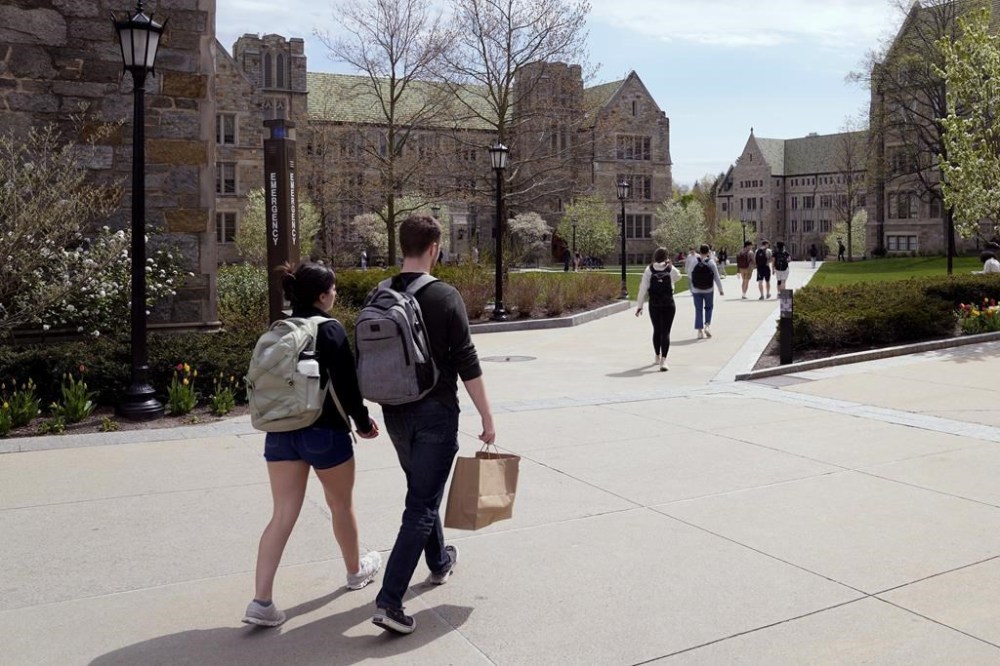
The dimming view of whether college is worth the time and money cuts across all demographics — including gender, age, political affiliation. Among Republicans, the number of respondents with high confidence in higher education has dropped 36 percentage points over the last decade — far more than it dropped for Democrats or independents.
“It’s so expensive, and I don’t think colleges are teaching people what they need to get a job,” says Randy Hill, 59, a registered Republican in Connecticut and a driver for a car service. His nephew plans to do a welding apprenticeship after graduating high school. “You graduate out of college, you’re up to eyeballs in debt, you can’t get a job, then you can’t pay it off. What’s the point?”
The June 2024 survey’s overall finding — that 36% of adults feel strong confidence in higher education — is unchanged from the year before. But what concerns researchers is shifting opinion on the bottom end, with fewer Americans saying they have “some” confidence and more reporting “very little” and “none.” This year’s findings show almost as many people have little or no confidence, 32%, as those with high confidence.
Experts say that fewer college graduates could worsen labor shortages in fields from health care to information technology. For those who forgo college, it often means lower lifetime earnings — 75% less compared with those who get bachelor’s degrees, according to Georgetown University’s Center on Education and the Workforce. And during an economic downturn, those without degrees are more likely to lose jobs.
“It is sad to see that confidence hasn’t grown at all,” says Courtney Brown, vice president at Lumina, an education nonprofit focused on increasing the numbers of students who seek education beyond high school. “What’s shocking to me is that the people who have low or no confidence is actually increasing.”
This year’s survey added new, detailed questions in an effort to understand why confidence is shrinking.
Almost one-third of respondents say college is “too expensive,” while 24% feel students are not being properly educated or taught what they need to succeed.
The survey did not specifically touch on the protests this year against the war in Gaza that divided many college campuses, but political views weighed heavily on the findings. Respondents voiced concerns about indoctrination, political bias and that colleges today are too liberal. Among the respondents who lack confidence, 41% cite political agendas as a reason.
Among other findings:
More than two-thirds, or 67%, of respondents say college is headed in the “wrong direction,” compared with just 31% who feel it’s going in the right direction.
Generally when people express confidence in higher education, they are thinking of four-year institutions, according to Gallup. But the survey found that more people have confidence in two-year institutions. Forty-nine percent of adults say they have “a great deal” or “quite a lot” of confidence in two-year programs, compared with 33% of Americans who feel that way about four-year colleges.

California college student Kristen Freeman understands why.
“It’s about saving money. That’s why I went to a two-year. It’s more bang for your buck,” says Freeman, 22, a sociology major at Diablo Valley Community College with plans to transfer to San Jose State University for the final two years of college.
Freeman understands the concerns about indoctrination and whether college prepares students for life and work but also feels the only way to change structural problems is from the inside. “I am learning about the world around me and developing useful skills in critical thinking,” Freeman says. “I think higher education can give students the spark to want to change the system.”
___
The Associated Press’ education coverage receives financial support from multiple private foundations. AP is solely responsible for all content. Find AP’s standards for working with philanthropies, a list of supporters and funded coverage areas at AP.org.