WEATHER ALERT

Fish biomass loss possible in Atlantic Canada amid rising emissions, researcher says

Advertisement

Advertise with us

HALIFAX - A new study is predicting a steep decline in global fish populations — including species in Atlantic Canada — by the end of the century, if unchecked greenhouse gas emissions continue.

Read this article for free:


or

Already have an account? Log in here »

To continue reading, please subscribe:

Subscribe and receive a limited-edition Free Press branded hat or tote.

Digital Subscription

One year of digital access for only $205*

  • Enjoy unlimited reading on winnipegfreepress.com
  • Read the E-Edition, our digital replica newspaper
  • Access News Break, our award-winning app
  • Play interactive puzzles

*First annual payment billed as $205.00 + GST for one year. This annual subscription will automatically renew at $233.00 + GST every 52 weeks (10% off the regular annual price of $259.35). Offer available to new and qualified returning subscribers only. Cancel any time.

To continue reading, please subscribe:

Add Free Press access to your Brandon Sun subscription for only an additional

$1 for the first 4 weeks*

  • Enjoy unlimited reading on winnipegfreepress.com
  • Read the E-Edition, our digital replica newspaper
  • Access News Break, our award-winning app
  • Play interactive puzzles
Start now

*Your next Brandon Sun subscription payment will increase by $1.00 and you will be charged $17.95 plus GST for four weeks. After four weeks, your payment will increase to $24.95 plus GST every four weeks.

Hey there, time traveller!
This article was published 17/07/2024 (800 days ago), so information in it may no longer be current.

HALIFAX – A new study is predicting a steep decline in global fish populations — including species in Atlantic Canada — by the end of the century, if unchecked greenhouse gas emissions continue.

The 108-page report published last week by the Food and Agriculture Organization of the United Nations projects that with an average temperature increase of between 3 and 4 C, fish biomass would decline by more than 30 per cent by 2100 in 48 countries.

China, which is the world’s largest seafood consumer, is among the countries whose catches will see the sharpest declines in the world, with a 31 per cent loss.
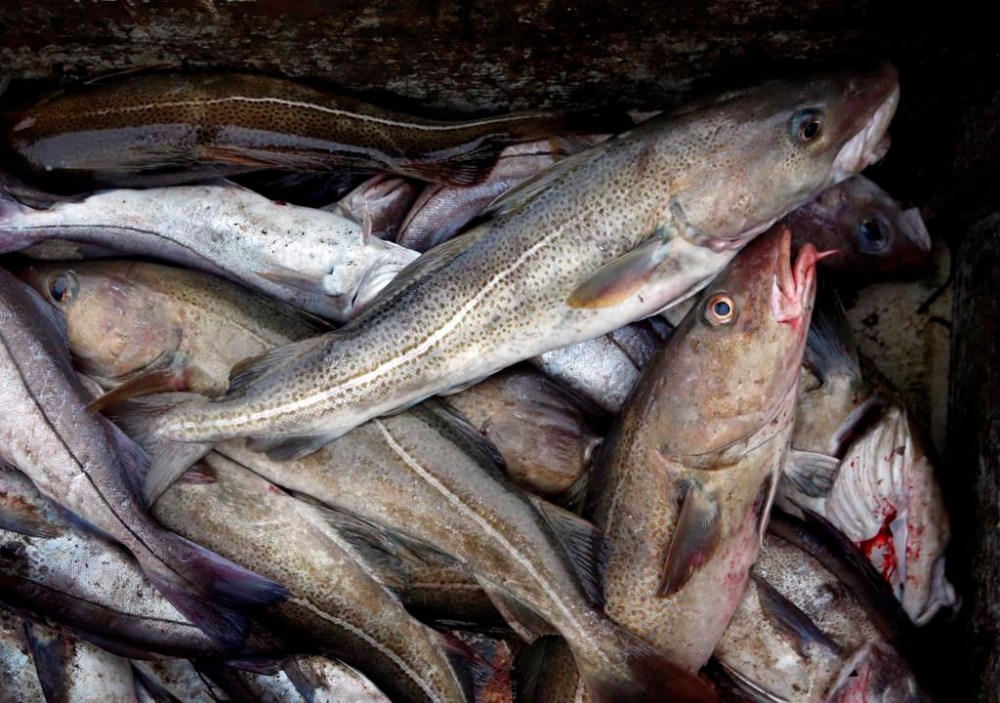
A new study published by the Food and Agriculture organization of the United Nations says new projections show a possible steep decline in global fish biomass by the end of the century under high greenhouse gas emissions, with several areas of Atlantic Canadian fishing areas affected. In this April 23, 2016, file photo, cod fill a box on a trawler off the coast of Hampton Beach, N.H. THE CANADIAN PRESS/AP/Robert F. Bukaty

A low carbon emissions scenario — or 1.5 to 2 C warming — by contrast, projects less than a 10 per cent loss of fish worldwide.

The study measures biomass as the total amount of fish counted in a specific body of water, using a measurement of grams of carbon per square metre of water.

Andrea Bryndum-Buchholz, a marine ecologist at Memorial University who is one of 41 contributors to the study, says in ninedifferent projection models anticipating fish declines,Canadian fisheries are found to be vulnerable as water temperatures rise in the northwest Atlantic.

“All these models agree that fish biomass is going to decline in certain areas because water temperature is increasing,” she said in an interview last week.

It shows three-quarters of the East Coast’s protected marine areas — regions that maintain the long-term conservation of marine species — fall within climate change hotspots, where waters are expected to warm at higher rates.

Bryndum-Buchholz said that has implications for the region’s fishers, who could face significant challenges in the worst case emission scenarios.

“The fishing industry is super important here. It needs to be sustainable,” Bryndum-Buchholz said.

She added that if climate change is allowed to continue at its current pace, it creates pressure for fishery closures that will harm a key part of the region’s economy.

“Fishing is integral to the Maritimes and other areas of the world, so we want to reduce moratoriums because the access (to fish) is important.”

Bryndum-Buchholz said governments managing fish populationscould adopt a risk-based approach that is appropriate to each region, carefully monitoring biomass, animal behaviour and water temperature in each area.

“We can’t have a global solution (to food security) even though we have these global projections. It’s not one cookie-cutter approach,” she said.

This approach involves a significantly higher investment and would lead governments to adjust allowable catches when there are early signs of decline, enforce catch restrictions to prevent fishing juvenile-aged fish, and adjust marine protected areas to respond more effectively as climate change continues.

Increased water temperatures can influence things like migration and breeding habits, Bryndum-Buchholz explained. Lobster migration is one example of migration habits changing, where more lobsters are moving away from waters in Maine as the Atlantic waters warm.

Areas in Atlantic Canada where there is expected warming and biomass declines include the Scotian Shelf, which follows the south shore of Nova Scotia, the Laurentian Channel, which is between Cape Breton Island and Newfoundland, and the Grand Banks, which follows the southeast corner of Newfoundland.

The Gulf of the St. Lawrence, which borders all four of the Atlantic provinces and Quebec, is the fastest warming area.

This report by The Canadian Press was first published July 17, 2024.

Report Error Submit a Tip

More Stories

Well-known Brandon-born rock drummer Sutherland dies at age 58

Rylee Gerrard 3 minute read Preview

Well-known Brandon-born rock drummer Sutherland dies at age 58

Rylee Gerrard 3 minute read Wednesday, Sep. 23, 2026

Chris (Suds) Sutherland, a Brandon-born drummer who was the driving force behind many top artists in the Canadian music industry, has died at 58.

Sutherland is widely praised throughout North America as a talented percussionist with an extensive discography.

He performed with such Canadian music legends as Kim Mitchell, Randy Bachman, Burton Cummings, Streetheart and others.

Sutherland brought presence and “plow” when he played, Tina Faye said about her husband.

Read
Wednesday, Sep. 23, 2026

‘Extremely disappointed’: hunters being turned away near Bloodvein First Nation, Manitoba Wildlife Federation says

Nicole Buffie 5 minute read Preview

‘Extremely disappointed’: hunters being turned away near Bloodvein First Nation, Manitoba Wildlife Federation says

Nicole Buffie 5 minute read Wednesday, Sep. 23, 2026

The Manitoba Wildlife Federation says hunters are again being refused access to land near Bloodvein River First Nation, a year after leadership told court it would let them through.

Read
Wednesday, Sep. 23, 2026

U of W marks 10 years of Indigenous education requirement

Maggie Macintosh 5 minute read Preview

U of W marks 10 years of Indigenous education requirement

Maggie Macintosh 5 minute read 2:00 AM CDT

The University of Winnipeg is collecting course outlines, historic concerns about systemic racism on campus and related records to mark the 10-year anniversary of mandating Indigenous studies.

The unveiling of a new archive drew nearly 200 people to Centennial Hall on Thursday afternoon to reflect on how the Indigenous course requirement, also known as “the ICR,” came to be.

University archivist Brett Lougheed told the crowd its inception is “an amazing story” of student activism that, until now, wasn’t accurately reflected in U of W records.

“What little material we had told the story of administration’s role in developing the ICR as though it was the ultimate driver… and not a student-led response to racism,” Lougheed said.

Read
2:00 AM CDT

Manitoba’s small oil, gas sector lists 31 ownerless sites — far cry from thousands in Alberta, Saskatchewan

Eva Wasney 7 minute read Preview

Manitoba’s small oil, gas sector lists 31 ownerless sites — far cry from thousands in Alberta, Saskatchewan

Eva Wasney 7 minute read Yesterday at 7:00 AM CDT

As other western provinces struggle to address the environmental and economic fallout from an accumulation of thousands of orphan oil and gas wells, only a tiny portion of Manitoba’s petroleum infrastructure is sitting idle and unclaimed.

But it’s unclear if the province’s small roster of orphan wells is the byproduct of effective regulation — or an historic lack of departmental oversight.

Manitoba’s oil and gas industry is relatively small and generally opaque. None of the experts contacted for this story had direct knowledge of the province’s orphan well landscape.

“My lab has probably measured the most non-producing wells in the country. I don’t think anybody I know is working on it (in Manitoba) who are in the academic realm,” says Mary Kang, an associate professor in civil engineering at McGill University in Montreal.

Read
Yesterday at 7:00 AM CDT

Today’s horoscope

Georgia Nicols 4 minute read Preview

Today’s horoscope

Georgia Nicols 4 minute read 2:00 AM CDT

MOON ALERT: There are no restrictions to shopping or important decisions. The moon is in Pisces.

ARIES (March 21-April 19)

Tread carefully because the sun is opposite Neptune in your sign which can make things confusing. You might think you know what’s going on but actually you either do not have the facts or you’re on the wrong page. And it’s probably not be your fault.

TAURUS (April 20-May 20)

Read
2:00 AM CDT

Several mayors bow out of fall’s municipal elections

Connor McDowell 3 minute read 2:01 AM CDT

BRANDON — A number of mayors have decided not to run for re-election in western Manitoba municipalities.

Heads of council in Dauphin, Neepawa, Boissevain-Morton and Riverdale have bowed out of the race ahead of the Oct. 28 civic election.

Final ballots were confirmed after candidate nominations closed on Tuesday.

Mayor David Bosiak is not running for re-election in the City of Dauphin after serving one term. A three-way race for the mayoral seat is underway between Coun. Steve Sobering and new candidates Keith Durston and Carter Taylor-Luke. Ten candidates entered the race for council; four are councillors running for re-election and six are new candidates. There are six council seats.