Butterflyway is the only way
Project of the David Suzuki Foundation in Dunnottar and across Canada creates gardens that help protect monarchs and more
Advertisement
Read this article for free:
or
Already have an account? Log in here »
To continue reading, please subscribe:
Digital Subscription
One year of digital access for only $1.44 a week*
- Enjoy unlimited reading on winnipegfreepress.com
- Read the E-Edition, our digital replica newspaper
- Access News Break, our award-winning app
- Play interactive puzzles
*Billed as $5.77 plus GST every four weeks. After 52 weeks, price increases to the regular rate of $19.95 plus GST every four weeks. Offer available to new and qualified returning subscribers only. Cancel any time.
To continue reading, please subscribe:
Add Free Press access to your Brandon Sun subscription for only an additional
$1 for the first 4 weeks*
- Enjoy unlimited reading on winnipegfreepress.com
- Read the E-Edition, our digital replica newspaper
- Access News Break, our award-winning app
- Play interactive puzzles
*Your next Brandon Sun subscription payment will increase by $1.00 and you will be charged $17.95 plus GST for four weeks. After four weeks, your payment will increase to $24.95 plus GST every four weeks.
Read unlimited articles for free today:
or
Already have an account? Log in here »
Hey there, time traveller!
This article was published 20/07/2024 (821 days ago), so information in it may no longer be current.
As symbols of hope and transformation, butterflies inspire poetry and provide reminders of life’s fleeting moments. The abundance of these delicate, colourful pollinators is linked to a healthy natural environment and there are people working to conserve and protect them, to prevent their decline.
Wendy Buelow is one of them. The Wolseley resident spends considerable time in the Interlake village of Dunnottar at the family cottage, but she’s not just there for leisurely beach and camping activities.
CARLA BUELOW PHOTO Semi-retired videographer and mother of two Wendy Buelow is in her fourth year as a volunteer Butterflyway Ranger with the David Suzuki Foundation in the village of Dunnottar, where her family cottage is located.
The semi-retired videographer and mother of two is also a birder and in her fourth year as a volunteer Butterflyway Ranger with the David Suzuki Foundation, Butterflyway Project.
In Dunnottar, Buelow manages five of the growing number of Butterflyway gardens — both private and public — in Canada.
“People are really excited when they start their gardens and get bees and butterflies showing up, and especially when tiny monarch caterpillars appear on their milkweed plants,” said the nature lover.
“Monarch and caterpillar sightings are always hoped for when you put your heart and soul into tending the gardens. And it’s not just about the monarchs — it’s all the other wonderful insects, even if they are not traditionally or conventionally beautiful.”
CARLA BUELOW PHOTO Seeing a Northern Crescent butterfly on a raspberry bush is one of the benefits of creating the kinds of plantings supported by the David Suzuki Foundation’s Butterflyway Project.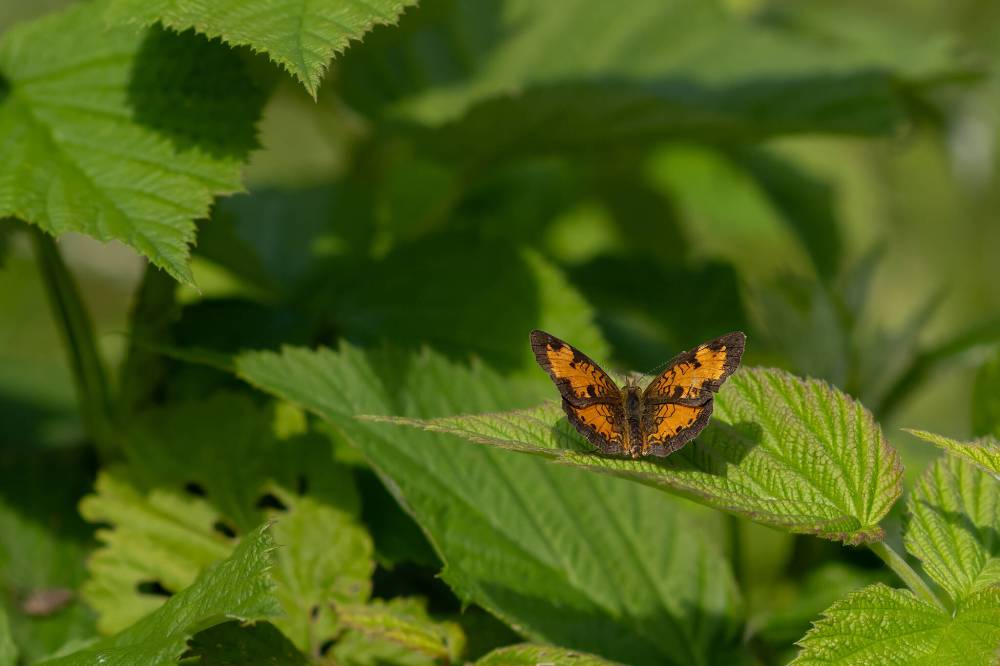
The Butterflyway Project is a volunteer-based campaign that creates networks of butterfly-friendly habitat in communities across Canada. The David Suzuki Foundation began in-person training of volunteer Butterflyway Rangers in five cities in 2017 and moved to online training in 2020.
“Our mandate is to get out in our communities and encourage people to start growing butterfly gardens”–Wendy Buelow
The project aims to create Butterflyways, which are defined as 12 or more native plant gardens in close proximity and to generally increase pollinator awareness and action in communities.
Gardens included in a Butterflyway can be any size, but must include a combination of native wildflowers, grasses, shrubs and trees, ideally sourced from local native plant suppliers.
WENDY BUELOW PHOTO The project aims to support fostering of butterfly-friendly plantings, including milkweed.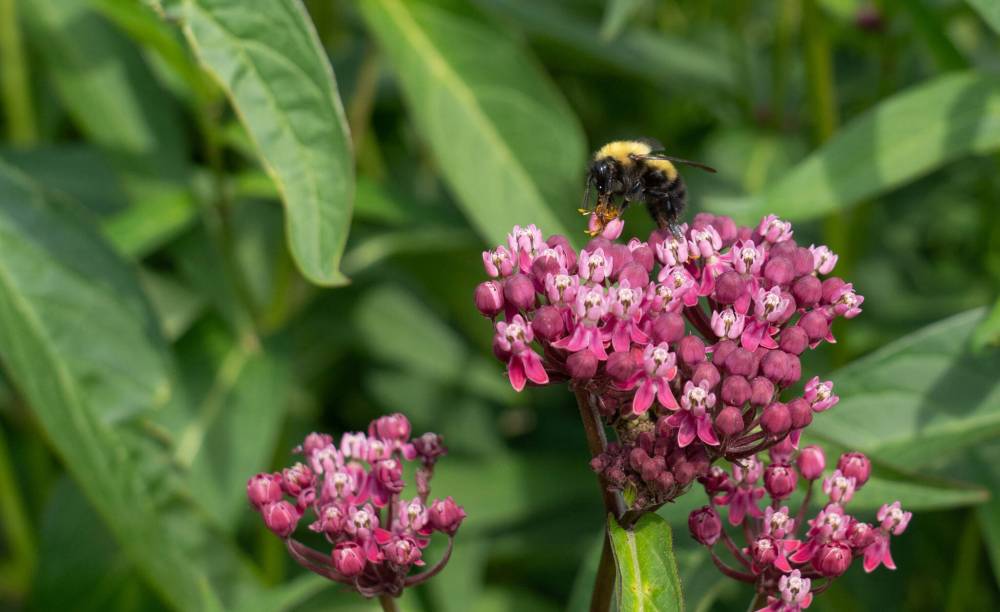
Designated individuals with the unique title of Butterflyway Ranger are provided with Butterflyway-branded materials, including garden signs and T-shirts, as well as educational resources.
“Our mandate is to get out in our communities and encourage people to start growing butterfly gardens, and in the bigger picture, make changes in the community to make more habitat for nature,” Buelow explained.
“Political action — advocating for nature — is another step, which is not for everyone. It is sort of an obsession [for me], especially after learning how insects and birds are disappearing,” she said, citing a 70 per cent decrease in the insect life that spelled what’s been called “an insect apocalypse” caused by human choices.
A self-described introvert, Buelow did her first Butterflyway presentation on Zoom during the pandemic, which, despite being challenging, got her motivated. She has since done numerous in-person presentations in Dunnottar, Gimli and Selkirk.
“I work with Age Friendly Dunnottar and they supported me with one garden in 2021 and then in 2022 we wrote a grant to get two more gardens going with the Westshore Community Foundation. We received $1,200 and bought plants from Prairie Originals, soil and other stuff. All the labour was volunteer and then the Village watered every week during summer when needed,” Buelow said, adding that the work is supported by the village council and several other local groups.
“In Dunnottar, there is an unofficial group of us working on both the public gardens and private home gardens. These all make up a Butterflyway. Dunnottar has 16 reported gardens that include the public ones.”
In the fall, Buelow and others have seed giveaways with the generous harvest from all the gardens and also advise people about how to start gardens. She and a network of others have lobbied the provincial government to reinstate and strengthen the cosmetic pesticide ban that the previous government had repealed.
Buelow encourages gardeners to apply to the City of Winnipeg for a buffer zone around spraying for mosquitoes and tree worms. She also recommends putting out a sign to explain to neighbours that their garden is for butterflies and pollinators, which is why it might look different from the usual petunias.
When buying greenhouse plants, she suggests asking to see if pesticides are used for growing, pointing out that a plant treated with neonicotinoids can kill an insect feeding on it and a bird can die after eating just one seed treated with these chemicals.
“There’s been a steep decline in monarchs since the newer pesticide is being used,” she said.
“When you start noticing things in the natural world, you see that we’ve got a great habitat. What can we do to preserve this natural habitat so the birds keep coming? What do birds eat to feed their young? They need insects, caterpillars, larvae. Chickadees will need six to nine thousand larvae to feed a clutch of young. We need plants and insects that can support that, so we can keep feeding our birds.”
WENDY BUELOW PHOTO The Butterflyway Project is a volunteer-based campaign that creates networks of butterfly-friendly habitat in communities across Canada.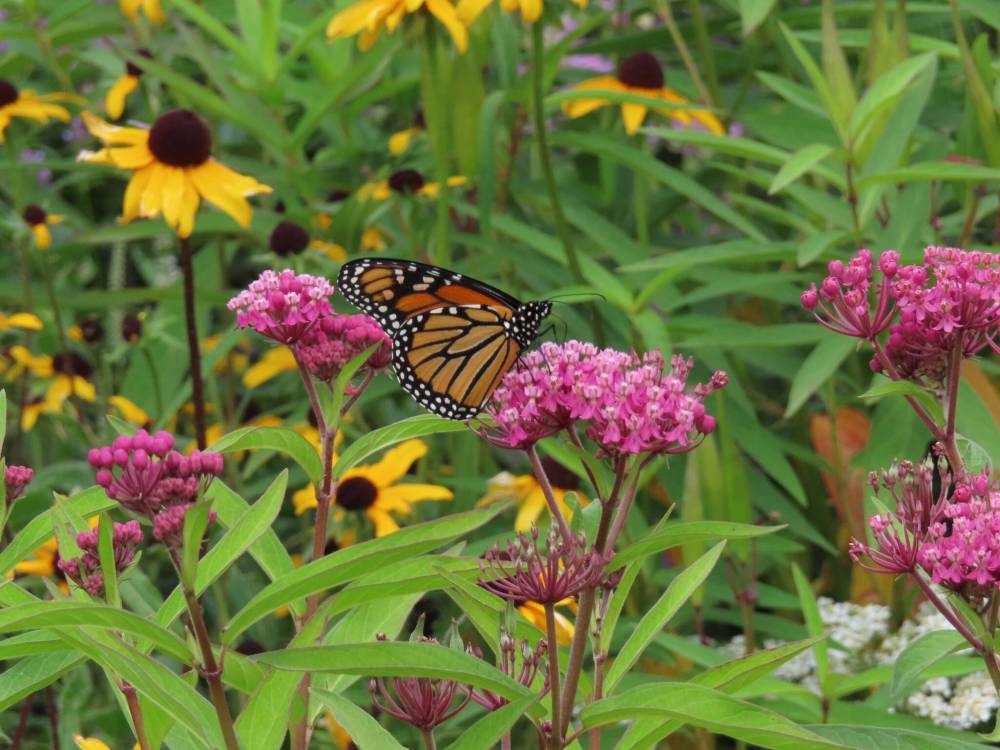
Buelow says there are a few things gardeners can do to encourage butterflies and other insects, including shrinking your lawn and turning the land back into habitat for the rapidly disappearing insects and birds, planting native Manitoba plants and getting rid of invasive species.
Another, lesser-known concern is light pollution.
“We are getting brighter all the time, the street lights are blue coloured LEDS. They’re energy-efficient but they’re hugely bright, insects are drawn to them, flying in circles, it messes them up. They’re exhausted and they die. It also messes up their mating; their whole life cycle is disturbed. Bright night lighting interferes with bird migrations and affects humans. The Butterflyway campaign is trying to make people aware of their own personal home lighting and to use a yellow-coloured bulb on a motion detector instead… insects aren’t quite as drawn to yellow.”
Quoting the famous entomologist E.O. Wilson, Buelow states: “‘Insects are the little things that run the world.’ They’re just working away all the time. Without them we are ruined, but they can live very well without us. A lot of our food is pollinated by bees, the insects recycle dead stuff and animal excrement. Organic garbage would really pile up. Trees wouldn’t be pollinated. We’d lose 90 per cent of our flowering plants.”
Buelow and a co-presenter will be offering an information session in Dunnottar on Saturday, July 27.
To register or learn more about the Butterflyway Project, email: dunnottargardens@gmail.com, search for Dunnottar & Area Butterflyway Gardens on Facebook or go to http://wfp.to/Cuz.