Wildfire smoke may be worse for your brain than other air pollution, study says

Advertisement

Advertise with us

Wildfire smoke may be worse for brain health than other types of air pollution, according to new research linking it to an increased risk of dementia.

Read this article for free:


or

Already have an account? Log in here »

To continue reading, please subscribe:

Subscribe and receive a limited-edition Free Press branded hat or tote.

Digital Subscription

One year of digital access for only $205*

  • Enjoy unlimited reading on winnipegfreepress.com
  • Read the E-Edition, our digital replica newspaper
  • Access News Break, our award-winning app
  • Play interactive puzzles

*First annual payment billed as $205.00 + GST for one year. This annual subscription will automatically renew at $233.00 + GST every 52 weeks (10% off the regular annual price of $259.35). Offer available to new and qualified returning subscribers only. Cancel any time.

To continue reading, please subscribe:

Add Free Press access to your Brandon Sun subscription for only an additional

$1 for the first 4 weeks*

  • Enjoy unlimited reading on winnipegfreepress.com
  • Read the E-Edition, our digital replica newspaper
  • Access News Break, our award-winning app
  • Play interactive puzzles
Start now

*Your next Brandon Sun subscription payment will increase by $1.00 and you will be charged $17.95 plus GST for four weeks. After four weeks, your payment will increase to $24.95 plus GST every four weeks.

Hey there, time traveller!
This article was published 29/07/2024 (782 days ago), so information in it may no longer be current.

Wildfire smoke may be worse for brain health than other types of air pollution, according to new research linking it to an increased risk of dementia.

The findings, reported Monday at the Alzheimer’s Association International Conference in Philadelphia, come as millions spent the weekend under air quality warnings from wildfires spewing smoke across the western U.S.

At issue is fine particulate matter or PM2.5 – tiny particles about 30 times smaller than the diameter of a human hair that can be inhaled deep into the lungs and move to the bloodstream. This pollution – from traffic, factories and fires – can cause or worsen heart and lung diseases, and the new study adds to evidence it may play some role in dementia, too.
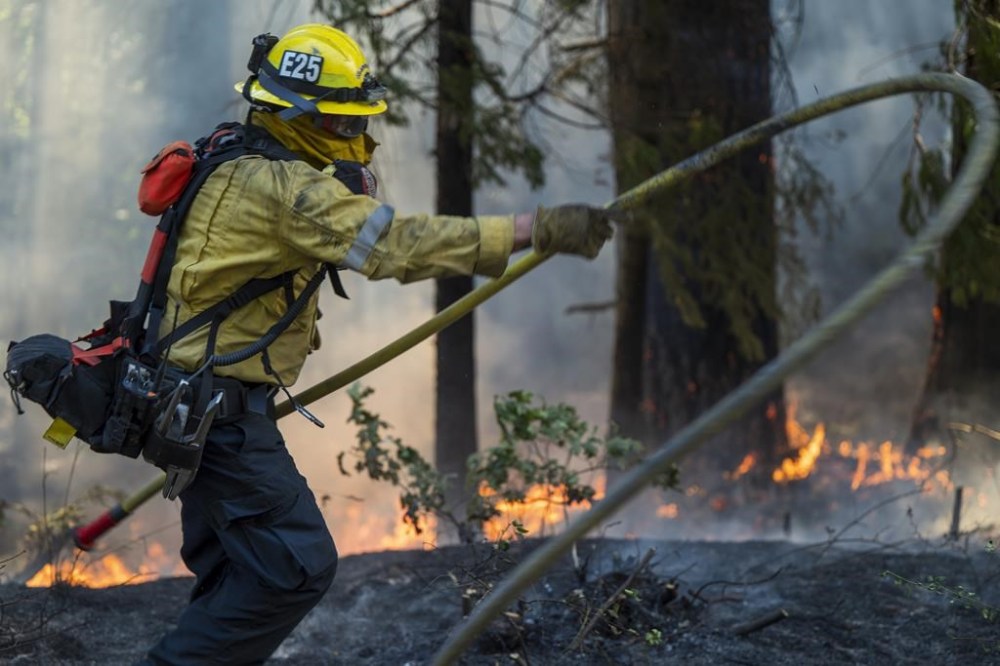
A firefighter lays out a hose line while fighting the Park Fire near Forest Ranch, Calif., Sunday, July 28, 2024. (AP Photo/Nic Coury)

Researchers tracked health records from 1.2 million older adults in Southern California between 2009 and 2019. They used air quality monitoring and other data to estimate residential exposure to PM2.5 over three years from wildfire smoke or other causes.

The study found the odds of a new dementia diagnosis increased about 21% for every 1 microgram increase in the concentration of wildfire particles. That compared with a 3% increased risk for every 3 microgram jump in non-wildfire particles, concluded researchers from the universities of Washington and Pennsylvania.

It’s not clear why there would be a difference. But with wildfires increasing, this needs more study, said Alzheimer’s Association chief science officer Maria Carrillo. That’s especially considering that the risk of Alzheimer’s, the most common form of dementia, is higher for lower-income populations who may have a harder time avoiding unhealthy air, she said.

Health warnings urge staying indoors when air quality is poor but “there are a lot of people who don’t have the option to stay home or they work outside,” she noted.

___

The Associated Press Health and Science Department receives support from the Howard Hughes Medical Institute’s Science and Educational Media Group. The AP is solely responsible for all content.
Report Error Submit a Tip

More Stories

A quick look at where provinces and territories stand on time changes

The Canadian Press 2 minute read Preview

A quick look at where provinces and territories stand on time changes

The Canadian Press 2 minute read Updated: 6:28 AM CDT

WINNIPEG - Manitoba's government said Thursday the province will be sticking with daylight time year-round, making it the latest jurisdiction to move away from twice-annual time changes. Here's a look at where things stand across Canada:

British Columbia said in March that it was moving to permanent Pacific daylight time. The change also means that parts of northeastern B.C., which have been on mountain standard time year round, are now in alignment with the rest of the province.

Alberta also switched to permanent daylight time this year in what it calls Alberta time. The change means it now has the same time as Saskatchewan year round.

Saskatchewan has been on permanent central standard time since 1966.

Read
Updated: 6:28 AM CDT

Gillingham in lead with decided voters

Nicole Buffie 6 minute read Preview

Gillingham in lead with decided voters

Nicole Buffie 6 minute read 6:55 PM CDT

A cloud of uncertainty is hanging over Winnipeg as October’s municipal election nears.

Three months after a poll showed more than 40 per cent of Winnipeggers wanted to see someone other than current mayor Scott Gillingham elected, a new Abacus Data poll indicates more than half of Winnipeg voters are undecided heading into next month’s civic election.

Of decided voters, 55 per cent favour Gillingham compared to 23 per cent for former councillor and provincial cabinet minister Kevin Klein and 11 per cent for funeral director Mike Vogiatzakis.

Of all respondents, just over 50 per cent said they were unsure while 13 per cent said they will not vote.

Read
6:55 PM CDT

Former Winnipeg Jet doing his part for future of funded deaf athletes

Taylor Allen 5 minute read Preview

Former Winnipeg Jet doing his part for future of funded deaf athletes

Taylor Allen 5 minute read 7:09 PM CDT

Jim Kyte defied the odds to have the hockey career that he did.

The hard-nosed defenceman from Ottawa made history by becoming the first legally deaf NHL player when the Winnipeg Jets drafted him 12th overall in 1982.

“Right now, I’m the only one in history to play in the NHL, but I’d like to be able to say I am the first player — which would imply that there would be a second player, and hopefully a third, fourth, fifth,” Kyte recently told the Free Press.

Between 1982 and 1996, he suited up in 598 career NHL games, including 399 as a member of the 1.0 Jets.

Read
7:09 PM CDT

Jets GM insists club’s not working under any deadline in netminder’s trade request

Mike McIntyre 7 minute read Preview

Jets GM insists club’s not working under any deadline in netminder’s trade request

Mike McIntyre 7 minute read Updated: Yesterday at 5:27 PM CDT

Connor Hellebuyck and his family were subject to so much post-Olympic vitriol that both the Winnipeg Jets security team and even police had to get involved.

Read
Updated: Yesterday at 5:27 PM CDT

Puzzles Palace

1 minute read Monday, Jul. 27, 2026

To solve our puzzles, please subscribe with this special offer: |

Hellebuyck standoff caused by… Nathan MacKinnon?

Mike McIntyre 6 minute read Preview

Hellebuyck standoff caused by… Nathan MacKinnon?

Mike McIntyre 6 minute read 6:34 PM CDT

Looking for someone to blame in the Connor Hellebuyck fiasco and cast as public enemy No. 1? How about long-time Winnipeg Jets nemesis Nathan MacKinnon?

Allow us to explain as we fire up the time machine and head back to February in Italy.

Oh, what could have been if MacKinnon had been able to score on what appeared to be an open net late in the third period of the men’s gold medal game with Hellebuyck down and seemingly out of position.

Instead, the star forward fired wide, keeping the score deadlocked at 1-1 as the clock ticked down on regulation.

Read
6:34 PM CDT