Not-so-great expectations: Students are reading fewer books in English class
Advertisement
Read this article for free:
or
Already have an account? Log in here »
To continue reading, please subscribe:

Digital Subscription
One year of digital access for only $205*
- Enjoy unlimited reading on winnipegfreepress.com
- Read the E-Edition, our digital replica newspaper
- Access News Break, our award-winning app
- Play interactive puzzles
*First annual payment billed as $205.00 + GST for one year. This annual subscription will automatically renew at $233.00 + GST every 52 weeks (10% off the regular annual price of $259.35). Offer available to new and qualified returning subscribers only. Cancel any time.
To continue reading, please subscribe:
Add Free Press access to your Brandon Sun subscription for only an additional
$1 for the first 4 weeks*
- Enjoy unlimited reading on winnipegfreepress.com
- Read the E-Edition, our digital replica newspaper
- Access News Break, our award-winning app
- Play interactive puzzles
*Your next Brandon Sun subscription payment will increase by $1.00 and you will be charged $17.95 plus GST for four weeks. After four weeks, your payment will increase to $24.95 plus GST every four weeks.
Read unlimited articles for free today:
or
Already have an account? Log in here »
Hey there, time traveller!
This article was published 16/09/2024 (756 days ago), so information in it may no longer be current.
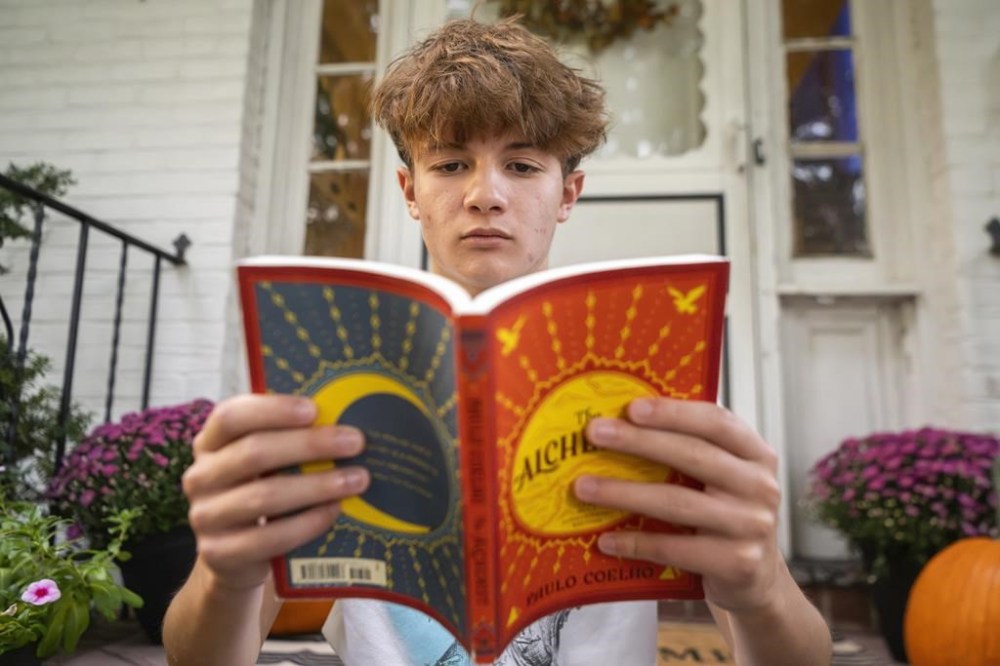
Chris Stanislawski didn’t read much in his middle school English classes, but it never felt necessary. Students were given detailed chapter summaries for every novel they discussed, and teachers played audio of the books during class.
Much of the reading material at Garden City Middle School in Long Island was either abridged books, or online texts and printouts, he said.
“When you’re given a summary of the book telling you what you’re about to read in baby form, it kind of just ruins the whole story for you,” said Chris, 14. “Like, what’s the point of actually reading?”
In many English classrooms across America, assignments to read full-length novels are becoming less common. Some teachers focus instead on selected passages — a concession to perceptions of shorter attention spans, pressure to prepare for standardized tests and a sense that short-form content will prepare students for the modern, digital world.
The National Council of Teachers of English acknowledged the shift in a 2022 statement on media education, saying: “The time has come to decenter book reading and essay-writing as the pinnacles of English language arts education.”
The idea is not to remove books but to teach media literacy and add other texts that feel relevant to students, said Seth French, one of the statement’s co-authors. In the English class he taught before becoming a dean last year at Bentonville High School in Arkansas, students engaged with plays, poetry and articles but read just one book together as a class.
“At the end of the day, a lot of our students are not interested in some of these texts that they didn’t have a choice in,” he said.
The emphasis on shorter, digital texts does not sit well with everyone.
Deep reading is essential to strengthen circuits in the brain tied to critical thinking skills, background knowledge — and, most of all, empathy, said Maryanne Wolf, a cognitive neuroscientist at UCLA specializing in dyslexia research.
“We must give our young an opportunity to understand who others are, not through little snapshots, but through immersion into the lives and thoughts and feelings of others,” Wolf said.
At Garden City Middle School, students are required to read several books in their entirety each year, including “Of Mice and Men” and “Romeo and Juliet,” Principal Matthew Samuelson said. Audio versions and summaries are provided as extra resources, he said.
For Chris, who has dyslexia, the audio didn’t make the reading feel more accessible. He just felt bored. He switched this fall to a Catholic school, which his mother feels will prepare him better for college.
Even outside school, students are reading less
There’s little data on how many books are assigned by schools. But in general, students are reading less. Federal data from last year shows only 14% of young teens say they read for fun daily, compared with 27% in 2012.
Teachers say the slide has its roots in the COVID-19 crisis.
“There was a trend, it happened when COVID hit, to stop reading full-length novels because students were in trauma; we were in a pandemic. The problem is we haven’t quite come back from that,” said Kristy Acevedo, who teaches English at a vocational high school in New Bedford, Massachusetts.
This year, she said she won’t accept that students are too distracted to read. She plans to teach time-management strategies and to use only paper and pencils for most of class time.
Other teachers say the trend stems from standardized testing and the influence of education technology. Digital platforms can deliver a complete English curriculum, with thousands of short passages aligned to state standards — all without having to assign an actual book.
“If admins and school districts are judged by their test scores, how are they going to improve their test scores? They’re going to mirror the test as much as possible,” said Karl Ubelhoer, a middle school special education teacher in Tabernacle, New Jersey.
For some students, it’s a struggle to read at all. Only around a third of fourth and eighth graders reached reading proficiency in the 2022 National Assessment of Educational Progress, down significantly from 2019.
Leah van Belle, a literacy advocate in Detroit, said when her son read “Peter Pan” in late elementary school, it was too hard for most kids in the class. She laments that Detroit feels like “a book desert.” Her son’s school doesn’t even have a library.
Still, she said it makes sense for English classes to focus on shorter texts.
“As an adult, if I want to learn about a topic and research it, be it personal or professional, I’m using interactive digital text to do that,” she said.
Teachers fit books in with other ‘spinning plates’
Even in well-resourced schools, one thing is always in short supply: time.
Terri White, a teacher at South Windsor High School in Connecticut, no longer makes her honors ninth-grade English class read all of “To Kill a Mockingbird.” She assigns about a third of the book and a synopsis of the rest. They have to move on quickly because of pressure for teachers to cram more into the curriculum, she said.
“It’s like spinning plates, you know what I mean? Like it’s a circus,” she said.
She also assigns less homework because kids’ schedules are so packed with sports, clubs and other activities.
“I maintain rigor. But I’m more about helping students become stronger and more critical readers, writers and thinkers, while taking their social-emotional well-being into account,” she said.
In the long run, the synopsis approach harms students’ critical thinking skills, said Alden Jones, a literature professor at Emerson College in Boston. She assigns fewer books than she once did and gives more quizzes to make sure students do the reading.
“We don’t value the thinking time that we used to have. It’s all time we could be on our phone accomplishing tasks,” she said.
Will Higgins, an English teacher at Dartmouth High School in Massachusetts, said he still believes in teaching the classics, but demands on students’ time have made it necessary to cut back.
“We haven’t given up on ‘Jane Eyre’ and ‘Pride and Prejudice.’ We haven’t given up on ‘Hamlet’ or ‘The Great Gatsby,’″ Higgins said. But he said they have given up assigning others like “A Tale of Two Cities.”
His school has had success encouraging reading through student-directed book clubs, where small groups pick a book and discuss it together. Contemporary authors like John Green and Jason Reynolds have been a big hit.
“It’s funny,” he said. “Many students are saying that it’s the first time in a long time they’ve read a full book.”
___
The Associated Press’ education coverage receives financial support from multiple private foundations. AP is solely responsible for all content. Find AP’s standards for working with philanthropies, a list of supporters and funded coverage areas at AP.org.