Cities are using sheep to graze in urban landscapes and people love it
Advertisement
Read this article for free:
or
Already have an account? Log in here »
To continue reading, please subscribe:
Digital Subscription
One year of digital access for only $1.44 a week*
- Enjoy unlimited reading on winnipegfreepress.com
- Read the E-Edition, our digital replica newspaper
- Access News Break, our award-winning app
- Play interactive puzzles
*Billed as $5.77 plus GST every four weeks. After 52 weeks, price increases to the regular rate of $19.95 plus GST every four weeks. Offer available to new and qualified returning subscribers only. Cancel any time.
To continue reading, please subscribe:
Add Free Press access to your Brandon Sun subscription for only an additional
$1 for the first 4 weeks*
- Enjoy unlimited reading on winnipegfreepress.com
- Read the E-Edition, our digital replica newspaper
- Access News Break, our award-winning app
- Play interactive puzzles
*Your next Brandon Sun subscription payment will increase by $1.00 and you will be charged $17.95 plus GST for four weeks. After four weeks, your payment will increase to $24.95 plus GST every four weeks.
Read unlimited articles for free today:
or
Already have an account? Log in here »
Hey there, time traveller!
This article was published 28/09/2024 (749 days ago), so information in it may no longer be current.
NASHVILLE, Tenn. (AP) — Along the Cumberland River just north of downtown Nashville, Tennessee, tourists on party pontoons float past the recognizable skyline, but they also can see something a little less expected: hundreds of sheep nibbling on the grass along the riverbank.
The urban sheepherder who manages this flock, Zach Richardson, said sometimes the tourist boats will go out of their way to let their passengers get a closer glimpse of the Nashville Chew Crew grazing a few hundred yards away from densely populated residential and commercial buildings.
The joy people get from watching sheep graze is partly why they are becoming trendy workers in some urban areas.
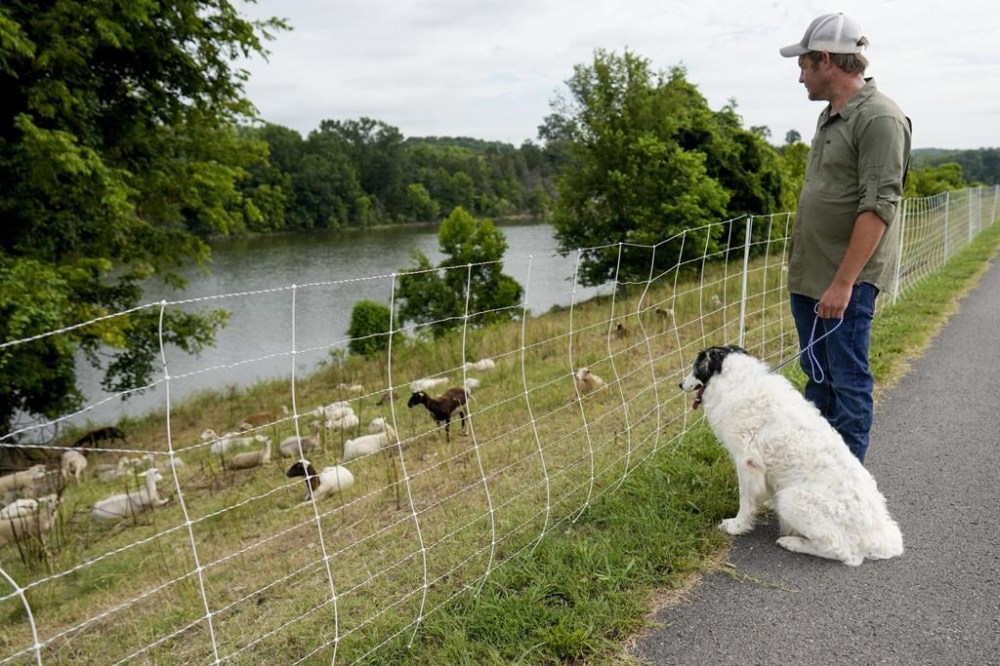
“Everybody that comes out here and experiences the sheep, they enjoy it more than they would someone on a zero-turn mower or a guy with a leaf blower or a weed eater,” Richardson said.
Using sheep for prescribed grazing is not a new landscaping method, but more urban communities are opting for it to handle land management concerns such as invasive species, wildfire risks, protection of native vegetation and animal habitats and maintaining historic sites.
Nashville’s parks department hired the Chew Crew in 2017 to help maintain Fort Negley, a Civil War-era Union fortification that had weeds growing between and along its stones that lawnmowers could easily chip. Sheep now graze about 150 acres (60.7 hectares) of city property annually, including in the historic Nashville City Cemetery.
“It is a more environmentally sustainable way to care for the greenspace and oftentimes is cheaper than doing it with handheld equipment and staff,” said Jim Hester, assistant director of Metro Nashville Parks.
Living among the sheep — and often blending in — are the Chew Crew’s livestock guardian dogs, Anatolian shepherds, who are born and stay with them 24/7 to keep away nosy intruders, both the two-legged and the four-legged kinds. The flock is comprised of hair sheep, a type of breed that naturally sheds its hair fibers and often is used for meat.
Another important canine employee is Duggie, the border collie. With only a few whistles and commands from Richardson, Duggie can control the whole flock when they need to be moved, separated or loaded onto a trailer.
Across the country, another municipality also has become reliant on these hoofed nibblers. Santa Barbara, California, has been using grazing sheep for about seven years as one way to manage land buffers that can slow or halt the spread of wildfires.
“The community loves the grazers and it’s kind of a great way of community engagement,” said Monique O’Conner, open space planner for the city’s parks and recreation. “It’s kind of a new shiny way of land management.”
The grazed areas can change how fire moves, said Mark vonTillow, the wildland specialist for the Santa Barbara City Fire Department.
“So if a fire is coming down the hill and it’s going through a full brush field, and then all of a sudden it hits grazed area that’s sort of broken up vegetation, the fire behavior reacts drastically and drops to the ground,” vonTillow said. “That gives firefighters a chance to attack the fire.”
Even some universities have tried out herds of goats and sheep on campus property. In 2010, the University of Georgia had a privet problem that was overtaking a section of the campus not used by students or staff and pushing out native plants, said Kevin Kirsche, the school’s director of sustainability.
Rather than using chemicals or mowers, Kirsche said they hired Jennif Chandler to send in a herd of goats to strip the bark off the privet, stomp on roots and defoliate the branches.
“Bringing the goats to the site was an alternative means of removing invasive plants in a way that was nontoxic to the environment and friendly to people,” Kirsche said.
Around the same time, Richardson, the owner of Chew Crew who at the time was a UGA student studying landscape architecture, was inspired to create his own goat grazing business. The goats became the most popular four-legged creatures on campus, he said.
“What was fun and less expected was kind of the side projects and a life of its own developed around the Chew Crew,” Kirsche said. “We had art students doing time-lapse photography, documenting changes over time. One point we had a student dressed as a goat playing goat songs on the guitar and other students serving goat cheese and goat ice cream.”
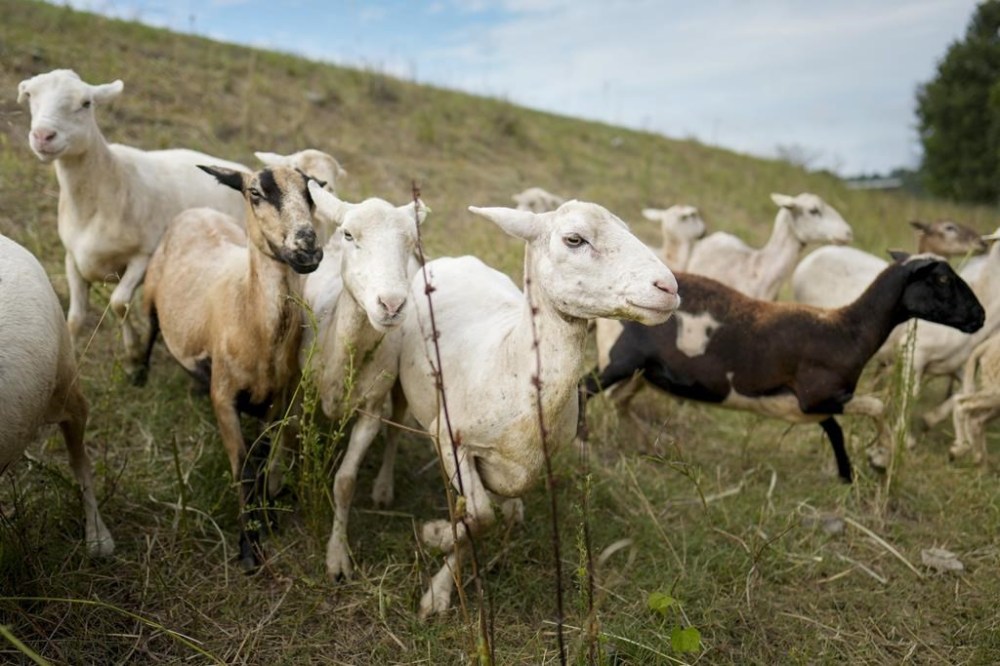
Richardson, who moved his company to Nashville after finishing his degree, now prefers sheep over goats. Sheep are more flock-oriented and aren’t inclined to climb and explore as much as goats.
“I’ll never own another goat,” he admitted. “They are like little Houdinis. It’s like trying to fence in water.”
But sheep are not a silver bullet solution for all cities and their lands, according to O’Conner. “We want to educate the public on why we’re choosing to graze where we’re grazing,” she said.
Not every urban site is ideal. Chandler owns City Sheep and Goat in Colbert, Georgia, about 12.4 miles (20 kilometers) northeast of UGA’s campus in Athens, where her sheep graze on mostly residential properties and community projects such as Clyde Shepherd Nature Preserve in North Decatur, just outside of Atlanta.
In 2015, some of her sheep were attacked and killed by dogs who got through the electric fencing while in a public park. Those kinds of incidents have been rare, according to Chandler.
The sheep need to be moved regularly because they tire of the same plants and relocating reduces the chances of a predator attack, Chandler said.
Hundreds of sheep can impact the environment by spreading seeds. The city of Santa Barbara does environment surveys before bringing in grazers since it can also affect bird habitats and nests.
“Throwing like 500 sheep into an area is a much larger impact on the land and those soils than our native herbivores would have,” O’Conner said.
Along the levee of the Cumberland River, the side of the greenway where the park uses mowers looks manicured like a golf course. On the other side where the Chew Crew ewes are munching, an ecosystem is flourishing.
“There’s rabbits, butterflies, groundhogs, turtles, nesting birds,” Richardson said. “The list goes on. It’s way more diverse. Even though we’ve removed some of the vegetation, there’s still a habitat that can support wildlife.”
Richardson checks on his flock daily, but he also often receives pictures and videos that people take of the sheep because his phone is listed on the electric fence.
“If the sheep can be a catalyst to connect back to nature just for a split second or spark a kid’s imagination to go down to the river and catch a crawdad, I think more of that is good,” Richardson said.