In Colombia, Amazon River’s extreme drought falls hard on Indigenous communities
Advertisement
Read this article for free:
or
Already have an account? Log in here »
To continue reading, please subscribe:

Digital Subscription
One year of digital access for only $205*
- Enjoy unlimited reading on winnipegfreepress.com
- Read the E-Edition, our digital replica newspaper
- Access News Break, our award-winning app
- Play interactive puzzles
*First annual payment billed as $205.00 + GST for one year. This annual subscription will automatically renew at $233.00 + GST every 52 weeks (10% off the regular annual price of $259.35). Offer available to new and qualified returning subscribers only. Cancel any time.
To continue reading, please subscribe:
Add Free Press access to your Brandon Sun subscription for only an additional
$1 for the first 4 weeks*
- Enjoy unlimited reading on winnipegfreepress.com
- Read the E-Edition, our digital replica newspaper
- Access News Break, our award-winning app
- Play interactive puzzles
*Your next Brandon Sun subscription payment will increase by $1.00 and you will be charged $17.95 plus GST for four weeks. After four weeks, your payment will increase to $24.95 plus GST every four weeks.
Read unlimited articles for free today:
or
Already have an account? Log in here »
Hey there, time traveller!
This article was published 24/10/2024 (693 days ago), so information in it may no longer be current.
LETICIA, Colombia (AP) — Marciano Flores stood knee-deep in the Amazon River with the rest of his crew, ready to haul in a giant net as a man in a canoe circled in an attempt to drive fish their way. At 69, after a life of working the river, Flores can tell at a glance just the right spots to seek a catch he can sell at the market.
But standing here a year ago would have been impossible, with the river far above his head. Flores has never seen the Amazon so low, and the men’s net came up empty before they relocated downriver and caught a few small fish. A declining catch is forcing him and his fellow fishermen to search farther and farther down the river each day, and costing him more in fuel too.
“The drought has hit me hard,” said Flores, of the Cocama Indigenous community. “When the water’s low, the fish die, so there’s nothing to get.”
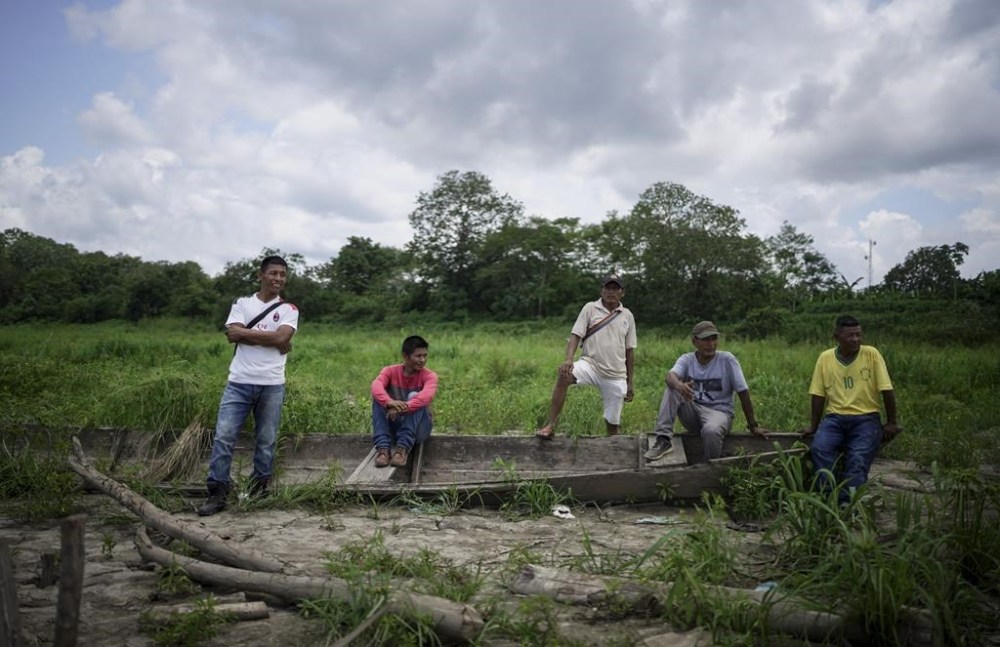
The Amazon River naturally fluctuates during the dry and rainy seasons. But since last year a dramatic drop has been evident, most critical in Brazil. Now the phenomenon is spreading into other Amazon nations, wreaking havoc on local economies and food supplies.
In Colombia, the river’s fall has isolated some rural Indigenous communities, prompting nonprofits and the government to deliver water and food to places that depend on rain and river water to survive. In some communities, it’s an arduous hourlong walk along the dried-up areas to get basic supplies. In other areas, schoolchildren have to walk two hours to get to their classes as boats are unable to drop them close by.
Water levels decreased between 80% and 90% in the past few months, Colombia’s National Unit for Disaster Risk Management said last month.
“I’ve been very concerned, particularly for the Indigenous communities that are affected the most because all the food has already run out,” said Álvaro Sarmiento, head of operations for the Colombian Civil Defense in the Amazonas province at Leticia’s port. “For Indigenous people, fishing is their main source of food.”
__
EDITOR’S NOTE: This is part of a series on how tribes and Indigenous communities are coping with and combating climate change.
___
Large patches of sandy areas can be seen where the river has receded. Evidence of how dramatically the water has fallen can be seen along banks where the earth has cracked under the heat, with large parts collapsing into what’s left of the river. In some areas, white marks high on tree trunks show where the water used to be.
“In the 35 years I’ve been in the Amazon, it’s the first time I’ve seen it this low,” said Jugalvis Valencia, 61, a boat tour guide. He worries that a repeat drought next year will dry up some parts of the river completely.
“If we have a similar summer next year, it’s possible that (the river) will get cut off and we’ll be stuck in Leticia,” he said.
Communities in need of resources, water
In a community called La Playa on the outskirts of Leticia, Ermencida Miranda runs a small store out of her wooden home propped on stilts, selling things like cleaning supplies and Peruvian, Colombian and Brazilian foods in this area where the three countries come together. And Miranda worries about access to water.
“In all the communities … we are suffering because of the water, because it’s not raining, the drought is really severe,” said Miranda, 48, who came from Putumayo eight years ago in search of better economic opportunities.
“We bathe in the river water, but for cooking and drinking we have to wait for rainwater and when there’s none, we have to buy water from Leticia. Imagine that!” said Miranda, of the Tikuna people.
Some 32 kilometers (about 20 miles) down the river is the Indigenous reserve of Santa Sofia, a community of about 2,400 made up of five different Indigenous groups, where locals waited in the shade of mango trees for the arrival of supplies from a nonprofit organization. Last year, the river came right up to the mango trees, but now the water is so low it takes a five-minute walk down a dry, cracked mud path.
The nonprofit delivered food supplies like lentils, rice and cooking oil, as well as three large cisterns that can be used to catch and store rainwater. Locals shouldered the heavy white bags of supplies to carry them back to their homes, and men teamed up to move the bulky cisterns.
“It’s been hard for us to get food, and to take our crops for sale to Leticia because of the drought,” said Santa Sofia resident Elder Kawache, 47.
Access to drinking water has been the most difficult part of the drought for the community since the local well also dried up, Kawache, from the Cocama community, said.
Colombia’s environment ministry didn’t respond to a request for comment on the drought. The National Unit for Disaster Risk Management said this month it will deliver motorized pumps and hoses for water supply to isolated territories and that a contract for the exploration of underground water sources will be initiated. It has said it is sending humanitarian assistance kits with drinking water and nonperishable food for the communities.
Peru announced a state of emergency and said it would deliver medicines and chlorinated water to communities near the river. Brazilian authorities have been distributing potable water and water purification systems and the government says it will make advance payments to those eligible for monthly welfare payments for poor families in affected areas.
The river has risen slightly in some places in recent days, but after back-to-back and increasingly severe droughts, locals worry about next year.
At her homemade store, Miranda has seen no evidence of help from the government. She’d love to see an elevated tank filled with water so people don’t have to “suffer so much in carrying water” during the summer.
“If someone could help us to get water, it would be a happiness and a change to life, wouldn’t it? Because water is very important for us.”
—
Follow Steven Grattan on X: @sjgrattan
—
The Associated Press’ climate and environmental coverage receives financial support from multiple private foundations. AP is solely responsible for all content. Find AP’s standards for working with philanthropies, a list of supporters and funded coverage areas at AP.org.