A TV as big as a bed? With the holidays approaching, stores stock more supersize sets
Advertisement
Read this article for free:
or
Already have an account? Log in here »
To continue reading, please subscribe:
Digital Subscription
One year of digital access for only $1.44 a week*
- Enjoy unlimited reading on winnipegfreepress.com
- Read the E-Edition, our digital replica newspaper
- Access News Break, our award-winning app
- Play interactive puzzles
*Billed as $5.77 plus GST every four weeks. After 52 weeks, price increases to the regular rate of $19.95 plus GST every four weeks. Offer available to new and qualified returning subscribers only. Cancel any time.
To continue reading, please subscribe:
Add Free Press access to your Brandon Sun subscription for only an additional
$1 for the first 4 weeks*
- Enjoy unlimited reading on winnipegfreepress.com
- Read the E-Edition, our digital replica newspaper
- Access News Break, our award-winning app
- Play interactive puzzles
*Your next Brandon Sun subscription payment will increase by $1.00 and you will be charged $17.95 plus GST for four weeks. After four weeks, your payment will increase to $24.95 plus GST every four weeks.
Read unlimited articles for free today:
or
Already have an account? Log in here »
Hey there, time traveller!
This article was published 03/11/2024 (717 days ago), so information in it may no longer be current.
NEW YORK (AP) — For some television viewers, size apparently does matter.
Forget the 65-inch TVs that were considered bigger than average a decade ago. In time for the holidays, manufacturers and retailers are rolling out more XXL screens measuring more than 8 feet diagonally. That’s wider than a standard three-seat sofa or a king-size bed.
Supersize televisions only accounted for 1.7% of revenue from all TV set sales in the U.S. during the first nine months of the year, according to market research firm Circana. But companies preparing for shoppers to go big for Christmas, Hanukkah and Kwanzaa have reason to think the growing ultra category will be a bright spot in an otherwise tepid television market, according to analysts.
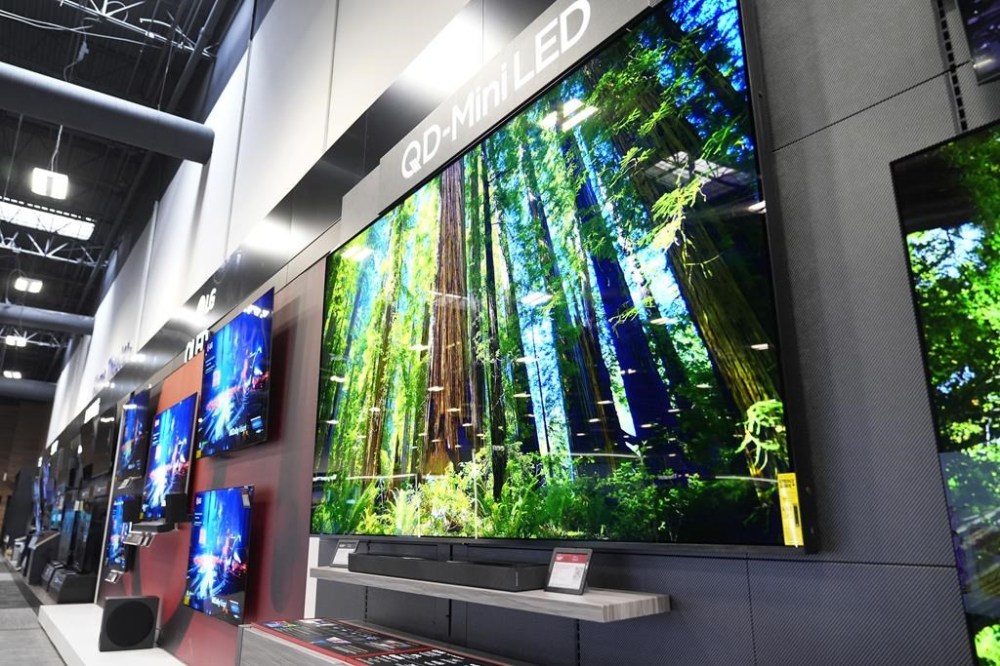
The 38,100 televisions of at least 97 inches sold between January and September represented a tenfold increase from the same period last year, Circana said. Best Buy, the nation’s largest consumer electronics chain, doubled the assortment of hefty TVs — the 19 models range in price from $2,000 to $25,000 — and introduced displays in roughly 70% of its stores.
“It’s really taken off this year,” Blake Hampton, Best Buy’s senior vice president of merchandising, said.
Analysts credit the emerging demand to improved technology and much lower prices. So far this year, the average price for TVs spanning at least 97 inches was $3,113 compared to $6,662 last year, according to Circana. South Korean electronics manufacturer Samsung introduced its first 98-inch TV in 2019 with a hefty price tag of $99,000; it now has four versions starting at $4,000, the company said.
Anthony Ash, a 42-year-old owner of a wood pallet and recycling business, recently bought a 98-inch Sony for his 14,000-square-foot house in Bristol, Wisconsin. The device, which cost about $5,000 excluding installation fees, replaced an 85-inch TV in the great room off his kitchen. Ash now has 17 televisions at home and uses some to display digital art.
“We just saw that the price was affordable for what we were looking for and thought, ‘Why not?’” he said of deciding to upsize to the Sony. “You get a better TV experience with a bigger TV. You’re sitting watching TV with a person on TV that is the same size as you. You can put yourself in the scene.”
The amount of time that many people spend staring at their cellphones and tablets, including to stream movies and TV shows, is another factor driving the growth of widescreen TV screens. Overall TV sales revenue fell 4%, while the number of units sold rose 1% from the January through September period, Circana said.
Most people only invest in a television every seven years, but when they do, they typically choose bigger ones, according to Rick Kowalski, the senior director of business intelligence at the Consumer Technology Association. In the past 15 years, the size of flat-panel TVs that were shipped to U.S. retailers and dealers grew an average of one inch a year, Kowalski said.
The coronavirus pandemic accelerated the elongation trend as people spent more time at home. In fact, screen sizes increased an average of two inches in both 2021 and 2022, and 85-inch TVs began gaining traction with consumers, Kowalski said. Shipments of 98-inch TVs to the U.S. are picking up pace this year, and models as huge as 110-115 inches are on the market right now, he said.
“You get better resolution over time,” Kowalski said. “You get better picture quality. And so just over time, it’s easier to produce those sets and improve the technology.”
Best Buy’s Hampton said a benefit of a colossal TV is the viewer can watch multiple shows at once, an experience he described as “incredible.”
“If you’re watching YouTube TV content or ‘ NFL Sunday Ticket,’ you can actually get four screens up, and that’s four 48-inch screens on it,” he said.
Manufacturers are also adding new features. Samsung said it designed its 98-inch lineup with a component that analyzes what the viewer is watching to increase sharpness and reduce visible noise across every scene.
James Fishler, senior vice president of the home entertainment division of Samsung’s U.S. division, said the way people watch TV and experience content is shifting.
“It’s even more so about watching TV as a shared experience,” Fishler said. “They want to host a watch party and gather around their TV to watch the big game, or set up a cinematic movie experience right at home. ”
Walmart, the nation’s largest retailer, its Sam’s Club division, and Chicago retailer Abt Electronics, also say they are expanding their TV ranges to meet customer demand for supersize screens.
TV industry experts say these monster TVs are beginning to encroach on home theater projectors, which create a 100- to 120-inch image that is less sharp and require rooms with blackout curtains or without windows.
“A dedicated viewing room for watching movies was exclusively the purview of projectors,” Andrew Sivori, vice president in the entertainment division of LG Electronics, another Korean manufacturer. “But you can get a much better viewing experience with direct TV.”
Retailers and TV makers said the buyers trading up range from millennials and members of Generation X to the tech-native Gen Z crowd. But as Jon Abt, co-president of Abt Electronics said, “It’s still a niche business.”
“A lot of people just don’t have the space to put one of those in,” he added.
Before dreaming big for the holidays, shoppers therefore should make sure a 98-inch TV will fit. Best Buy said its Geek Squad team asks if stairwells and entry halls are large enough to accommodate delivery and installation. An augmented reality feature on the Best Buy app that allows customers to see if products are the right size has been especially helpful for XXL TVs, the retailer said.

But for those worried about having the space for viewing, the good news is that the recommended distance for a 98-inch TV is actually just 6-12 feet from the seating area. The rule of thumb is to multiple the diagonal length of the TV by 1.2 to determine the ideal viewing distance, Samsung’s Fishler said.
If bigger is better in the TV department, how big can they go?
“I think we’ll have to wait and see,” Fishler said.
___
This story was first published on Nov. 3, 2024. It was updated on Nov. 5, 2024 to correct that TV sizes are measured on the diagonal, not by width.