‘We do need to harvest’: Alberta government expands cougar hunting areas, quotas

Advertisement

Advertise with us

EDMONTON - The Alberta government has created six new areas where cougar hunting is allowed, including inside a provincial park.

Read this article for free:


or

Already have an account? Log in here »

To continue reading, please subscribe:

Subscribe and receive a limited-edition Free Press branded hat or tote.

Digital Subscription

One year of digital access for only $205*

  • Enjoy unlimited reading on winnipegfreepress.com
  • Read the E-Edition, our digital replica newspaper
  • Access News Break, our award-winning app
  • Play interactive puzzles

*First annual payment billed as $205.00 + GST for one year. This annual subscription will automatically renew at $233.00 + GST every 52 weeks (10% off the regular annual price of $259.35). Offer available to new and qualified returning subscribers only. Cancel any time.

To continue reading, please subscribe:

Add Free Press access to your Brandon Sun subscription for only an additional

$1 for the first 4 weeks*

  • Enjoy unlimited reading on winnipegfreepress.com
  • Read the E-Edition, our digital replica newspaper
  • Access News Break, our award-winning app
  • Play interactive puzzles
Start now

*Your next Brandon Sun subscription payment will increase by $1.00 and you will be charged $17.95 plus GST for four weeks. After four weeks, your payment will increase to $24.95 plus GST every four weeks.

Hey there, time traveller!
This article was published 04/12/2024 (668 days ago), so information in it may no longer be current.

EDMONTON – The Alberta government has created six new areas where cougar hunting is allowed, including inside a provincial park.

Forestry and Parks Minister Todd Loewen says the government estimates Alberta’s cougar population has reached about 2,000, while an ideal population is 1,500.

He says he doesn’t want to see cougars overhunted, but some “harvesting” is needed.
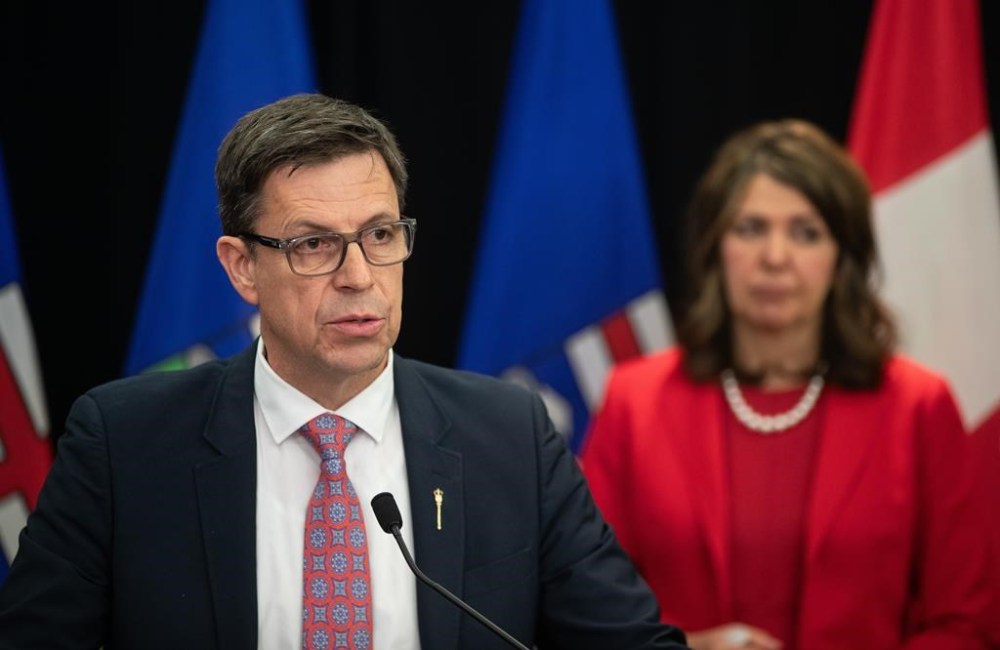
Minister of Forestry and Parks Todd Loewen gives an update on the Alberta wildfire situation, in Edmonton on May 15. THE CANADIAN PRESS/Jason Franson

“The cougar populations have expanded,” Loewen said Tuesday.

“We definitely don’t want to get into a situation where we over harvest, but we do need to harvest across the broad landscape where the cougars exist.”

All but one new zone cover the largely forested area northwest of Edmonton that separates Grande Prairie and High Level. The last new zone covers the area including and surrounding Cypress Hills Provincial Park, about 360 kilometres southeast of Calgary.

Loewen said these areas, which include parts of his Central Peace-Notley riding, are where the big cats are starting to appear more commonly.

The government also increased the cougar hunting quota for the 2023-2024 hunting season by more than doubling the limit on female cougars to 72.

A spokesperson for Loewen did not immediately respond to a question about when the cougar hunting quota for this season would be published.

Alberta Wilderness Association conservationist Ruiping Luo said she’s concerned the government has expanded cougar hunting opportunities without transparent reasoning.

“I can’t verify those numbers,” Luo said of Loewen’s cougar population estimate, adding she’s been asking the government for its data since the summer to no avail.

“We were told that some people believe cougar numbers are unacceptably high, but we weren’t shown where that was coming from.”

Luo said it’s concerning the government has expanded hunting opportunities again without clear scientific justification.

Last month, Loewen said his ministry had removed trapping limits on fur-bearing animals, like wolverines and lynx, because existing data wasn’t strong enough to justify the limitations.

One of the last reliable estimates of Alberta’s wolverine population, completed in 2003, found there were less than 1,000 breeding ones left.

Loewen said last month that removing trapping limits would allow the government to get a better idea of how many wolverines are now in the province by relying on logs and data kept by trappers.

After that data is gathered, in a year or two, Loewen said the government would be in a position to recalculate what a responsible trapping limit would be.

Luo was critical of that decision as well, saying at the time she thought the government should take a more cautionary approach, as getting a new population estimate should happen before making changes to trapping limits.

When it comes to the cougar hunting changes, Luo said she has the same concern.

“I feel like I’m repeating myself,” she said.

“It’s really concerning that Alberta seems to continuously be opened up to more and broader hunting and that a lot of these decisions don’t seem to have scientific justification. We don’t understand the reasoning behind them, and there hasn’t been public consultation.”

The Opposition NDP’s environment and protected areas critic, Sarah Elmeligi, said she was highly frustrated by the trapping and cougar limit changes.

“It is very, very unusual to allow for hunting in provincial parks,” said Elmeligi, who holds a PhD in interdisciplinary conservation science.

“My biologist colleagues and I are extremely dismayed that decades of data is not feeding into decisions about how to manage wildlife populations in Alberta.”

Loewen, who prior to being elected owned and operated a hunting outfitting company, said he’s likely more passionate about hunting than many. But he said the government needs to have data to defend hunting limits.

“If we want people to have confidence in a management system, we have to have data … and quotas that we can defend,” he said.

“I have people asking me questions. And if I don’t have a good answer then I think we need to change something.”

This report by The Canadian Press was first published Dec. 4, 2024.
Report Error Submit a Tip

More Stories

A day on the campaign trail: Winnipeg's mayor, seeking a second term, does double duty

Malak Abas 12 minute read Preview

A day on the campaign trail: Winnipeg's mayor, seeking a second term, does double duty

Malak Abas 12 minute read Updated: Yesterday at 5:56 PM CDT

In the weeks leading up to the civic election, Scott Gillingham has been performing a juggling act: he’s running to be Winnipeg’s 45th mayor, while still serving as its 44th.

“If someone asks me about the campaign, I’m going to answer them. But I think for most people, I’m the mayor of Winnipeg, even if I’m showing up as a candidate,” Gillingham, 58, says. “I try to do all I can to maintain that distinction.”

The Free Press joined Gillingham on a recent rainy September Saturday on the campaign trail, where he served in both roles during an event-laden day. City council’s final meeting before the Oct. 28 election was days earlier.

In Winnipeg, it’s rare for an incumbent to be defeated. But Gillingham knows his win in 2022 wasn’t exactly a landslide — he won with 27.5 per cent of the vote — and he’s been thinking about his second term ever since.

Read
Updated: Yesterday at 5:56 PM CDT

Clock ticks down on destruction of records documenting residential school abuses

Marsha McLeod 13 minute read Preview

Clock ticks down on destruction of records documenting residential school abuses

Marsha McLeod 13 minute read Yesterday at 12:49 PM CDT

In less than a year, a private company is set to destroy the largest cache of records detailing the widespread abuse of Indigenous children at residential schools in Canada.

The destruction, which was ordered by an Ontario court in 2014 and later upheld by the Supreme Court, is set to take place on Sept. 19, 2027.

This countdown is igniting emotional conversations that seek to balance the immense historical value of the records alongside the confidentiality survivors were promised as part of the process of providing detailed testimony about abuses they’d suffered.

The records were created as part of the Indian Residential Schools Settlement Agreement, a class-action settlement stemming from survivors who began suing the federal government in the late 1990s over the harm they’d been subjected to at residential schools.

Read
Yesterday at 12:49 PM CDT

Alouettes not short on reasons why they want to beat Bombers

Taylor Allen 5 minute read Preview

Alouettes not short on reasons why they want to beat Bombers

Taylor Allen 5 minute read Yesterday at 7:55 PM CDT

MONTREAL — Clinching top spot in the East isn’t the only reason why Tyson Philpot is itching to beat the Winnipeg Blue Bombers.

“Obviously, my brother (Jalen) plays for the (Calgary) Stampeders, so I’d love to help push the Stampeders above them and help him get in the playoffs,” said the star receiver for the Montreal Alouettes after Friday’s walkthrough.

While the Als are sitting comfortably at 11-3, the Bombers (7-7) are trying to fend off Calgary (7-8) while also keeping pace with B.C. and Saskatchewan, who both entered the week at 8-6.

But there’s another reason that applies to everyone on the Als: they want revenge for the embarrassing 44-28 loss they suffered in Winnipeg in Week 13.

Read
Yesterday at 7:55 PM CDT

Health minister warns $1.2 billion in annual federal funding set to expire in March

Scott Billeck 4 minute read Preview

Health minister warns $1.2 billion in annual federal funding set to expire in March

Scott Billeck 4 minute read Thursday, Oct. 1, 2026

Manitoba’s health minister is warning of possible cuts to health care with $1.2 billion in annual funding from Ottawa set to expire next year.

“We’re very concerned that what would be the largest cut to health care in a generation is right in front of us,” Health Minister Uzoma Asagwara said Thursday at the Manitoba legislature. “It means that services that Manitobans depend on will be in jeopardy and be at risk.

“Any reductions, any cuts from Canada, will have direct impacts on the health outcomes of Manitobans.”

Asagwara, who serves as the provincial and territorial health minister lead, chaired a virtual meeting Tuesday with provincial and territorial health ministers to discuss federal funding for health care, mental health care and substance use services, which is scheduled to expire March 31, 2027.

Read
Thursday, Oct. 1, 2026

A 22-year-old man is dead and an 18-year-old is in hospital in critical condition after a two-vehicle crash on Highway 8 on Thursday evening.

A Gimli RCMP officer was driving north on the highway, near Riverton, when he witnessed the collision at about 6:45 p.m.

A vehicle headed north had passed the Mountie at a high speed before colliding with an SUV that was turning west onto Provincial Road 329 from Highway 8.

The driver of the first vehicle, an 18-year-old man from Arborg, was rushed to hospital by a helicopter ambulance with injuries RCMP describe as serious and life-threatening.

Nearly four in 10 Manitobans hope Canada restarts trade talks after U.S. midterm elections, poll reveals

Gabrielle Piché 4 minute read Preview

Nearly four in 10 Manitobans hope Canada restarts trade talks after U.S. midterm elections, poll reveals

Gabrielle Piché 4 minute read Yesterday at 7:00 AM CDT

Disorganized — that’s what Marcus Langlois calls recent United States tariffs.

He expects suppliers’ prices to increase — on mugs, pens, hoodies — for his employer, Dreamcatcher Promotions, if the United States–Canada trade war persists.

Still, he’s not pining for a quick trade deal.

“I think it should wait,” said Langlois, Dreamcatcher Promotions’ vice-president. “Let’s hope that it’s later on with proper negotiations happening.”

Read
Yesterday at 7:00 AM CDT