Some breast cancer patients can avoid certain surgeries, studies suggest
Advertisement
Read this article for free:
or
Already have an account? Log in here »
To continue reading, please subscribe:

Digital Subscription
One year of digital access for only $205*
- Enjoy unlimited reading on winnipegfreepress.com
- Read the E-Edition, our digital replica newspaper
- Access News Break, our award-winning app
- Play interactive puzzles
*First annual payment billed as $205.00 + GST for one year. This annual subscription will automatically renew at $233.00 + GST every 52 weeks (10% off the regular annual price of $259.35). Offer available to new and qualified returning subscribers only. Cancel any time.
To continue reading, please subscribe:
Add Free Press access to your Brandon Sun subscription for only an additional
$1 for the first 4 weeks*
- Enjoy unlimited reading on winnipegfreepress.com
- Read the E-Edition, our digital replica newspaper
- Access News Break, our award-winning app
- Play interactive puzzles
*Your next Brandon Sun subscription payment will increase by $1.00 and you will be charged $17.95 plus GST for four weeks. After four weeks, your payment will increase to $24.95 plus GST every four weeks.
Read unlimited articles for free today:
or
Already have an account? Log in here »
Hey there, time traveller!
This article was published 12/12/2024 (644 days ago), so information in it may no longer be current.
Some early breast cancer patients can safely avoid specific surgeries, according to two studies exploring ways to lessen treatment burdens.
One new study, published in the New England Journal of Medicine, examines whether removing lymph nodes is always necessary in early breast cancer. Another in the Journal of the American Medical Association suggests a new approach to a type of breast cancer called ductal carcinoma in situ, or DCIS.
The research was discussed Thursday at the San Antonio Breast Cancer Symposium.
DCIS and active monitoring
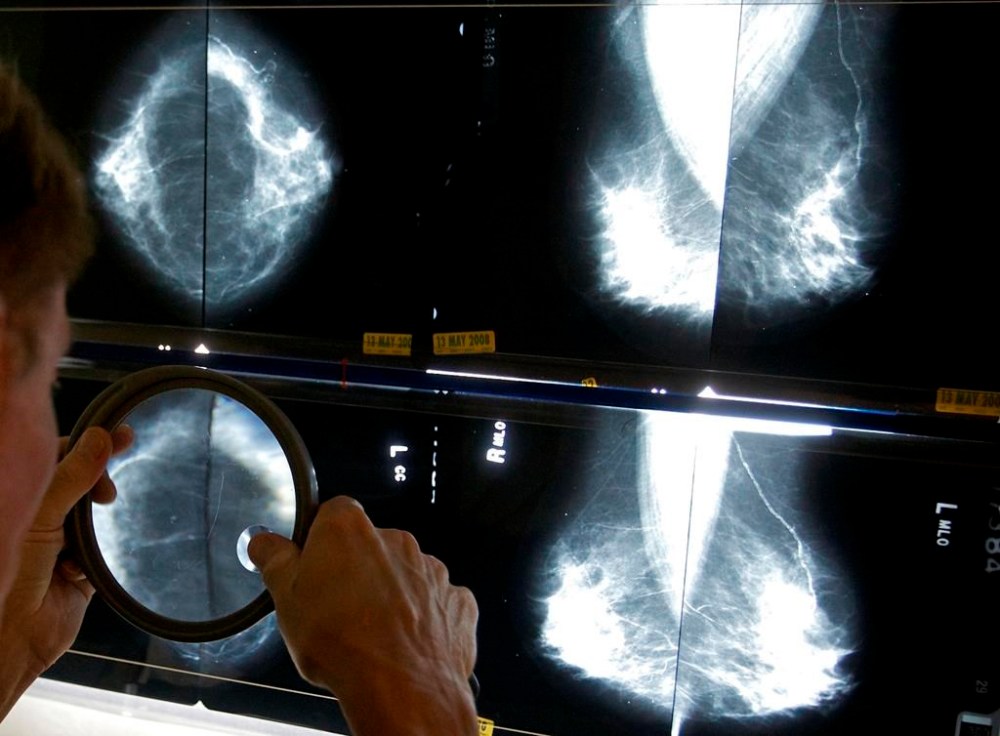
Every year, about 50,000 women in the U.S. are diagnosed with ductal carcinoma in situ, or DCIS, where the cells that line milk ducts become cancerous, but the nearby breast tissue remains healthy. Many choose to have surgery, although it’s unclear whether they could instead take a “wait-and-see” approach with more frequent monitoring.
The new study, based on two years of data, suggests that such active monitoring is a safe alternative to surgery for many of these women, though some doctors will want to see if the results hold up over time.
“This is an option that patients should consider for their DCIS,” said Dr. Virginia Kaklamani of the University of Texas Health Science Center San Antonio, who was not involved in the research. “For a long time, we’ve had the feeling that we’re overtreating some patients with DCIS. This is a confirmation of what we suspected is happening.”
Taking a more cautious view, Dr. Monica Morrow of Memorial Sloan Kettering Cancer Center, who was not involved in the study, said a two-year study isn’t long enough to draw conclusions.
The finding is based on following more than 950 U.S. patients randomly assigned to surgery or active monitoring. All had low-risk DCIS with no sign of invasive cancer. They had the type of DCIS that responds to hormone-blocking drugs and many in the study took those drugs as part of their treatment.
After two years, the rates of invasive cancer were low and did not differ significantly between the groups, with about 6% in the surgery group and about 4% in the monitoring group diagnosed with invasive cancer.
Among patients in the monitoring group, changes spotted on a mammogram would prompt a biopsy. They also could opt for surgery at any time for any reason.
Some study participants didn’t stick with the treatment they were randomly assigned. So in a separate analysis looking at those who actually had surgery or not, the rates of invasive cancer were about 9% for the surgery group and 3% for the monitoring group.
The researchers will continue to follow the patients to see if the finding holds up over a decade.
Tina Clark, 63, of Buxton, Maine, joined the study after being diagnosed with DCIS in 2019. Randomly assigned to the monitoring-only group, she was able to avoid surgery and radiation during a time when she was raising a teenage nephew and going through the illness and death of her husband.
“I feel just so grateful and fortunate that I found this study when I did,” Clark said.
She has mammograms every six months to keep watch on the DCIS in her right breast, which has not advanced. The mammograms spotted a small cancer in her other breast in 2023, unrelated to the DCIS. She had a lumpectomy to remove it.
“If you’re diagnosed with low-risk DCIS, you have time to understand more about your disease and understand what your options are,” said study author Dr. Shelley Hwang of Duke University School of Medicine.
Lymph nodes and early breast cancer
Women having surgery for breast cancer often also have what’s called a sentinel lymph node biopsy where a few lymph nodes in the armpit are removed to check for spreading cancer.
But removing lymph nodes can cause lasting pain and arm swelling, so research is underway to determine when it can be avoided. A study in Europe last year showed that older women with small tumors could safely avoid the added surgery.
In the new study, researchers in Germany looked at whether women with early breast cancer who were planning to have breast-conserving surgery could safely skip having lymph nodes removed. They followed 4,858 women who were randomly assigned to have lymph nodes removed or not.
After five years, about 92% of women in both groups were still alive and free of cancer.
“Removing lymph nodes does not improve survival, and the risk of cancer coming back in the armpit is quite low when lymph nodes are not removed,” said Morrow, who added that some women will still need the lymph node procedure to help determine which treatment drugs they should take after surgery.
___
The Associated Press Health and Science Department receives support from the Howard Hughes Medical Institute’s Science and Educational Media Group. The AP is solely responsible for all content.