Virtual safari trips, a return to the cockpit: seniors embrace VR in long-term care
Advertisement
Read this article for free:
or
Already have an account? Log in here »
To continue reading, please subscribe:
Digital Subscription
One year of digital access for only $1.44 a week*
- Enjoy unlimited reading on winnipegfreepress.com
- Read the E-Edition, our digital replica newspaper
- Access News Break, our award-winning app
- Play interactive puzzles
*Billed as $5.77 plus GST every four weeks. After 52 weeks, price increases to the regular rate of $19.95 plus GST every four weeks. Offer available to new and qualified returning subscribers only. Cancel any time.
To continue reading, please subscribe:
Add Free Press access to your Brandon Sun subscription for only an additional
$1 for the first 4 weeks*
- Enjoy unlimited reading on winnipegfreepress.com
- Read the E-Edition, our digital replica newspaper
- Access News Break, our award-winning app
- Play interactive puzzles
*Your next Brandon Sun subscription payment will increase by $1.00 and you will be charged $17.95 plus GST for four weeks. After four weeks, your payment will increase to $24.95 plus GST every four weeks.
Read unlimited articles for free today:
or
Already have an account? Log in here »
Hey there, time traveller!
This article was published 18/12/2024 (674 days ago), so information in it may no longer be current.
TORONTO – Ingrid Menezes gestures toward herself as she takes in the sight of an African wilderness.
“Come on zebra, come,” she says as she starts to pet the air above her lap.
“What else do you see Ingrid?” asks Dorothy Laugo, a recreation assistant running the virtual reality session on a tablet as the duo sits side-by-side in a Toronto long-term care home.
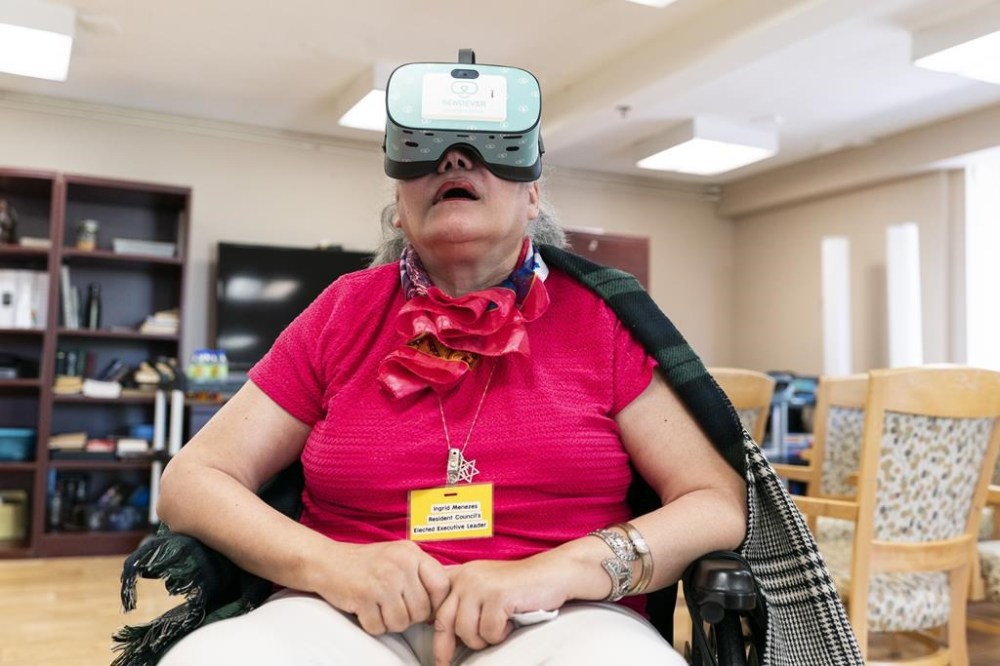
The 71-year-old Menezes looks up, down and around, then points to the floor to the left of her wheelchair.
“Is this a rhinoceros?” she asks.
“Yes,” Laugo says, smiling. But she knows what Menezes is looking forward to the most.
“I think this is your favourite — what do you see?” she asks.
“The giraffe,” Menezes says, looking up. “He’s beautiful.”
After Laugo gently lifts the VR goggles from her head, Menezes says “Oh!” as her African safari disappears and she sees the other people in the common room.
“Welcome to the real world,” Laugo says.
Menezes moved to Kennedy Lodge in east Toronto after brain surgery about five years ago. She’s one of a growing number of long-term care residents in Canada who are getting virtual reality as part of their recreation programs.
Proponents say the technology not only provides entertainment but can help reduce isolation by encouraging residents to share their virtual experiences with recreation staff, fellow residents and family members. The 15 to 20 minute sessions can also reach and comfort many long-term care residents with dementia, they say.
In an emailed statement, the Canadian Association for Long Term Care said it “supports technology like VR as an additional tool staff can use to enhance the quality of life and care for long-term care (LTC) residents.”
“Looking ahead to 2025, CALTC is prioritizing the rapid development of technology and its effective integration into LTC settings,” said Jodi Hall, the CEO of the association.
Sandra Morgan, Kennedy Lodge’s program manager, said VR experiences must be tailored to each resident’s likes and needs — especially for those with dementia.
“You’ve got to know your resident. You can’t just put a (VR) headset on your resident and choose (what they experience),” she said.
Morgan and her recreation staff keep lists of each resident’s interests, as well as their likes and dislikes, to determine the best VR programs for each person. If someone doesn’t respond well to animals, Morgan said, they wouldn’t use the African experience Menezes likes so much.
Morgan also encourages visiting family members — especially grandchildren — to join residents in VR experiences as a way to connect.
“I always say, ‘OK you can use the VR. We’re not going to be on our phone,” she said. “We’re going to interact with Grandma during this visit. And they’re excited because it’s their thing, it’s VR.”
Laugo said higher-functioning residents benefit from using VR as a group, “because it allows them to share experiences and interact with each other in a more social environment.”
But for residents with dementia who aren’t able to interact in the same way, she does one-on-one sessions. If residents are agitated, she chooses VR videos that provide “calm and serene environments (that) help reduce anxiety and also provides sensory stimulation.”
Babies, nature and beaches are popular VR experiences that can have a calming effect, Laugo said.
Baycrest Centre, a teaching and research hospital and long-term care provider in Toronto, often uses VR to help seniors tap into what they did when they were younger.
“We have a resident who was a former scuba diver and so the program was taking him under the sea,” said Cyrelle Muskat, Baycrest’s director of quality systems, wellness and culture.
“His expression was one of joy. He was talking about how incredible that experience was talking to his family about it,” she said.
Many seniors also enjoy VR tours of cities, Muskat said.
“It’s taking them to places that they otherwise would not be able to go to or experiences that they wouldn’t be able to experience at this stage of their life,” she said.
Baycrest is actively researching whether or not VR can help reduce “responsive behaviours” related to dementia, such as kicking, hitting, punching, spitting, grabbing or wandering.
The principal investigator for that study, Mara Swartz, said they held individual VR sessions with 10 residents who have dementia, as well as two others in the pre-pilot research phase.
The results were “positive,” she said, noting that she can’t give more specifics until the study is submitted to a journal for publication next year.
But the key, she said, was matching the VR experience to the person.
“I always went back to, as much as possible, what they were like, what they enjoyed and engaged in prior to the disease taking over.”
One resident with dementia used to be a pilot. When he was placed in the virtual cockpit of a Cessna plane, he reached for the controls.
“They were getting the plane ready to fly,” Swartz said.
When his VR headset came off, “there were smiles” and he stayed seated and engaged afterward, she said.
The VR programs for both Kennedy Lodge and Baycrest were bought from Rendever, a Boston-based virtual reality company specializing in health care and senior living.
The company has more than 150 clients in Canada, including long-term care homes in Ontario, Manitoba, Alberta and British Columbia — and the number continues to grow, said David Stoller, Rendever’s vice-president of partner success.
Long-term care homes subscribe to the VR service monthly, and the cost varies depending on the amount of programming and the number of headsets provided, he said.
One of the most exciting applications is that the technology can create virtual trips to specific neighbourhoods and regions with the help of Google maps, and photos and videos uploaded by loved ones, Stoller said.
”We can actually take them back to their childhood home. We can take them back to a restaurant where they used to have family celebrations. We can take them back to vacation destinations. We can take them to a church, a synagogue, a mosque where they got married,” he said.
“We’re able to bring people back to those positive emotions that they associated with those experiences,” Stoller said.
This report by The Canadian Press was first published Dec. 18, 2024.
Canadian Press health coverage receives support through a partnership with the Canadian Medical Association. CP is solely responsible for this content.