How American presidents have planned their own funerals
Advertisement
Read this article for free:
or
Already have an account? Log in here »
To continue reading, please subscribe:

Digital Subscription
One year of digital access for only $205*
- Enjoy unlimited reading on winnipegfreepress.com
- Read the E-Edition, our digital replica newspaper
- Access News Break, our award-winning app
- Play interactive puzzles
*First annual payment billed as $205.00 + GST for one year. This annual subscription will automatically renew at $233.00 + GST every 52 weeks (10% off the regular annual price of $259.35). Offer available to new and qualified returning subscribers only. Cancel any time.
To continue reading, please subscribe:
Add Free Press access to your Brandon Sun subscription for only an additional
$1 for the first 4 weeks*
- Enjoy unlimited reading on winnipegfreepress.com
- Read the E-Edition, our digital replica newspaper
- Access News Break, our award-winning app
- Play interactive puzzles
*Your next Brandon Sun subscription payment will increase by $1.00 and you will be charged $17.95 plus GST for four weeks. After four weeks, your payment will increase to $24.95 plus GST every four weeks.
Read unlimited articles for free today:
or
Already have an account? Log in here »
Hey there, time traveller!
This article was published 30/12/2024 (640 days ago), so information in it may no longer be current.
WASHINGTON (AP) — Jimmy Carter’s memorial journey will end at his house in the tiny town of Plains, Georgia, where he grew up on a peanut farm. That is where his wife, Rosalynn, was laid to rest last year in a burial plot that they chose years ago.
But before Carter reaches his humble final destination, there will be an interstate choreography of grief, ceremony and logistics that is characteristic of state funerals. Ever since the nation’s founding, America has bid farewell to former presidents with an intricate series of events weaving together longstanding traditions and personal touches.
Funerals often are planned by the presidents themselves, who usually have years after leaving the White House to ponder how they want to be memorialized.
“They are very much involved in the planning process, and the decisions that they make tell us a lot about who they are, how they see the presidency, and how they want to be remembered by the American people,” said Matthew Costello, senior historian for the White House Historical Association, who co-wrote a book called “Mourning the Presidents: Loss and Legacy in American Culture.”
Carter had more time to plan than most. He lived for 43 years after his presidency ended, the longest post-presidency in U.S. history, before dying Sunday at 100.
Many details of his funeral remain under wraps, at the discretion of the family and military units that are responsible for carrying out the plans. Most presidents lie in state in the U.S. Capitol, and there is usually a service at Washington National Cathedral.
President Joe Biden let slip last year that Carter had asked him to give a eulogy. (“Excuse me, I shouldn’t say that,” Biden admitted.)
Biden said Sunday his team is working with Carter’s family and others “to see to it that he is remembered appropriately, here in the United States and around the world.” Carter’s son Chip is his main point of contact, though Biden said he has spoken with all the Carter children.
He described a process underway “that will take a little time” but will result in a “major service in Washington, D.C.” for Carter, which Biden scheduled for Jan. 9.
Sometimes former presidents help with even the smallest details.
Jeffrey Engel, director of the Center for Presidential History at Southern Methodist University in Dallas, recalled meeting with George H.W. Bush shortly after the former president revised the seating chart for his funeral.
“And I said, ‘Is that weird? You know, it’s your own death,’” Engel recalled. “And he said, ‘You know, you do it every three months. You kind of get used to it.’”
President Dwight Eisenhower, who commanded Allied troops during World War II before becoming a politician, wanted to be buried in an $80 government-issued casket. Apart from a glass seal that was added to the design, it was indistinguishable from the casket of any other solider.
Details of the processions also can reflect aspects of a president’s life. Ronald Reagan’s casket was carried up the west steps of the U.S. Capitol, which face his home state of California. When Gerald Ford died, his casket was brought through the House side of the building, a nod to his years as a lawmaker.
The job of carrying out presidential funerals falls to the Joint Task Force-National Capital Region, which includes 4,000 military and civilian personnel. The unit said in a statement that it “is privileged to provide this support on behalf of the nation.”
Presidential funerals can leave lasting marks on the American consciousness. One of the most memorable descriptions of George Washington — “first in war, first in peace, and first in the hearts of his countrymen” — came from a eulogy that was widely reprinted when the country’s first leader died.
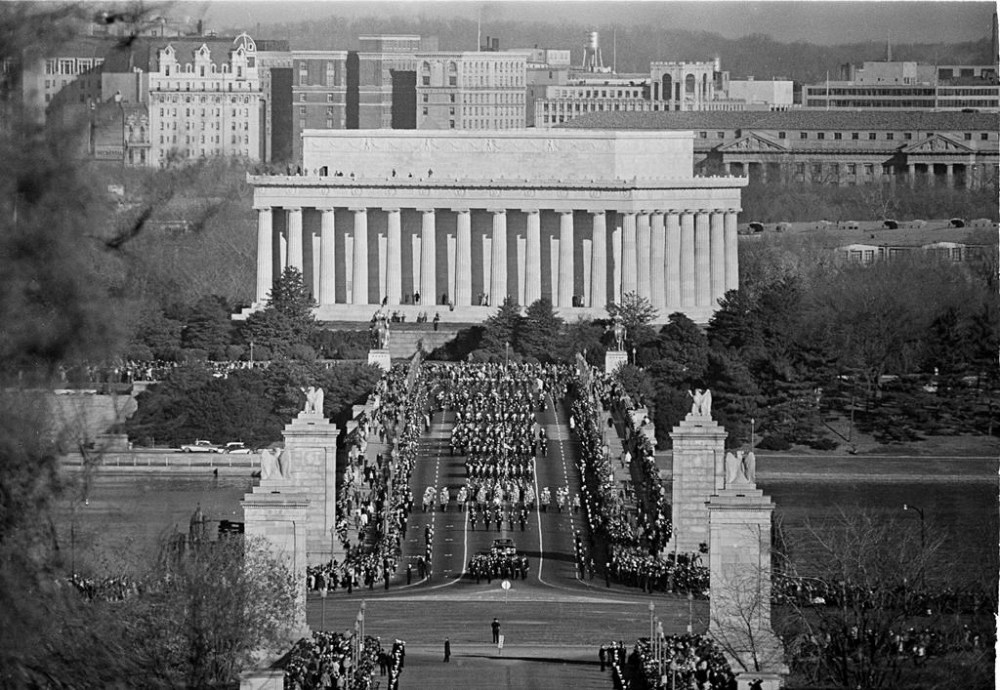
After John F. Kennedy was assassinated, his son John Jr. was photographed saluting the casket. Kennedy’s casket was transported down Pennsylvania Avenue on the same caisson that carried Abraham Lincoln after he was assassinated a century earlier, and a riderless horse was included in the procession.
Kennedy’s was the first presidential funeral to be widely televised.
“Technology has made mourning in a way more accessible, more democratic. More people have the opportunity to take a moment and reflect upon what this person meant,” Costello said. “And I think it also opens the door to more people being involved in the grieving process.”
In many democratic countries, the head of state and the head of government are two different people. The United States combines both roles, ceremonial and chief executive, into the office of the presidency.
“Since we have no national figure other than the president, we’ve essentially taken all the traditional weight and civic emotion that is put on to the death or the birth or a wedding for a sovereign or a king and placed it on the heads of the presidents,” Engel said. “And there aren’t that many of them, to be honest. So whenever one of them passes, it’s unusual and a big deal.”
He described funerals as a moment to remember “that we’re all in this together” and “this man was the president for all of us, whether you’re a Republican or a Democrat.”

However, in today’s divided politics, state funerals can produce awkward, even tense, moments.
During George H.W. Bush’s funeral in 2018, the audience included President Donald Trump. He shook hands with former President Barack Obama, his predecessor, but did not interact with Hillary Clinton, who he defeated in the 2016 election, or her husband, former President Bill Clinton.
“These funerals are always political,” Engel said. “Whatever happens in the Carter funeral is going to be political, frankly, whether people around the Carter family want it to be or not.”
___
Associated Press video journalist Nathan Ellgren contributed to this report.