

In freezing temperatures, swimmers in China plunge into a river for health and joy
Advertisement
Read this article for free:
or
Already have an account? Log in here »
To continue reading, please subscribe:
Monthly Digital Subscription
$1 per week for 24 weeks*
- Enjoy unlimited reading on winnipegfreepress.com
- Read the E-Edition, our digital replica newspaper
- Access News Break, our award-winning app
- Play interactive puzzles
*Billed as $4.00 plus GST every four weeks. After 24 weeks, price increases to the regular rate of $19.95 plus GST every four weeks. Offer available to new and qualified returning subscribers only. Cancel any time.
Monthly Digital Subscription
$4.99/week*
- Enjoy unlimited reading on winnipegfreepress.com
- Read the E-Edition, our digital replica newspaper
- Access News Break, our award-winning app
- Play interactive puzzles
*Billed as $19.95 plus GST every four weeks. Cancel any time.
To continue reading, please subscribe:
Add Free Press access to your Brandon Sun subscription for only an additional
$1 for the first 4 weeks*
*Your next subscription payment will increase by $1.00 and you will be charged $16.99 plus GST for four weeks. After four weeks, your payment will increase to $23.99 plus GST every four weeks.
Read unlimited articles for free today:
or
Already have an account? Log in here »
Hey there, time traveller!
This article was published 07/01/2025 (444 days ago), so information in it may no longer be current.
HARBIN, China (AP) — Even as the mercury dropped well below freezing, enthusiasm soared among about a dozen hardy swimmers during a daily ritual in northeast China’s “ice city” of Harbin.
The swimmers trained daily throughout the year for this.
They first carved out a pool in the Songhua River, breaking the 10-centimeter (4-inch) thick layer of ice that had formed again overnight and scooping out the pieces. Then they stripped down and, one by one, plunged into the bone-chilling waters of a pool about 10 meters (30 feet) long.
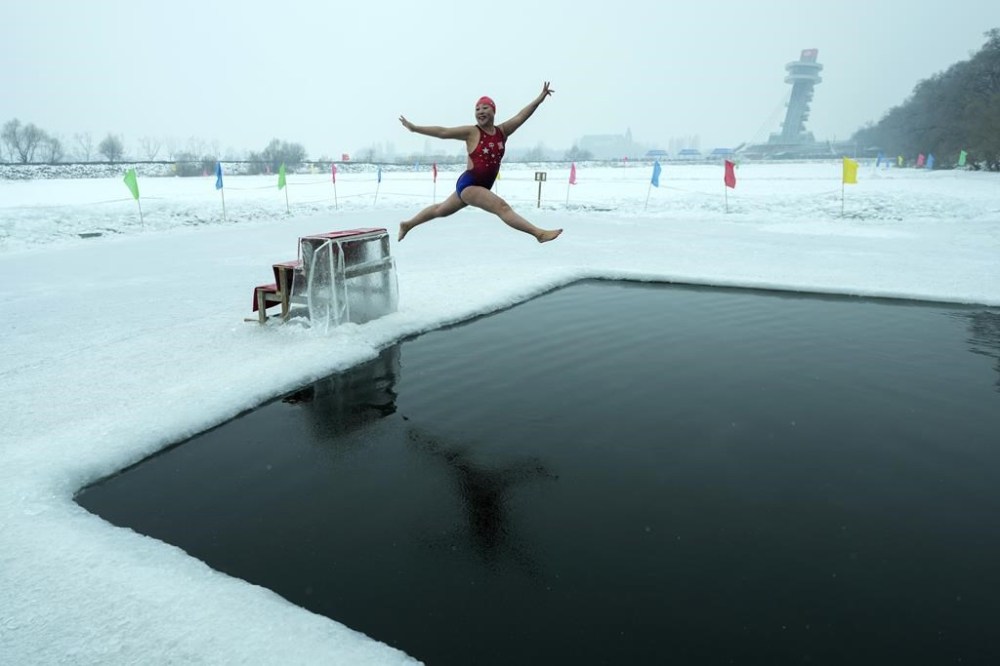
Some said their limbs were already numb in the -13 C (8 F) weather.
Chen Xia, who came from Zhejiang province about 1,700 kilometers (1,000 miles) to the south, dived into the river even though she had a cold. She said the winter waters in her home city are warmer than those in Harbin, where the water temperature hovered around the freezing mark.
The experience strengthened her confidence in winter swimming, a sport she has been devoted to for about two decades.
“I felt prickling all over my body,” said Chen, 56. “But it still made me feel blissful.”
Harbin resident Yu Xiaofeng said that winter swimming in her city can be dated back to the 1970s, after locals saw Russian Orthodox faithful being baptized in the river. The city is near the border with Russia. In 1983, Harbin’s winter swimming association was established.
The city is considered a “holy land” for winter swimming, she said, as the sport gained popularity here earlier than in other parts of China. Harbin is also known for its ongoing winter festival, which features giant ice and snow sculptures, and smaller, delicate ones too.
Yu, 61, said she found a sense of a big family and joy during her three decades of swimming.
“Since the pandemic, we came up with a slogan: Rather suffer through winter swimming than line up at the hospital,” she said, adding that winter swimmers appeared to have better health than others.

You Decang, 76, said that swimming kept him healthy and he had never caught a cold.
“If I go just one day without winter swimming, I feel quite uncomfortable,” he said.
___
Olivia Zhang and Caroline Chen contributed to this report.