A key to protecting apples from climate change might be hiding in Michigan’s forests
Advertisement
Read this article for free:
or
Already have an account? Log in here »
To continue reading, please subscribe:

Digital Subscription
One year of digital access for only $205*
- Enjoy unlimited reading on winnipegfreepress.com
- Read the E-Edition, our digital replica newspaper
- Access News Break, our award-winning app
- Play interactive puzzles
*First annual payment billed as $205.00 + GST for one year. This annual subscription will automatically renew at $233.00 + GST every 52 weeks (10% off the regular annual price of $259.35). Offer available to new and qualified returning subscribers only. Cancel any time.
To continue reading, please subscribe:
Add Free Press access to your Brandon Sun subscription for only an additional
$1 for the first 4 weeks*
- Enjoy unlimited reading on winnipegfreepress.com
- Read the E-Edition, our digital replica newspaper
- Access News Break, our award-winning app
- Play interactive puzzles
*Your next Brandon Sun subscription payment will increase by $1.00 and you will be charged $17.95 plus GST for four weeks. After four weeks, your payment will increase to $24.95 plus GST every four weeks.
Read unlimited articles for free today:
or
Already have an account? Log in here »
Hey there, time traveller!
This article was published 20/01/2025 (586 days ago), so information in it may no longer be current.
In the quest to make apple trees more resilient in a warming climate, some Michigan researchers are looking for a late bloomer.
A native Michigan apple tree, the Malus coronaria, learned to fight frost by blooming two or three weeks later than the trees that produce cultivated varieties of apples like Honeycrisp or Red Delicious.
“That doesn’t sound like a lot, but almost always that’s enough for the flowers to escape the killing spring frost,” said Steve van Nocker, a Michigan State University professor and plant geneticist.
Van Nocker wants to identify the genes responsible for the Malus coronaria’s delayed blooms and use them to develop more frost-resistant apple varieties, a decades-long process. But first, he’s hiking through forests, trying to find the elusive trees.
Van Nocker’s project is one of many ways researchers and growers are trying to make apples more resilient as climate change makes weather less predictable.
In Europe and South Korea, growers are experimenting with solar panels in vineyards and orchards. The panels protect fruit from hail and sun damage but also let in light and heat when necessary, said Jared Buono, the director of Cornell University’s Hudson Valley Research Lab. Buono’s lab is also adding solar panels to its experimental orchard.
University of Maryland researchers recently announced the development of a more heat-tolerant apple variety. At Penn State University, a team built an unmanned vehicle with a propane-fueled heater that can roll through an orchard and automatically warm trees.
Buono said such efforts can mitigate the impact of unusual weather like a May 18, 2023 frost that damaged trees across New York state and cut apple production by 20%.
“Growers’ jobs are already hard,” Buono said. “The change in climate, the increased unpredictability and variability, makes it that much harder.”
According to a Washington State University study published this month, major apple-growing counties in the top three U.S. apple-producing states — Washington, Michigan and New York — are seeing fewer cold days and more warm fall nights than they used to. Washington also is experiencing more extreme heat.
The study, which examined climate data from 1979 to 2022, said the temperature trends could alter bloom timing, bring trees out of dormancy too early and increase the risk of sunburn, which hurts the appearance and quality of apples.
That’s why, on a chilly day in December, van Nocker and graduate assistant Lily “Kaz” Christian hiked through a public park near Michigan State to check on a handful of Malus coronaria trees they had found there.
Malus coronaria – also called sweet crabapple — was once so common in Michigan its blossoms were designated as the state flower in 1897. But the species appears to be in decline, van Nocker said. Parking lots and shopping centers now stand in many of the places where the tree was documented in the past, and the remaining trees often produce little new growth or fruit.
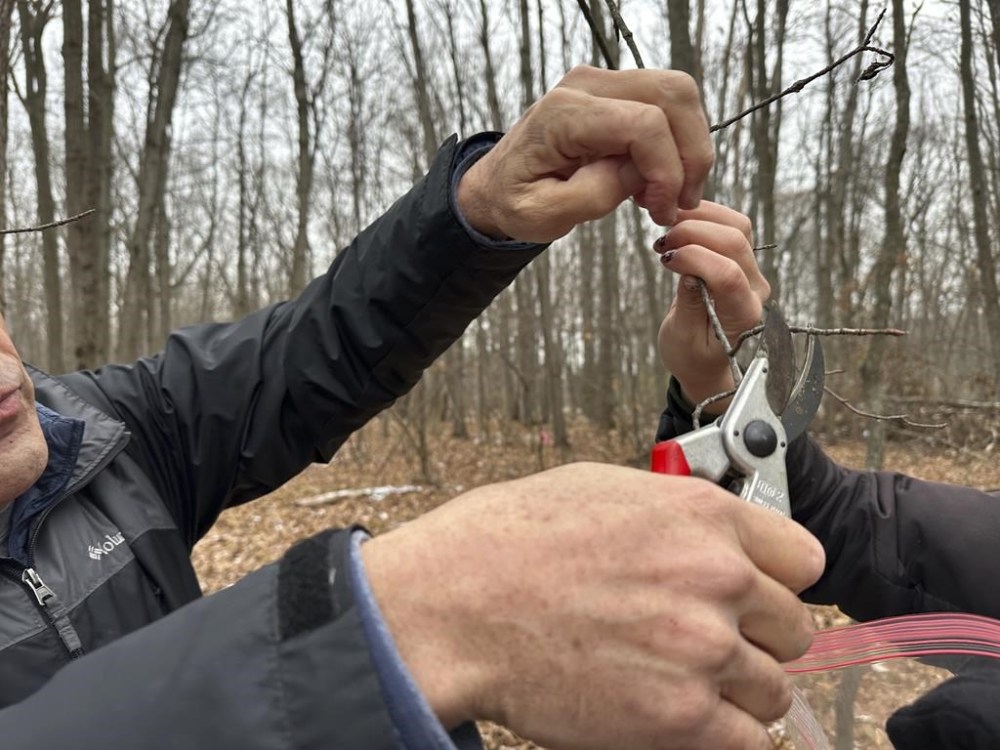
When they reached the trees, van Nocker and Christian cut off small pieces of the stems. The snippets will be tested to ensure they are fully Malus coronaria and not a hybrid. Then, these Malus coronaria cuttings — along with cuttings from previous hunts — will be grafted onto an apple rootstock. That will allow them to grow into trees which are identical to the original.
However, the goal is not to replace popular varieties like Fuji or Honeycrisp with Malus coronaria apples, since the Michigan tree’s fruit is small, green and bitter.

“To me, they don’t taste good at all,” van Nocker said.
Instead, he wants to identify the genes that cause late blooming and create a genetic stock that breeders could use to develop commercial apples. Van Nocker also is sending seeds to the U.S. Department of Agriculture so the genetic stock won’t be lost if the tree continues to decline.
Making a later-blooming commercial apple could take decades. If a Malus coronaria is crossed with a commercial apple tree to make a new hybrid, it would take four or five years for that tree to start producing apples. Crossbreeding would continue until researchers developed an apple with the desired traits of both varieties.
But van Nocker said it’s critical to try.
“With climate change, it’s quite possible that apples won’t be able to be produced in Michigan in the future,” he said. “That’s why cultivar improvement, especially in terms of frost resistance, is so important.”