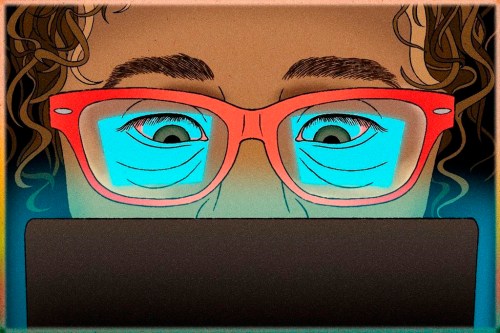
Screen breaks and the right desk setup offer relief from work-related eye strain
Advertisement
Read this article for free:
or
Already have an account? Log in here »
To continue reading, please subscribe:

Digital Subscription
One year of digital access for only $205*
- Enjoy unlimited reading on winnipegfreepress.com
- Read the E-Edition, our digital replica newspaper
- Access News Break, our award-winning app
- Play interactive puzzles
*First annual payment billed as $205.00 + GST for one year. This annual subscription will automatically renew at $233.00 + GST every 52 weeks (10% off the regular annual price of $259.35). Offer available to new and qualified returning subscribers only. Cancel any time.
To continue reading, please subscribe:
Add Free Press access to your Brandon Sun subscription for only an additional
$1 for the first 4 weeks*
- Enjoy unlimited reading on winnipegfreepress.com
- Read the E-Edition, our digital replica newspaper
- Access News Break, our award-winning app
- Play interactive puzzles
*Your next Brandon Sun subscription payment will increase by $1.00 and you will be charged $17.95 plus GST for four weeks. After four weeks, your payment will increase to $24.95 plus GST every four weeks.
Read unlimited articles for free today:
or
Already have an account? Log in here »
Hey there, time traveller!
This article was published 23/01/2025 (625 days ago), so information in it may no longer be current.
NEW YORK (AP) — The trouble started every day at around 3 p.m., after Cathy Higgins had spent five or six hours staring at an array of computer screens at her desk. Her university job overseeing research projects involved peering closely at numbers and details on contracts, applications and budgets.
“My vision was so blurry, I couldn’t even see what was on the screen, and I was squinting so much that I could not function,” Higgins said.
When her eyesight got bad, Higgins walked around and spoke with members of her staff. She began planning in-person meetings for afternoons. But she would resume the computer work late at night after her children went to bed.
“If I had to continue working through the blurry vision, that’s when the migraines would happen,” Higgins said.
Digital screens are pervasive, not only at work but in our homes, schools and shops. An estimated 104 million Americans of working age spend more than seven hours a day in front of screens, according to the American Optometric Association. All that screen time can take a toll.
Too much exposure to screens can lead to dry or watery eyes, fuzzy vision and headaches. It can also lead to myopia, or nearsightedness, in some people, especially children. Some technology workers even describe short bouts of vertigo when they look at screens for too long.
Overworked eyes
One reason for the discomfort is that staring closely at screens for prolonged periods causes the muscle that helps eye focus to tighten up.
“That muscle’s not supposed to stay tight all day long. And if it does, it’s like picking up a light weight and trying to hold it over your head for hours,” American Optometric Association President Steven Reed said. “It’s not hard to pick it up. But after a while, even though it’s not a heavy lift, your body just gets tired.”
Fortunately, exposure to blue light from computer screens and devices has not been shown to cause permanent eye damage, according to the American Academy of Opthalmology.
Nevertheless, symptoms can disrupt work, family time and rest. As an optometrist in Mississippi, Reed sees patients who complain of frequent eye pain, headaches and blurry vision associated with computer use. He advises getting an eye exam and taking frequent breaks.
For Higgins, trying to catch up on the work she couldn’t do when her eyes were too fatigued on weekdays cut into time she spent with her daughters on weekends. “They’d be playing together, and I couldn’t be as engaged as I would have liked to have been in what they were doing,” she said.
Here are some tips from eye health professionals to reduce eye strain caused by devices.
Follow the 20-20-20 rule
Take a break every 20 minutes from sitting at a computer. During the break, focus your eyes on something that’s about 20 feet away for 20 seconds. Pausing close-up work and looking at something in the distance gives tired, tight muscles time to relax.
“Luckily, eye strain is temporary,” said Raj Maturi, an ophthalmologist at Midwest Eye Institute in Indianapolis who serves as spokesperson for the American Academy of Ophthalmology. “The best way to avoid these symptoms is by taking breaks from our screens or near work activities and using lubricating eye drops, if needed.”
People usually blink about 18 to 22 times per minute. But when looking at a screen, the rate drops to three to seven times per minute, according to the Cleveland Clinic. That’s where eye drops come in.
It’s good to move around and go outside, but when you don’t have time for an outdoor walk, frequent 20-second breaks can help.
Change your desk setup
Some people find that using a larger computer monitor helps reduce eye fatigue. You can also increase the font size on your laptop, monitor or smartphone screen.
Higgins did all of the above after she started a new job as senior vice president at Stand Up to Cancer. Since she works remotely from home in Midlothian, Virginia, she got a 29-inch monitor and sits about three feet away from it, about a foot farther than in most office setups.
The changes helped. She still has occasional issues with blurriness, but not as frequently. “When I have an extended day, like a 12-hour day, that’s when I start to have vision issues again,” she said.
Sitting an arm’s length away from your screen and adjusting it so you’re looking slightly downward also can help reduce eye strain, according to the American Academy of Opthalmology.
Be wary of product claims
Some products, such as blue light glasses, are marketed with claims that they will reduce digital eye strain, improve sleep and prevent eye disease. But several studies have found the glasses are not very effective, according to the American Academy of Opthalmology. It’s really our behavior with digital devices that causes symptoms, not the small amount of blue light coming from screens, the group said.
Extracurricular optics
After stepping away from computers at work, many people find themselves reading or scrolling on smartphone screens. It’s not just workers: children are using laptops, tablets and smart screens in school settings throughout the day.
Too much screen time or focusing on nearby objects can accelerate the onset and progression of nearsightedness, especially in children, said Ayesha Malik, pediatric optometrist in the division of ophthalmology at Children’s Hospital of Philadelphia. Anyone streaming shows should do so on a television, instead of a tablet, to help relieve eye strain, she said.
Children should follow the 20-20-20-2 rule, which includes an extra “2” at the end to encourage playing outdoors for 2 hours a day, which helps with eye development, she said.
“The reality is that most children are engaging with screens throughout the day at school and home. It becomes difficult to track the total number of hours,” Malik said. “Aim for not more than 20 minutes during any one session.”

Sleeping soundly
The blue light that digital screens emit can increase alertness, so watching Netflix on an iPad or scrolling through social media feeds in bed may make it hard to get restful sleep.
To give your eyes and brain the rest they need, doctors recommend turning off screens one to two hours before going to sleep. You can also set devices to “dark mode” in the evening to reduce the impact of bright light. If you’re used to streaming videos at night, try listening to an audiobook or podcast instead.
___
Have you overcome an obstacle or made a profound change in your work? Send your questions and story ideas to cbussewitz@ap.org. Follow AP’s Be Well coverage, focusing on wellness, fitness, diet and mental health at https://apnews.com/hub/be-well.