A North Carolina wildlife crossing will save people. Can it save the last wild red wolves too?
Advertisement
Read this article for free:
or
Already have an account? Log in here »
To continue reading, please subscribe:
Digital Subscription
One year of digital access for only $1.44 a week*
- Enjoy unlimited reading on winnipegfreepress.com
- Read the E-Edition, our digital replica newspaper
- Access News Break, our award-winning app
- Play interactive puzzles
*Billed as $5.77 plus GST every four weeks. After 52 weeks, price increases to the regular rate of $19.95 plus GST every four weeks. Offer available to new and qualified returning subscribers only. Cancel any time.
To continue reading, please subscribe:
Add Free Press access to your Brandon Sun subscription for only an additional
$1 for the first 4 weeks*
- Enjoy unlimited reading on winnipegfreepress.com
- Read the E-Edition, our digital replica newspaper
- Access News Break, our award-winning app
- Play interactive puzzles
*Your next Brandon Sun subscription payment will increase by $1.00 and you will be charged $17.95 plus GST for four weeks. After four weeks, your payment will increase to $24.95 plus GST every four weeks.
Read unlimited articles for free today:
or
Already have an account? Log in here »
Hey there, time traveller!
This article was published 04/02/2025 (626 days ago), so information in it may no longer be current.
ALLIGATOR RIVER NATIONAL WILDLIFE REFUGE, N.C. (AP) — Hunters were once the greatest human threat to the country’s only unique wolf species. Today, it’s motorists.
That fact was brought home last June, when red wolf breeding male No. 2444 was struck and killed on U.S. 64 near Manns Harbor, North Carolina. His death likely meant five pups he’d been providing for died, too.
“We were hoping the mother would return and resume care, but she never did,” Joe Madison, head of the U.S. Fish and Wildlife Service’s red wolf recovery program, said during a recent visit to the site.
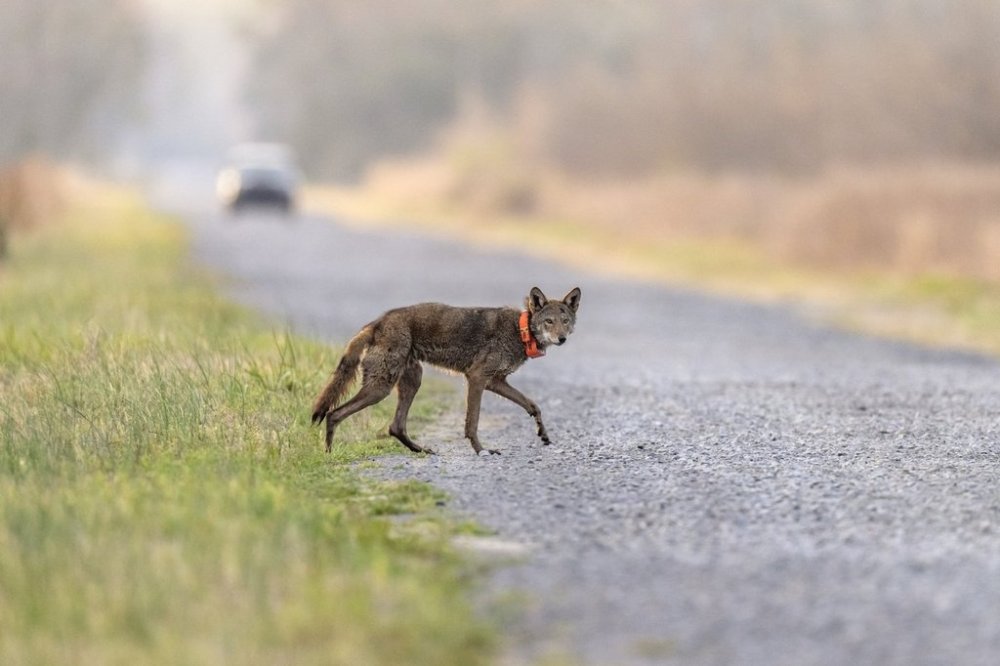
For decades, conservationists have pushed for changes to U.S. 64, a busy two-lane highway to the popular Outer Banks that runs straight through the Alligator River National Wildlife Refuge – one of just two places in the world where red wolves run free.
They may finally be getting their wish.
In late December, the Federal Highway Administration awarded the first grants under a new $125 million Wildlife Crossings Pilot Program. Unless the grants are somehow undone by President Donald Trump, part of the money will help state agencies and nonprofit groups rebuild a 2.5-mile section of the highway with fencing and a series of culverts, or small underpasses, to allow red wolves – as well as black bears, white-tailed deer and other animals – to pass safely underneath traffic.
“When you build wildlife bridges or underpasses, you reduce human-wildlife conflict,” said Duke University ecologist Stuart Pimm, who studies wildlife migrations but is not directly involved in the project. “There is increasing awareness that reducing traffic collisions is smart for wildlife, smart for people too.”
Other agency grants will support new bridges and underpasses for mule deer in Idaho, pronghorn antelope in New Mexico, and cougars and bears in Oregon, among other projects.
But what’s notable about the U.S. 64 project is that the goal is twofold: reducing dangerous collisions and roadkill – and saving a critically endangered species. There are thought to be fewer than 20 red wolves left in the wild; besides Alligator River, the other remaining habitat is in the nearby Pocosin Lakes National Wildlife Refuge.
Madison calculates that No. 2444 represented 7% of the known wild red wolf population. “So, every time you get a mortality, that’s a significant hit,” he said.
Reducing roadkill — and saving a species?
Wildlife crossings have proliferated across the U.S. in the past 20 years with broad nonpartisan support. Most often, the objective is safety. One congressional report estimated that dangerous highway collisions with large animals kill hundreds of people and cost more than $8 billion each year.
Researchers have learned a lot about what works for different species.
“Pronghorn don’t want to go through tunnels or close spaces, so they avoid underpasses and need bridges,” said Arthur Middleton, an ecologist who studies animal migration at the University of California, Berkeley. “Whereas deer will go under or over.”
Gray wolves and coyotes – and, presumably, red wolves – will also use underpasses, or culverts, of 6 or 8 feet in diameter. Fencing is critical to funnel the animals to the structures.
Along U.S. 30 in Wyoming, seven small underpasses and fencing cut mule deer collisions by 81%. In Canada, a series of overpasses and underpasses along the Trans-Canada Highway in Banff National Park reduced collisions with hooved animals by 94%.
But whether wildlife crossings can help prevent extinctions is a harder question to answer.
“Conservation was always a part of the story, but now we’re seeing crossings increasingly pop up that have conservation as a primary rationale,” said Ben Goldfarb, author of the book “Crossings: How Road Ecology is Shaping the Future of Our Planet.”
Some of the most ambitious crossings for conservation have just been built – and it will take time to assess the results.
Outside Los Angeles, a wildlife crossing over 10 lanes of U.S. 101 is expected to open in 2026. The primary aim is to help connect the habitat of mountain lions, which need to cross the freeway to find suitable mates. Inbreeding among mountain lions in the LA region has already led to genetic mutations and decreased fertility.
In Brazil’s Rio de Janeiro state, construction of a wildlife bridge spanning BR 101 was finished in 2020, then native seedlings were planted in a soil bed. Once those trees mature, researchers will study if the target species — an endangered monkey called a golden lion tamarin – uses the bridge regularly. Experts say the trees are necessary for creatures like monkeys or sloths to move across the bridge. Species that scamper on the ground, including foxes, anteaters and armadillos, are already crossing.
Hope at the end of the tunnel underpass for red wolves?
While it’s not certain that a wildlife crossing can save the last red wolves, scientists say that doing nothing will almost certainly hasten their demise.
Canis rufus, often called “America’s wolf,” once roamed from central Texas to southern Iowa and as far east as Long Island, New York. After being declared extinct in the wild, red wolves were reintroduced in North Carolina in 1987.
For about 20 years, the population grew steadily to reach around 120 animals. Then their numbers crashed — with vehicle collisions a primary culprit. One study found that vehicle strikes had killed about 5% of the red wolf population each year between their reintroduction and 2022.
Marcel P. Huijser, a study co-author and a research ecologist at Montana State University’s Western Transportation Institute, warned that the cost of doing nothing, “including losing a wild species, can be far higher than the cost of implementing effective mitigation.”
In North Carolina, Fish and Wildlife biologists have tried other measures to prevent crashes — like flashing road signs and reflective collars — without much success.
Following No. 2444’s death, conservation groups like the Wildlands Network and the Center for Biological Diversity pushed for another solution.
In September, the North Carolina Department of Transportation submitted a grant application for the Red Wolf Essential Survival Crossings Under Evacuation Route – or RESCUER – project.
Plans for the U.S. 64 wildlife crossing call for a series of underpass structures – several of them big enough for wolves and other large mammals to pass through – and the accompanying fencing. The exact number and size of the underpasses has yet to be determined, said Travis W. Wilson, eastern habitat conservation coordinator for the North Carolina Wildlife Resources Commission.
The estimated total cost for the project is about $31.5 million, including $4 million in private donations raised by conservation groups and an anonymous donor’s matching grant.
“This is one of the most important wildlife connectivity projects in the country,” said Beth Pratt, founder of the nonprofit The Wildlife Crossing Fund, which raised funds for the project. “Critically endangered red wolves will disappear if we do nothing.”
___
The Associated Press’s Health and Science Department receives support from the Howard Hughes Medical Institute’s Science and Educational Media Group and the Robert Wood Johnson Foundation. AP’s climate and environmental coverage receives financial support from multiple private foundations. The AP is solely responsible for all content.
___
Find AP’s standards for working with philanthropies, a list of supporters and funded coverage areas at AP.org.