What makes a dog a winner? A Westminster Kennel Club judge explains
Advertisement
Read this article for free:
or
Already have an account? Log in here »
To continue reading, please subscribe:

Digital Subscription
One year of digital access for only $205*
- Enjoy unlimited reading on winnipegfreepress.com
- Read the E-Edition, our digital replica newspaper
- Access News Break, our award-winning app
- Play interactive puzzles
*First annual payment billed as $205.00 + GST for one year. This annual subscription will automatically renew at $233.00 + GST every 52 weeks (10% off the regular annual price of $259.35). Offer available to new and qualified returning subscribers only. Cancel any time.
To continue reading, please subscribe:
Add Free Press access to your Brandon Sun subscription for only an additional
$1 for the first 4 weeks*
- Enjoy unlimited reading on winnipegfreepress.com
- Read the E-Edition, our digital replica newspaper
- Access News Break, our award-winning app
- Play interactive puzzles
*Your next Brandon Sun subscription payment will increase by $1.00 and you will be charged $17.95 plus GST for four weeks. After four weeks, your payment will increase to $24.95 plus GST every four weeks.
Read unlimited articles for free today:
or
Already have an account? Log in here »
Hey there, time traveller!
This article was published 08/02/2025 (607 days ago), so information in it may no longer be current.
NEW YORK (AP) — The competitors can come in forms as different as a Chihuahua, a great Dane, a bulldog and a greyhound. Each one is a champion. So how is a judge to decide which dog is the best in show at the Westminster Kennel Club competition?
To the casual viewer, it might be hard to fathom what judges glean from patting down and peering at carefully prepped canines. But choosing a winner at the United States’ most storied dog show requires an encyclopedic knowledge of 201 different breeds and varieties. And it takes some steady nerves.
“When you’re judging at Westminster on any level, it’s unlike any other judging experience,” said Donald Sturz, who awarded the top prize in 2022 to a bloodhound named Trumpet. Sturz is now the kennel club’s president as the show returns to Madison Square Garden this week after four years elsewhere.
“You walk out onto the floor of, you know, the world’s most famous arena, and the world is watching,” he said. “And you do have a moment where you’re like, ‘My God, what am I going to do?’”
Judges perform hands-on examinations and watch dogs in motion to discern which one comes closest to the ideal for its breed, as set out in a “standard” that details desired features. It’s meant to reflect a breed’s roots and historic function.
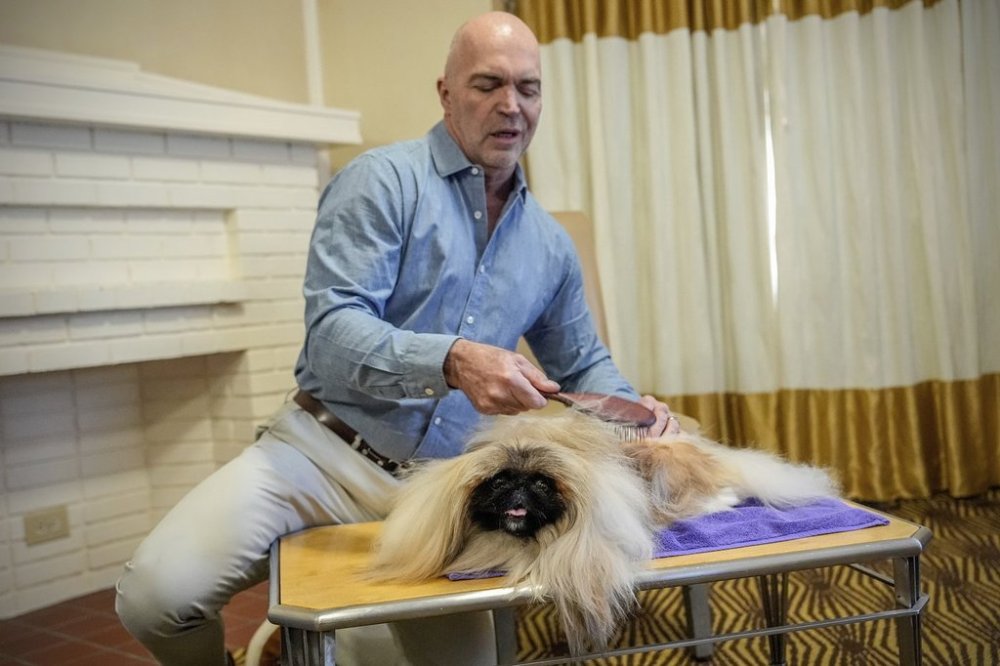
Consider, for example, a Pekingese — specifically, Fiona, Sturz’ 18-month-old pet, show champion and obliging model when he demonstrated for Associated Press journalists how judges work. (Fiona, a niece of 2021 Westminster winner Wasabi, is not competing at this year’s show.)
A clinical psychologist and retired suburban school district superintendent, Sturz has shown dogs since he was 10 and judged them for decades. He looks for “presence of virtue, versus faults” and focuses on “the dog that rang the most bells of virtue for me as I went from nose to tail.”
Demonstrating with Fiona, Sturz started by scrutinizing the big, round eyes on the little dog’s dark, flat face. He rested his hands on top and bottom of her head to check whether it was duly “envelope-shaped.”
“The head is a hallmark of the breed,” descended from ancient Chinese palace dogs that were prized as self-assured companions with a lionlike look, he said.
Then he felt the shape of Fiona’s forelegs, the depth of her chest, the length of her neck, the breadth of her ribs and how much her body tapered from her forequarters to her rear. The standard calls for Pekingese to be pear-shaped, compact and low-slung.
As Fiona continued to stand serenely on a table, it was time to check out the shape of her back, the texture of her voluminous, tawny coat and the way her tail sits. The hands-on examination ended with Sturz gently lifting Fiona — her breed is supposed to “pick up heavy,” or feel quite substantial for its size, he said.
The next step is, well, steps. Judges watch each dog walk with its handler. Pekes are known for their slow, rolling gait, which Sturz describes by invoking both the stride of a heavyset rugby player and the wavy grace of a swimming goldfish.
Judges also pay attention to a dog’s temperament — Fiona projected a comfortable, tail-wagging confidence — and whether its overall condition indicates proper exercise, nutrition, care and grooming, Sturz said.

Dog shows start with judges picking a top dog from each breed. Each of those competes against the others in its “group,” such as hounds or, for Pekingese, toy dogs. The seven group winners then face off for best in show.
Westminster sequesters the best-in-show judge through all the preceding action. The person is expected to know the standard for every breed but is allowed to ask which ones (though not which particular dogs) are going into the final ring. Sturz said he chose not to inquire because he wanted a completely blank slate.
“As a judge in best in show at Westminster, you really can’t go wrong because you know a case could be made for any one of the seven of them,” he said.
So what makes a winner?
“A great dog having a great night,” Sturz said. “There’s just something that that dog brings that night that just put them a notch above the other great dogs in the ranks.”
Related Articles
Penny the Doberman pinscher wins the 150th Westminster dog show
Advertisement Advertise With Us
Advertisement Advertise With Us